
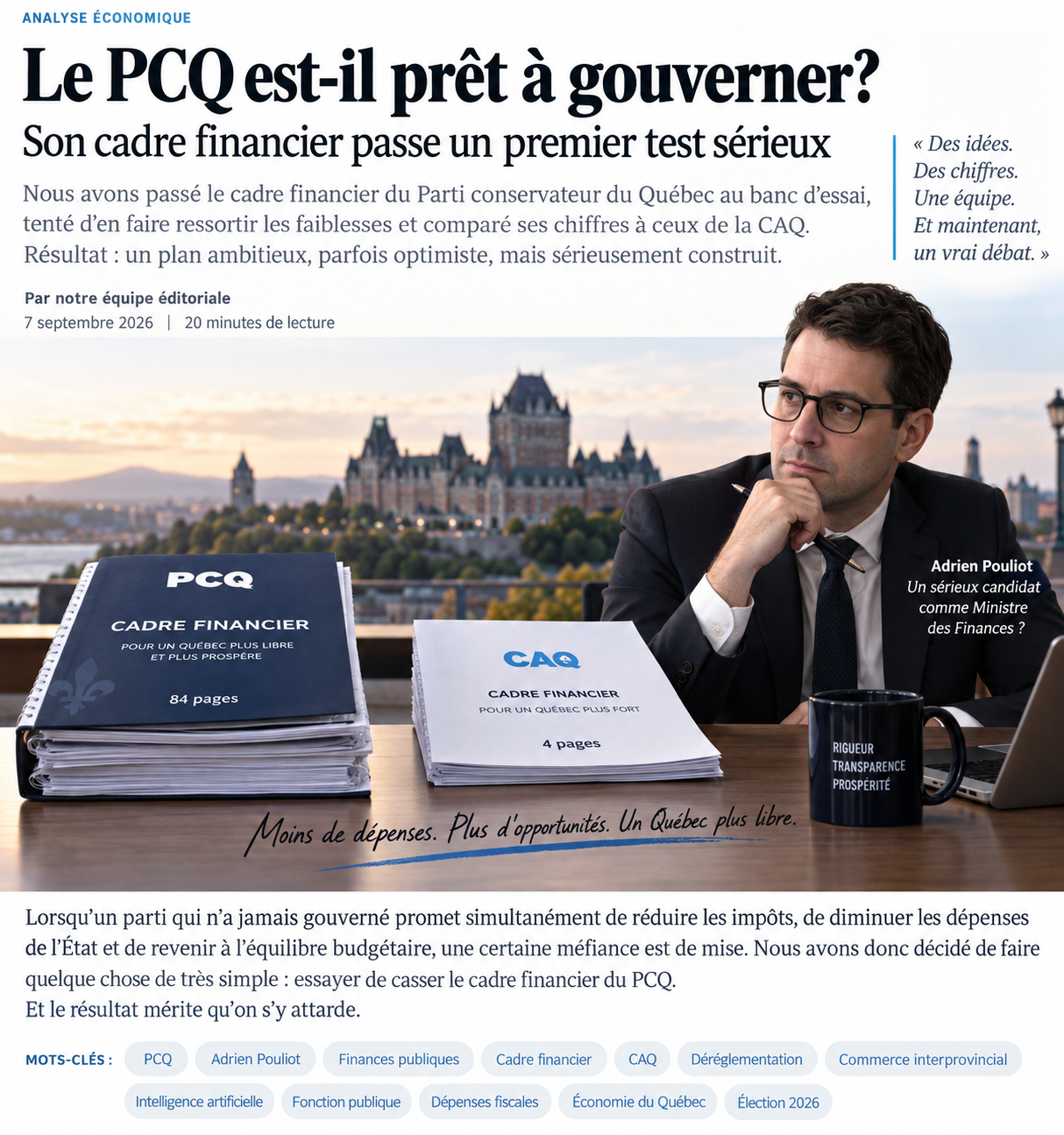
Its financial framework undergoes a first serious test
When a party that has never governed simultaneously promises to reduce taxes, decrease state spending and return to a balanced budget, a certain degree of mistrust is warranted.
After all, election campaigns are that wonderful time when politicians suddenly discover that it is possible to give more to everyone while asking less of each individual.
The Conservative Party of Quebec therefore faced a particular challenge with its financial framework. It wasn't enough for Éric Duhaime and Adrien Pouliot to demonstrate that their policies were desirable. They had to demonstrate that their figures held up.
The challenge is all the more important as the PCQ seeks to convince Quebecers that it is not only a credible opposition party, but a real alternative to government.
Its financial framework constitutes a first serious test in this regard.
So we decided to do something very simple: try to break it.
And the result deserves closer attention.
A political preference is not an economic proof
Let's lay our cards on the table first.
Several of the PCQ's economic policies are closer to my own convictions than those of the Coalition Avenir Québec. I support a reduction in the size of the government, lower taxes, fewer subsidies to businesses, and a reduction in the regulatory burden.
It would therefore be particularly easy for me to read the PCQ's financial framework with a great deal of goodwill.
This would also be an excellent way to produce an analysis of little value.
We actually did the opposite.
We looked for its weakest assumptions, went back to the studies cited, examined the risks of double counting and deliberately reduced some anticipated gains in order to see what would happen to the budget result.
Since we were likely to agree with the conclusion, we tried to refute it.
The difference is not the number of pages
The contrast with the CAQ is immediately apparent.
THE PCQ financial framework account 84 pagesthat of the CAQ only four.
This obviously doesn't mean that an 84-page document is automatically superior. Our governments have long demonstrated their remarkable ability to fill hundreds of pages without necessarily increasing the amount of useful information.
The important difference lies elsewhere: auditability.
The PCQ framework lays out its main assumptions, calculations, sources, historical precedents and even several of the objections that could be raised against its own projections.
We can therefore work backward from the result to the hypotheses and ask: Is that reasonable?
That is precisely what we did.
Both parties essentially start from the same place: the Ministry of Finance's pre-election report and its simulator. Both also aim for a return to a balanced budget by 2029-2030.
Then, their paths diverge considerably.
An attempt to transform the Quebec model
The PCQ is not proposing a few minor adjustments.
It proposes, among other things, significant reductions in personal and corporate taxes, the elimination of many corporate subsidies and tax expenditures, the abolition of the Electrification and Climate Change Fund, withdrawal from the carbon market, a reduction in administrative staff through attrition, a review of government programs, a digital transformation of the state, significant deregulation, and a much greater openness to interprovincial trade.
This is not a marginal modification of the current model.
It's an attempt to transform it.
Despite the proposed tax cuts, the framework anticipates a deficit of 8.54 billion in 2026-2027, of 5.35 billion in 2027-2028 and about 1 billion in 2028-2029before a slight surplus of 336 million in 2029-2030 and 1.89 billion the following year.
The PCQ therefore does not claim to be able to eliminate the deficit instantly.
Most importantly, it maintains payments to the Generations Fund, preserves contingency provisions, and does not include any mysterious "gap to be closed" at the end of his term.
But all of this is only valid if the assumptions hold true.
So let's attack them.
The directly controllable economies are holding up rather well
In particular, we expected to find aggressive assumptions in the spending cuts.
That's generally not what we've found.
The elimination of many tax breaks and expenditures for businesses relies primarily on existing programs, credits, and measures. This is not about hypothetical future growth: it is about aid, programs and tax expenditures that the government is proposing to abolish or reduce.
The review of the programs also holds up quite well.
At maturity, the PCQ seeks approximately 1.6 billion in annual savings within overall portfolio spending, representing less than 1% of total spending. The framework compares this target to previous program review exercises.
The hypothesis is therefore not particularly extravagant.
Attrition in the public sector is also better documented than one might think. The framework presents several scenarios, protects frontline employees, and explicitly recognizes the risks associated with overtime, consultants, and outsourcing.
The PCQ even considers an economy lower than that produced by some of its own scenarios.
All of this could obviously fail in execution. Identifying savings on paper and politically succeeding in eliminating the expenditure are two different things.
But the orders of magnitude are defensible.
Artificial intelligence requires more caution
We are less convinced by the 3.45 billion in cumulative savings attributed to digital modernization and artificial intelligence.
It is perfectly plausible that automation and AI will improve the productivity administrative.
But improving productivity and reducing government spending are not exactly the same thing.
If a civil servant saves 10% of their time thanks to a new tool, the government can process more files, reduce delays or decrease the resources needed.
Only the last option directly produces budget savings.
The PCQ figure remains plausible in terms of order of magnitude, but it is less solidly derived from a Quebec cost base than several other elements of the framework.
Pouliot also plans a gradual increase, with the first phase serving in particular to establish an inventory of processes and to identify possible gains.
So it's more a reasonable target than a proven economy.
The real Achilles' heel: dynamic effects
It is when we come to the effects of deregulation and interprovincial trade that the risk increases considerably.
The PCQ plans 13.69 billion in additional cumulative revenue stemming from deregulation and 6.827 billion of the opening of domestic trade.
Contrary to what one might suspect, these figures are based on identifiable studies and a calculation method explained within the frameworkThis obviously does not mean that the results will necessarily materialize.
And the general idea that regulatory overload can weigh on economic activity has independent support. A study of Statistics Canada on Regulatory Accumulation The study linked increased regulatory requirements between 2006 and 2021 to a cumulative 1.7 percentage point reduction in GDP growth in the business sector, as well as a decline in investment. However, the authors caution that this is not a comprehensive cost-benefit analysis of regulation.
The same applies to domestic trade. International Monetary Fund estimates that the complete elimination of non-geographic internal barriers could raise Canada's real GDP by nearly 7% in the long termthat is approximately 0 billion. However, this is a scenario of complete liberalization on a Canadian scale, and not a prediction of what a Quebec government could achieve alone during a mandate.
So the question isn't really:
Can these reforms increase growth?
The answer is most likely yes.
The much more difficult question is:
By how much, and more importantly, at what speed?
This is where the framework becomes optimistic.
A good portion of the anticipated gains must appear during the first term to allow the PCQ to reach balance according to its timetable.
There is also a more subtle risk: Some dynamic effects may overlap.
A company simultaneously benefiting from a tax cut, deregulation, and improved access to the Canadian market does not necessarily produce three completely independent economic effects. The framework acknowledges certain risks of double counting and makes adjustments, but no projection of this nature can completely eliminate this uncertainty.
This is where the plan's main vulnerability lies.
So we put stress on the figures
We have deliberately reduced some of the PCQ's assumptions.
Not because we think we know the "right" values. We don't.
It's simply a matter of sensitivity tests, designed to measure how much the result depends on the assumptions.
In an initial test, we only grant 75% of the anticipated gains from deregulation and domestic tradeonly half of the dynamic recovery attributed to the reduction in corporate tax and 75% to digital savings and program review.
The result changes considerably.
The expected surplus of 336 million in 2029-2030 becomes a deficit of approximately 3.1 billion.
That of 1.89 billion in 2030-2031 becomes a deficit of approximately 2.2 billion.
We then applied a much more severe test: only 50% of the two major structural gains, no dynamic recovery of corporate tax and only half of the digital and program review savings.
The deficit would then reach approximately 6.25 billion in 2030-2031.
These scenarios are not predictions.
They simply demonstrate one important thing:
The PCQ's return to equilibrium is sensitive to the speed with which its reforms produce their economic effects.
336 million: a very slim margin
The year 2029-2030 is particularly revealing.
The PCQ is forecasting a surplus of only that year 336 million.
However, its additional revenues attributable to deregulation and domestic trade alone amount to approximately 6.57 billion.
All other things being equal, approximately 95% of these two gains must therefore be achieved to maintain balance that year..
This is probably the most serious criticism that can be leveled at the framework.
Pouliot presents a plausible economic scenario.
But He has very little room for error regarding the schedule..
In 2030-2031, the situation becomes more comfortable as the surplus reaches 1.89 billion, but the dynamic effects remain significant.
The framework is therefore credible without being particularly conservative in its growth assumptions.
Let's now compare with the outgoing government
This is where the exercise becomes politically interesting.
The CAQ presents a much more conventional approach.
It relies more on the existing economic scenario and therefore depends less on behavioral changes that are difficult to predict.
That's a real advantage of its setting.
But let's look at how she creates the space necessary for her own commitments.
Her financial framework forecasts approximately .357 billion in additional federal transfers, next to 5 million in additional revenue from state-owned enterprises and reduced by 5 billion contingency provisions.
These assumptions are not necessarily unrealistic.
But they present different risks.
The federal transfers could very well materialize. However, Quebec does not control Ottawa.
Reducing a contingency reserve does indeed free up budgetary space. But it's not a structural saving. It means accepting a smaller buffer against unforeseen events.
And above all, the CAQ framework retains a "Gap to be closed" of 1.85 billion in 2028-2029, then of 2 billion per year in 2029-2030 and 2030-2031.
In other words, at the very moment when the outgoing government claims to be returning to a balanced budget, Part of the solution has yet to be identified.
Were Duhaime and Pouliot right to attack the CAQ?
During the presentation of their financial framework, Éric Duhaime and Adrien Pouliot themselves emphasized several of these weaknesses in the CAQ framework.
Their political interest in doing so is obvious.
It would therefore have been quite unwise to simply adopt their arguments.
We instead sought to verify it independently.
Of the three main elements, their criticism resists.
Yes, the CAQ is counting on additional federal transfers that it does not fully control.
Yes, she is reducing her contingency supplies.
And yes, it still has savings to be identified in its announced return to balance.
But the exercise obviously has to work both ways.
The PCQ has its own vulnerability, and it is significant: Its scenario depends more on dynamic economic gains, the extent and especially the timing of which remain uncertain..
That's a fair comparison.
Two very different risks
It could be summarized like this.
The CAQ takes less macroeconomic riskHis scenario relies more on the continuation of the economy as it currently exists.
But part of its funding depends on sums from another government, a reduction in provisions and savings that have yet to be identified.
The PCQ takes more economic risks because it proposes a much more significant transformation.
But he outlines these risks in much greater detail.
We know what spending he wants to eliminate, what taxes he wants to reduce, what reforms he believes will produce growth, and what assumptions allow him to arrive at his result.
Therefore, they can be challenged.
And that is precisely what a good financial framework should allow.
Another successful test: Adrien Pouliot himself
The framework also produces a more personal political outcome.
He This significantly strengthens Adrien Pouliot's credibility as a potential Minister of Finance. in a Duhaime government.
A financial framework alone is obviously not enough to demonstrate that a person would make a good minister. Administering the Department of Finance, working with the public service, negotiating with Ottawa, and responding to a recession are far more difficult tests than developing an election platform.
But Pouliot has at least provided something tangible to evaluate.
His work demonstrates an understanding of static and dynamic effects, the risks of double counting, budgetary constraints, and the need to document assumptions. Crucially, the framework is detailed enough to allow his opponents to attempt to refute it.
That matters.
For a party aspiring to govern for the first time, the question is not just whether its leader is ready.
It is also necessary to know if he has a team capable of handling the main ministries.
This framework obviously does not answer this question for the entire PCQ team.
But in the case of Finance, Pouliot has just presented a rather convincing piece of evidence for his case..
So, is the PCQ ready to govern?
A financial framework cannot obviously answer this question alone.
It tells us nothing about a government's ability to manage a crisis, to negotiate with its partners, to get its reforms adopted, or to resist the groups that will defend every dollar of spending at risk.
But it does allow us to answer a more limited, yet nonetheless important, question:
Is a party that has never governed Quebec capable of presenting a financial plan serious enough to stand comparison with that of an outgoing government?
After trying to break the numbers, my answer is Yes.
The PCQ has just crossed an important threshold of credibility.
Its financial framework demonstrates that it is capable of presenting a government plan detailed and coherent enough to stand comparison with that of the outgoing government.
In terms of transparency and auditability, it does even better.
This does not guarantee that his predictions will come true.
Its rapid return to equilibrium depends heavily on dynamic effects whose timing remains uncertain. Its surplus in 2029-2030 is particularly vulnerable, and certain savings, notably those attributed to digital transformation, still need to be demonstrated.
But after trying to break its figures, we found neither a gaping hole nor accounting trickery.
We found an ambitious, sometimes optimistic, but seriously constructed plan.
And for a party that aspires to move from opposition to government, It was a test that had to be passed.
About the Author





1 thought on “Is the PCQ ready to govern?“