Winston Churchill is often credited with this quip:
"The best argument against democracy is a five-minute conversation with the average voter."
Too bad for the legend: Churchill never seems to have said it.International Churchill Society explicitly classifies this sentence among the quotes that are falsely attributed to him.
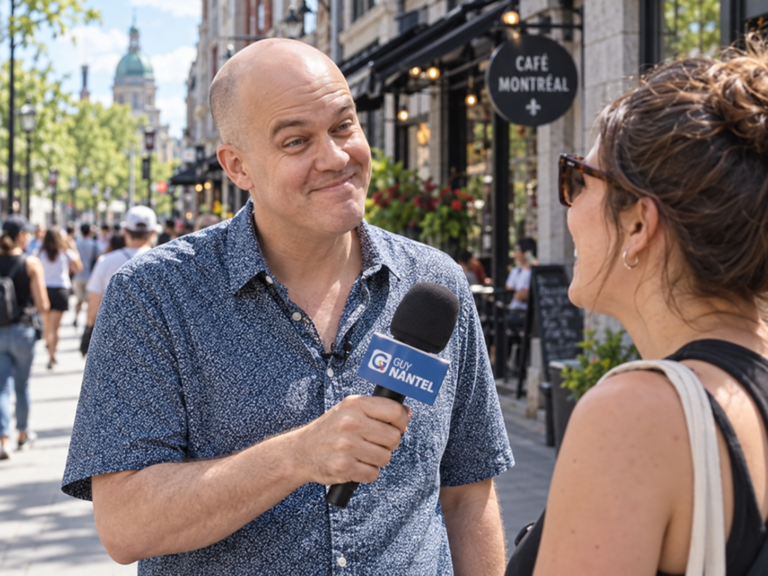
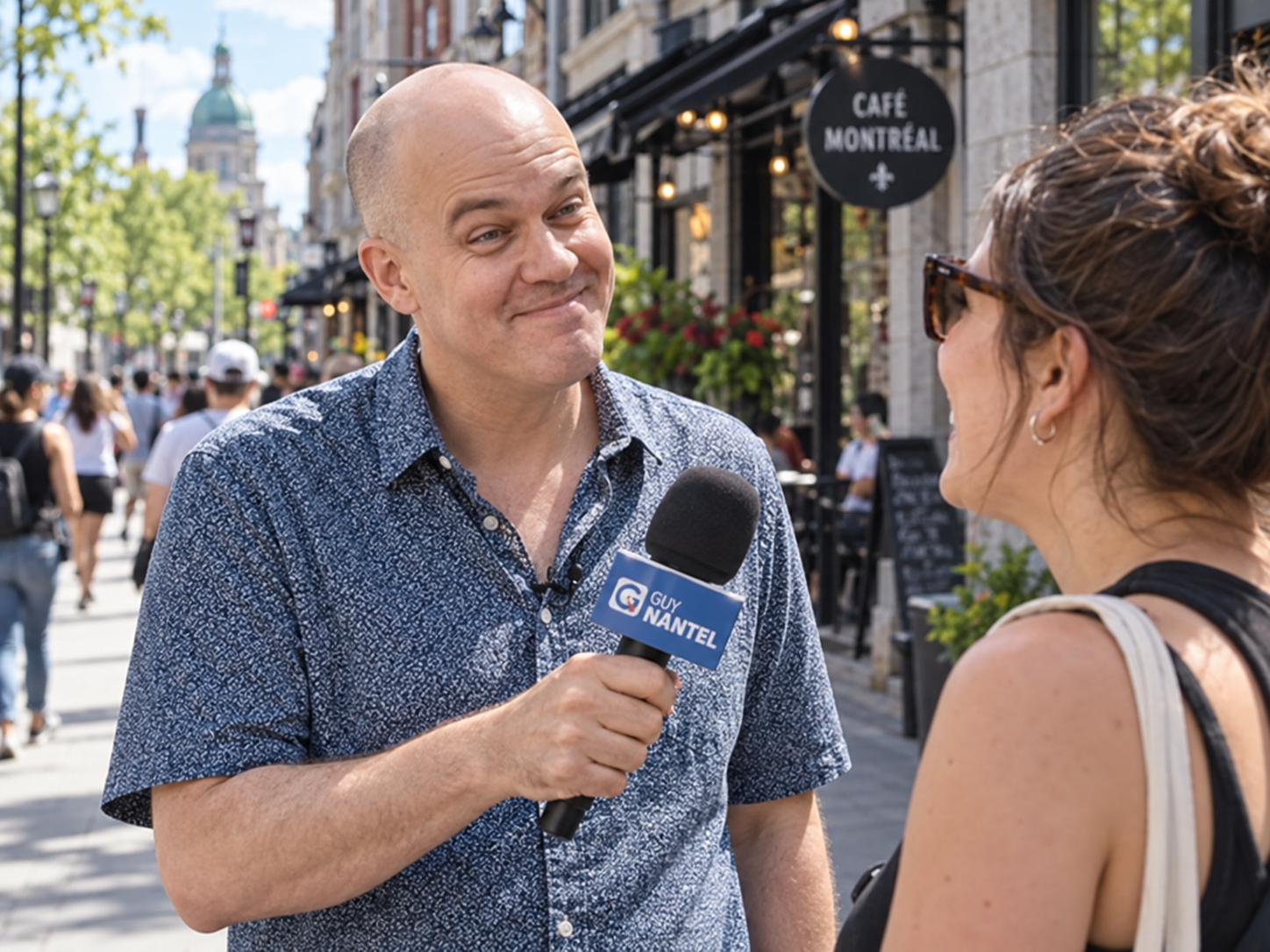
But after watching a vox pop with Guy Nantel, one could be forgiven for wanting to recycle it.
Or, better still, to adapt it to Quebec tastes:
Perhaps the best argument against democracy is a vox pop by Guy Nantel.
Seven minutes that make you think
Guy Nantel returned to the streets this week to test the political knowledge of Quebecers in the midst of an election campaign.
As usual, he asks relatively simple questions and lets his interlocutors provide the comic material themselves.
We laugh.
Then, after a few minutes, the laughter becomes slightly uncomfortable.
Because all these people have something in common with you and me: on election day, their ballot is worth exactly the same number of votes.
Before taking out the pitchforks and abolishing universal suffrage, a clarification is necessary.
A vox pop by Guy Nantel is obviously not a scientific survey. His job is to make people laugh, not to create a representative sample of the Quebec population. Correct answers rarely make for the best clips.
It would therefore be absurd to judge the entire electorate based on a few minutes of footage.
But his vox pop nevertheless puts his finger, whether intentionally or not, on a real problem of modern democracy:
It takes a great deal of knowledge to vote in a truly informed way on everything our governments claim to administer.
Can we really expect everyone to know everything?
Let's just take Quebec.
To make a fully informed choice in an election, one should ideally understand the parties' proposals regarding health, education, housing, transportation, energy, taxes, public debt, the environment, immigration, economic development, relations with Ottawa and probably a dozen other topics.
We would then need to understand the possible consequences of these policies.
How much will they cost?
Who will pay for them?
What behaviors will they change?
What will their second-order effects be?
Are the budget projections realistic?
Do governments even possess the information necessary to produce the results they promise?
Good luck.
The majority of citizens have a job, a family, bills, leisure activities and probably better things to do with their evenings than compare three 150-page financial frameworks.
And contrary to what our instinct might suggest, this behavior is not necessarily irrational.
Rational ignorance
The economist Anthony Downs formalized part of this problem in An Economic Theory of Democracy, published in 1957.
Acquiring political information costs something. Not necessarily money, but time and effort.
You have to read, compare, check the claims, understand the issues and sometimes learn enough economics or constitutional law to distinguish a plausible policy from a nicely packaged election promise.
Meanwhile, the probability that your individual vote alone will determine the outcome of an election is minuscule.
Therefore, it may be rational for the individual not to invest a huge amount of time to become perfectly informed.
In other words, our voter who is not familiar with all the issues is not necessarily stupid.
He responds to incentives.
And this is where the problem becomes more interesting.
The wrong solution
Given this observation, one might be tempted to say:
"Very well. Let's have a test before allowing people to vote."
After all, you have to pass a test to drive a car. Why not to choose a government?
The problem appears immediately.
Who writes the exam?
What level of knowledge is required?
Do we need to know the Constitution? The economy? History? Federal and provincial powers?
And most importantly: who controls those who decide which answers are good enough to grant you the right to participate in an election?
You don't necessarily solve a problem of concentration of power by giving someone a new power: the power to decide who can vote.
However, there is another way to approach the question.
Instead of asking:
How can we make every voter competent enough to choose those who will administer almost every aspect of society?
We could ask:
Why is it necessary to make so many decisions collectively?
Perhaps we are asking too much of the voter
That's the paradox.
The more the scope of state action expands, the greater the number of subjects on which a voter should be informed in order to exercise their right to vote in a truly informed manner.
And the more decisions are concentrated in the hands of the government, the more significant the potential consequences of a bad electoral decision become.
If the government makes few decisions, political ignorance has relatively limited consequences.
If it intervenes in health, education, transport, energy, pensions, the taxationhousing and a growing share of economic activity, the possible consequences of political choices extend with it.
The problem could be summarized as follows:
Political ignorance × political power = collective risk.
We can certainly try to reduce the first factor.
Better civic education would be helpful. Better information too.
But there are obvious limits to what can reasonably be expected of the average citizen.
This observation leads us to question the other variable in the equation:
the amount of power held by those we elect.
The problem of knowledge
Friedrich Hayek addressed a related problem in his famous 1945 article, The Use of Knowledge in Society.
His argument was not that the officials would be stupid or malicious.
It was much more fundamental.
The information necessary for the functioning of a complex society never exists in its entirety in a single brain or organization. It is dispersed among millions of individuals, each possessing a small portion of the information relevant to their own situation.
That is why Hayek placed so much importance on decentralized mechanisms.
The owner of a small business knows things about his business that the Minister of the Economy will never know.
A nurse knows about certain problems in her unit that the Minister of Health will never see in his Excel spreadsheets.
A parent knows their child better than the Ministry of Education.
A consumer knows the specific priorities of their own family better than a government committee.
No planner, however brilliant, can gather all this information in an office in Quebec City.
So here's the first irony.
The problem is not just that the voter cannot know everything. Neither can the government.
Politicians are human too
In addition to this problem of knowledge, there is also the problem of incentives.
This is where the theory of public choice, associated in particular with James Buchanan and Gordon Tullock, becomes particularly interesting.
Buchanan spoke of politics "without romance".
The idea is remarkably simple: why assume that human beings suddenly cease to respond to their interests and incentives when they enter a voting booth, a bureaucracy, or Parliament?
The voter responds to incentives.
The civil servant too.
And the politician as well.
Thomas Sowell He bluntly summarized this reality: to understand politics, he wrote, one must understand that the politician's two primary concerns are getting elected and getting re-elected. Everything else comes far behind.
This does not mean that all politicians are corrupt or malicious.
A politician who completely ignores electoral considerations risks simply not being a politician for very long.
Similarly, an administration may have an interest in defending its budget, its mandate, or its staff.
A special interest group hoping to gain millions of dollars has a huge incentive to lobby the government. Each of the millions of taxpayers who will share the cost has far less individual incentive to spend hours fighting the measure.
Public choice therefore does not require believing that people become bad when they enter politics.
He is asking for something much less spectacular:
Let's just assume they remain human.
Bad policies, then, require neither conspiracy nor extraordinary malice.
Incentives may be enough.
Which is not necessarily more reassuring.
Another way of thinking about the problem
There are several ways to respond to political ignorance.
Civic education can be improved.
We can hope for better quality media information.
We can ask citizens to devote more effort to understanding the issues.
And we can also examine the very design of our institutions: decentralization of decisions, subsidiarity, separation of powers, constitutional limits and distribution of responsibilities between different levels of government.
These mechanisms do not make political errors disappear. Rather, they seek to limit the impact of a single error and to bring certain decisions closer to those who possess the relevant information or who will directly suffer the consequences.
This leads to an important distinction:
Democracy and the extent of political power are two different issues.
One can defend universal suffrage while vigorously debating what the majority, or the government it chooses, should have the power to decide.
Let's get back to Guy Nantel
We can hope that citizens are better informed.
We can teach more about history, economics, and how our institutions work.
We can ask the media to provide better information.
We can ask voters to do their homework before entering the voting booth.
All of this can improve things.
But we will never transform eight million Quebecers into public policy specialists.
And this is where Guy Nantel's vox pop stops being merely funny.
Initially, it seems to show us a problem of poorly informed voters.
But perhaps he unintentionally raises a much more interesting question.
While a bad election decision can determine an ever-increasing number of aspects of citizens' lives, the problem may not be just that some voters are unfamiliar with their files.
We must also question the extent of the power entrusted to those they elect.
After a few minutes listening to some of the answers in Nantel's vox pop, one might be tempted to conclude that some voters are dangerous with a ballot in their hands.
I prefer to return the proposal.
If politicians had less power, voters would be less dangerous with a ballot in their hands.
About the Author