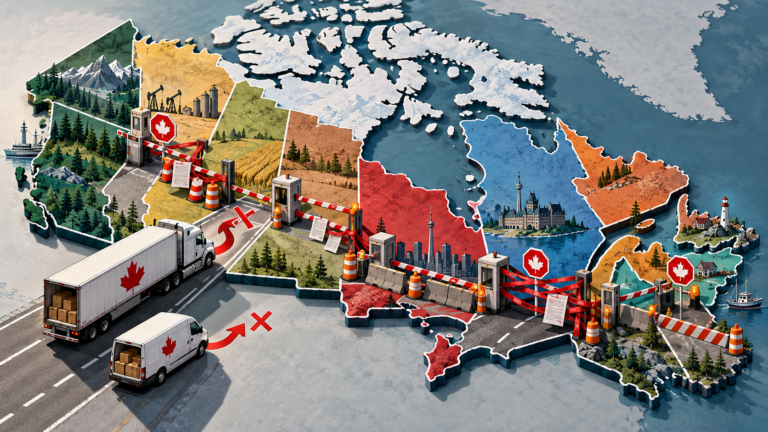

Quebec is currently facing two disruptive projects.
Paul St-Pierre Plamondon proposes first and foremost to change the political framework within which Quebec operates. Éric Duhaime proposes primarily to change the way Quebec functions within that framework.
The distinction is not absolute.
The Parti Québécois is also proposing to reform the state. It has notably announced a 2.5% reduction in public sector compensation costs over three years, as well as a streamlining of regulations and administrative processes. Source: Parti Québécois.
The Conservative Party, for its part, does not limit its program to taxes and spending. Its platform also includes a section on Quebec autonomy. Source: Conservative Party of Quebec.
But their priorities remain different.
The PQ places independence at the heart of its transformation. Its Blue Book explicitly lays out the architecture of a sovereign Quebec and envisions, in the long term, a Quebec currency, a central bank, and a Quebec monetary policy. Source: Parti Québécois.
The PCQ is focusing its offensive on the Quebec model itself: spending, taxation, regulations, government organization, and service delivery. Its financial framework notably includes a return to a balanced budget by 2029-2030 while reducing the tax burden. Source: Conservative Party of Quebec.
Two radical projects, then.
But above all, two different diagnoses.
And behind them lies a much more interesting question than the eternal clash between federalists and sovereigntists:
What truly limits Quebec's development: the powers it lacks or the way it uses the powers it already possesses?
Independence answers one question, but not all of them.
Independence primarily addresses a fundamental political question:
Who decides?
A sovereign Quebec would have powers currently exercised by Ottawa and could coordinate under a single authority policies that are currently divided between the two levels of government.
For a sovereigntist, this is obviously not a minor detail.
But a second question remains:
What decisions will be made?
An independent Quebec could either reduce or increase its taxes.
It could reduce the size of the state or increase it.
It could deregulate its economy or increase its interventions.
It could open some public services to more competition or strengthen existing monopolies.
Independence therefore changes considerably the range of possible decisions.
It does not determine their content.
This distinction becomes essential as soon as sovereignty and prosperity are linked.
A new constitutional status can create new opportunities. It does not automatically increase the capital stock, the skills of workers, or the productivity of businesses.
It does not make a debt, bad regulation, or a management problem disappear either.
The passport is a powerful political symbol. As a factor of production, its performance is considerably less impressive.
Quebec already has many levers at its disposal.
Quebec obviously does not possess all the powers of a country.
But he already owns a lot of them.
The Constitution grants the provinces significant powers in matters of direct taxation, borrowing, provincial civil service, hospitals, municipal institutions, property and civil rights, as well as numerous activities of a local nature. Source: Government of Canada.
In other words, a considerable portion of the policies that influence the Quebec economy on a daily basis are already determined in Quebec City.
The Quebec government sets a large part of its taxation.
He chooses how he spends.
He borrows.
It regulates.
He organizes his health and education networks.
He manages his state-owned companies.
It subsidizes certain businesses and industries.
It oversees a large part of the professions and economic activities falling within its jurisdiction.
This observation does not resolve the national question at all.
However, it allows us to ask another question:
How many problems that we attribute to the Canadian framework could already be corrected without changing that framework?
What our North American comparison reveals
OUR recent work on the 50 American states and the 10 Canadian provinces brings some interesting elements to light here.
Over the period 2007-2024, Quebec is not among the North American jurisdictions that have experienced the best economic performance.
In our comparative base, its cumulative growth in real GDP per capita is at 41st out of 60.
Its productivity growth is at 48th rank.
For the year 2024 alone, its real GDP per capita growth was slightly negative, placing it in the 54th rank.
Meanwhile, our measures of subnational government intervention place Quebec near the other end of the distribution: approximately 33.7% of GDP in provincial and local public spending, which is 59th out of 60 according to this measure, and approximately 20.2% of GDP in subnational tax revenue, the highest level in our sample.
The juxtaposition deserves attention:
a relatively large state and relatively modest economic performance.
But it does not prove that one causes the other.
And it is precisely here that we must resist the temptation to transform a convenient correlation into a political certainty.
What the data doesn't tell us
Our analyses of the 60 jurisdictions do not allow us to simply state:
The larger the state, the less prosperous the economy.
The American data show some results consistent with this hypothesis, as we examined in more detail in State size and prosperity in Quebec: what the Armey curve revealsIn several specifications of our Armey curve type analysis, the relationship between government spending and future growth appears to change somewhere around 25 to 29% of GDP.
But when Canadian provinces are isolated, the result becomes much less stable.
There are only ten of them. Their economic structure varies considerably. Federal spending and transfers also complicate the attribution of effects to the provincial government alone.
Some Canadian tests don't even match the initial hypothesis.
And that's perfectly fine.
Serious research serves precisely to discover what the data can support and, above all, what it cannot support.
We can therefore see that Quebec combines a significant state presence with some relatively weak economic performance.
We can examine the hypothesis of a link between the two.
We cannot claim to have demonstrated that reducing the size of the state would be enough to transform Quebec's economic trajectory.
No more than we can assume that changing its constitutional status would do so.
The Duhaime test
This is where the project to reform the Quebec model becomes interesting as a political experiment.
Suppose a Quebec government reduces certain expenditures, substantially simplifies regulations, modifies taxation and reforms the delivery of certain services.
Let us then assume that investment, productivity, and real per capita income grow more rapidly.
These changes would have been achieved without altering Quebec's constitutional status.
This would indicate that at least some of Quebec's economic difficulties stemmed from policies already under Quebec's jurisdiction.
But let's also do the reverse test.
Suppose that major reforms constantly run up against federal jurisdictions.
Let's assume that the results remain modest because Quebec does not control certain essential levers.
The hypothesis that the constitutional framework itself constitutes a constraint would then gain in importance.
That's the whole point of the test.
It would allow us to gradually distinguish between two categories of problems:
those that Quebec can resolve with its current powers and those that it cannot resolve without additional powers.
The PSPP test
Let us now apply the same reasoning to independence.
Let's suppose that Quebec becomes sovereign.
The next morning, the workers would be the same.
The companies would be the same.
The infrastructure would be the same.
The ministries would be largely the same.
The hospitals would be the same.
The capital stock would be the same.
And the level of productivity would essentially be the same as the day before.
Independence would therefore not instantly create additional wealth.
However, it would profoundly alter the options available to the Quebec government.
This is, in fact, what the PQ itself implicitly acknowledges. Its monetary plan does not stop at obtaining new powers: it also includes post-independence economic measures, notably more competitive corporate taxation and regulatory relief. Source: Parti Québécois.
The true economic argument for sovereignty is therefore more precise than the idea that independence automatically makes Quebec richer.
Rather, it consists of arguing that independence would give Quebec more tools to adopt the policies it deems best suited to its development.
The difference is significant.
The first proposition assumes a result.
The second one proposes a mechanism that can be analyzed.
What problem truly requires independence?
We can then apply a fairly simple method to almost all of Quebec's major economic problems.
Let's take productivity.
What part of the problem stems from policies already under the purview of the provincial government?
Which part results from federal decisions or constraints?
Let's talk about health.
What problems can be corrected by modifying the Quebec organization of the network?
Which ones truly result from the sharing of skills?
The same exercise applies to taxation, regulation, infrastructure, debt, investment and workforce training.
For each case, the question should be the same:
Does Quebec already possess the necessary power to act?
If the answer is yes, it becomes difficult to explain the poor results solely by federalism.
If the answer is no, the argument in favor of additional powers becomes directly relevant.
This method is significantly less spectacular than waving a flag on a stage.
However, she possesses a rather unusual quality in politics:
It allows us to verify the claims.
The real debate is about the sequence
We then return to the fundamental choice between the two projects.
The first scenario can be summarized as follows:
to obtain all the levers of a sovereign state, then use those levers to transform Quebec.
The second method proceeds in the reverse order:
first use the levers that Quebec already possesses, transform what can be transformed and then determine which important constraints remain truly constitutional.
One believes that transforming the framework will allow for a more complete transformation of Quebec.
The other would allow us to test how far Quebec can transform itself without changing its framework.
These two paths do not necessarily lead to incompatible destinations.
A Quebec that has profoundly reformed its economy could still choose independence.
An independent Quebec would still have to choose its economic model.
The disagreement therefore concerns less the existence of the change than the the sequence of the change and the location of the main constraint.
Prosperity changes the conditions of choice
This is where this article connects Prosperity before independence.
A more productive, richer and financially stronger Quebec would not automatically answer the national question.
But it would significantly alter the conditions under which this question would be asked.
A more productive economy has more resources.
Stronger public finances provide more room for maneuver.
A diversified and competitive economy can better absorb a period of institutional uncertainty.
And if, after having exploited the powers it already has, Quebec found that certain important reforms remain impossible because of the Canadian framework, we would know much better what independence would actually change.
In other words, reforming first would not close the door to independence.
This might help us to know Why We want to open it.
Independence or reform of the model?
The debate should therefore not be limited to asking whether Quebec would be better off in Canada or outside of Canada.
The question is too broad to teach us much.
The question should rather be:
What problems can we already solve ourselves?
What problems truly require powers that we do not possess?
And what would we do with these powers once we obtained them?
This is where the PSPP and Duhaime projects become interesting.
The first one essentially poses the following question:
What could Quebec accomplish if it possessed all the powers of a sovereign state?
The second one poses another question:
What could Quebec already accomplish if it used the powers it possesses differently?
Even an independent Quebec would one day have to answer this second question.
And even a profoundly reformed Quebec might eventually discover that some important limitations actually stem from the Canadian framework.
That's why the alternative between independence or reform of the model is perhaps poorly worded.
The real question is that of order.
Do we need to obtain new powers to transform Quebec?
Or should Quebec first be transformed in order to discover what powers it truly lacks?
Before moving to a new country, it might be helpful to determine exactly what we are looking to change.
About the Author