
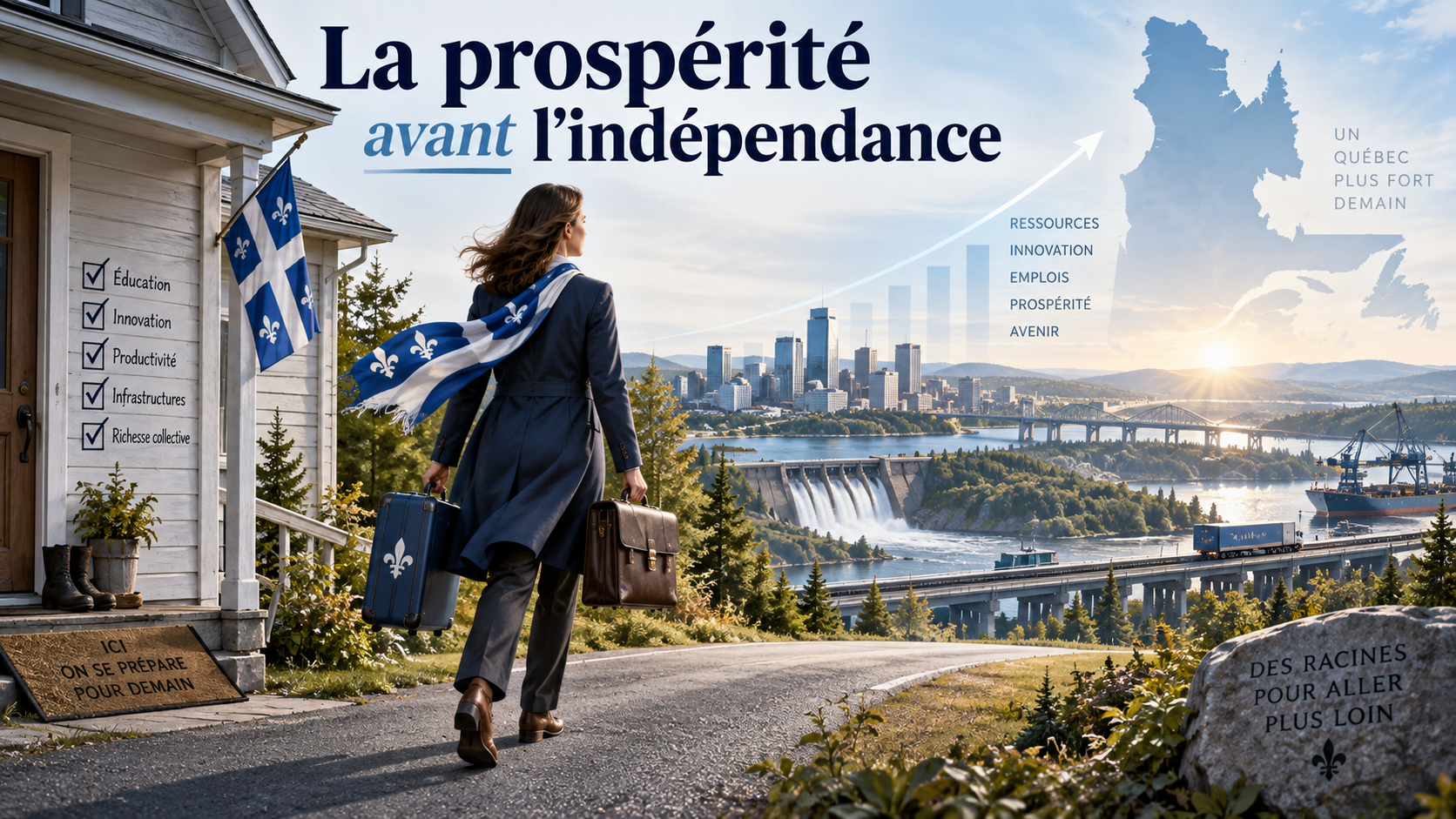
Jordan Peterson often repeats an idea that I paraphrase here: before going out to change the world, it's better to start by cleaning your own room.
In other words, before undertaking major transformations, it is best to have put one's own affairs in order.
The principle applies equally to a society and to an individual.
In the case of Quebec, wanting to achieve independence in the current economic context is a bit like putting the cart before the horse.
Before seeking to free oneself from CanadaQuebec should start by freeing itself from its own dependencies.
A society that aspires to become a country should first be able to stand on its own two feet economically: produce enough wealth to finance its choices, maintain sound public finances and have an economy productive enough to absorb the costs and uncertainties that a constitutional rupture would necessarily entail.
In other words, before claiming its political independence, Quebec must become economically mature.
Independence should not be conceived as the means by which Quebec hopes to become prosperous.
Prosperity should be one of the conditions that make independence credible.
An economically fragile Quebec that became independent would not make its problems disappear.
He would take them with him.
Independence begins with financial autonomy
Talking about "addiction" can easily become a slogan. Therefore, it's important to clarify what it means.
Quebec is obviously not a province incapable of funding its own services. It would also be wrong to present federal transfers as money that Ottawa is generously giving us.
Quebecers also pay federal taxes.
A significant portion of the transfers also goes towards funding programs such as health and social services. An independent Quebec would regain control of certain fiscal areas currently held by Ottawa, but would also have to assume the responsibilities that come with them.
Therefore, we must avoid the simplistic calculation of subtracting federal transfers and declaring that independence would automatically create an equivalent deficit.
However, equalization raises a different question.
In 2026-2027, Quebec is to receive .9 billion in equalization payments, on approximately .3 billion in major federal transfers.
This does not mean that Quebec receives .9 billion without contributing to the federal treasury.
But equalization does indeed measure something important: the relative fiscal capacity of the provinces.
This is what a serious economic independence project should seek to change.
Not because receiving equalization payments constitutes a national humiliation.
Because a company that plans to assume all the responsibilities of a state on its own should want to possess a sufficiently strong economic and fiscal capacity so that it no longer needs to.
We produce less wealth
The question inevitably leads us back to the creation of wealth.
In 2024, Quebec's real GDP per capita reached ,812It had also decreased compared to 2023.
This does not mean that Quebec is inexorably becoming poorer. Over the long term, our standard of living has improved.
But when we talk about economic autonomy, the wealth produced per capita counts enormously.
A society that produces less ultimately has less wealth for wages, investment, public services, and social programs.
And there is no constitutional formula capable of circumventing this reality.
We can change the flag.
We cannot legislate a gain of productivity.
The shovel and the excavator
Productivity is sometimes presented as a mysterious economic concept.
She is not.
Suppose one worker digs a hole with a shovel and another digs the same hole with an excavator.
The second one is not necessarily braver, more intelligent, or more hardworking.
He simply has better tools.
And with these tools, he can accomplish much more work in the same amount of time.
That's what productivity is.
On an economic scale, the excavator can be a machine, a software program, a robot, an automated production line, a technology, an infrastructure, or simply a more efficient organization of work.
That's why the investment is so important.
A company that invests in better equipment allows its employees to produce more value with the same number of hours.
This additional productivity can then translate into better wages, profits, new investments and, ultimately, a higher standard of living.
Conversely, an economy that invests too little ends up asking its workers to continue digging with shovels while its competitors arrive with excavators.
We can always urge people to work harder.
But at a certain point, the problem is no longer the effort.
This is the tool.
Where are the excavators?
This is where the diagnosis becomes worrying.
Between 1997 and 2024, the stock of manufacturing capital has decreased by 5.3% in Quebec.
During the same period, it progressed by 54% in the United States.
Investment in intellectual property has also stagnated for about two decades in Quebec and Canada, while it has grown significantly in the United States.
The result is evident in the production.
According to the Institut du Québec, each employee in the manufacturing sector produces approximately Quebec's GDP is 8,000, compared to 9,000 in the United States..
This obviously does not mean that the American worker works 50% harder than the Quebec worker.
Differences in industrial structure, company size, technology and economies of scale also matter.
But the principle remains.
The American worker generally has more productive capital.
His excavator is bigger.
Why are we investing less?
However, simply acknowledging that we are underinvesting does not answer the following question:
For what?
A company invests when it believes that the future return justifies the risk taken today.
She's looking at taxation.
The cost and availability of energy.
The availability of the workforce.
The infrastructure.
Regulatory deadlines.
The stability of the rules.
Access to markets.
The cost of capital.
Growth prospects.
None of these factors alone explains our economic performance.
But their accumulation necessarily influences decisions.
Capital has no patriotic feelings.
He generally goes where he believes he can obtain the best return given the risk.
This does not mean that all regulations should be removed or taxes abolished. A modern society has rules and must fund its public services.
The relevant question is that of the cost and return of each of these choices.
At what point does additional regulation cost more in investment and growth than the benefit it provides?
At what level does an additional tax begin to substantially alter investment decisions?
These are economic questions.
Not professions of faith.
We do not lack resources
The Quebec paradox becomes even harder to ignore when we consider what we have.
Hydroelectric power.
Mineral resources.
Forests.
Agricultural land.
Access to the St. Lawrence River and the Atlantic Ocean.
Immediate proximity to the American market.
An educated population.
Universities and research centers.
Quebec's problem is clearly not a lack of potential.
The challenge is to transform this potential into productive capital, businesses, innovations and revenues.
A resource left underground is not yet wealth.
A technology that remains in a laboratory is not yet wealth.
A river capable of producing electricity truly becomes an economic asset when that energy helps to produce something that people value.
Wealth is not what we potentially possess. It's what we manage to do with what we possess.
And independence would not change this reality.
The day after a victorious referendum, Quebec would possess the same resources as the day before.
The same workers.
The same companies.
The same infrastructure.
And, unless economic policies are changed, the same incentives to invest or not to invest will remain.
What if the problem wasn't just Ottawa?
This is perhaps the most uncomfortable question in the whole debate on independence.
For decades, part of the sovereigntist movement has presented federalism as a constraint on the development of Quebec.
Some of these arguments deserve to be taken seriously.
Federalism sometimes creates overlaps. Ottawa controls important levers of power. Its policies can conflict with Quebec's priorities.
But Ottawa can also become a far too convenient excuse.
Because Quebec already possesses a great deal of power.
He controls his provincial taxes.
Its natural resources.
His work schedule.
Its education system.
Its healthcare network.
Its municipalities.
A good portion of its infrastructure.
And, thanks to Hydro-Québec, a huge part of its energy system.
Before attributing our economic backwardness to powers we do not possess, it would be reasonable to ask ourselves what we are doing with those we already have.
The Quebec model must pass the performance test
For several decades, Quebec has made a fairly clear collective choice: a relatively present state and significant redistribution.
In 2024, the tax burden on provincial, territorial and local governments reached 21.2% of Quebec's GDP, the highest proportion among Canadian provinces.
This observation alone does not prove that taxation explains our economic backwardness.
And a more present state can offer services that the population values highly.
The real question, therefore, is that of efficiency.
If we dedicate more resources to the state, do we obtain results proportional to those resources?
That is what should constitute the test.
Not how much we spend.
Not how many programs we created.
Not how many billions were announced.
What do we actually get in return?
We cannot distribute our path to prosperity
Redistribution can change the way wealth is distributed.
It can finance a social safety net.
It can provide public services that we collectively value.
But before a dollar can be redistributed, someone has to produce that dollar.
A society can debate forever about the best way to cut the cake.
She does not become richer simply because she perfects the technique of cutting.
At a certain point, you have to make the cake bigger.
And for that, you need investment, capital, innovation and productivity.
We're back to our excavator again.
The state can decide how to share the income of the worker who digs the hole.
But if no one invests in the excavator, the hole won't get dug any faster.
We cannot distribute our path to prosperity.
At some point, we must invest in our path to prosperity.
Sovereignty is not an economic policy
This is where the economic argument for independence must be subjected to its most serious test.
Independence would give Quebec complete control over several levers that it currently shares with Ottawa.
These are real powers.
But owning a lever does not obligate you to use it well.
A sovereign state can impose additional taxes.
Over-regulate.
Accumulate deficits.
Discourage investment.
To waste.
To administer effectively or ineffectively.
Sovereignty is therefore not an economic policy.
It is an institutional framework within which good and bad policies can be adopted.
So when people claim that Quebec would be more prosperous if it became independent, they're missing a crucial question:
What would he do differently?
And if some of these reforms are already possible today, why wait for independence to begin?
This is a real societal project
This is where I return to Jordan Peterson's room.
Perhaps the true societal project should not simply be about "achieving independence".
The goal should be to build a Quebec that is prosperous, productive, autonomous and strong enough that independence ceases to be a promise and becomes a real possibility.
As long as Quebec can improve its situation by correcting its own policies, increasing its productivity, attracting more investment, cleaning up its finances and using the powers it already possesses more effectively, there is still work to be done at home.
Let's do it.
No playing the teenager who slams the door of the family home without a stable job, without savings and without a plan, only to discover later that independence costs more than expected.
And I speak from experience.
True independence is not simply about leaving.
It consists of being able to live standing up once you've left.
That's exactly what I want for Quebec.
What if one day we had done all of that?
Has Quebec become one of the most prosperous jurisdictions on the continent?
Are its public finances sound?
Has equalization become unnecessary?
If we have corrected what was within our control and the main obstacles remaining in our path are truly the constraints imposed by Ottawa?
Then the situation will have changed.
Perhaps it will be time to put our constitutional resignation.
Not to run away from our own problems.
But because we will have settled those matters that depended on us.
This is not a question of right or left
Ultimately, this reasoning is neither right-wing nor left-wing.
It's a matter of common sense.
Before leaving a political union, it is reasonable to ensure that one can fully assume the responsibilities that come with independence.
Before forgoing certain transfers, it is necessary to know precisely what income and responsibilities will replace them.
Before asking for more powers, one must demonstrate that one is using the ones already possessing correctly.
One can be a social democrat, conservative, libertarian, nationalist, or federalist and recognize the same principle:
A decision as important as independence should be made from a position of strength, not in the hope that constitutional change will then solve our economic problems.
This is not a question of ideology.
It's a question of sequence.
First, let's get our affairs in order.
Then decide how far we want to go.
"Yes, and it becomes possible."
My own position on the national question has always been more conditional than identity-based.
I did not yet have the right to vote during the 1980 referendum. I obtained it less than a month later.
But if I had been able to vote, I would have voted "No".
I did indeed vote "No" in the 1995 referendum.
It wasn't because I viewed independence as inherently bad or illegitimate.
It was because I did not believe that Quebec had sufficiently put its own affairs in order to undertake such a fundamental break.
My position remains essentially the same today.
In 1995, the Yes campaign notably used a slogan that has become famous:
"Yes, and it becomes possible."
In hindsight, I think the formula should almost be reversed.
First, it would have to become possible.
Only then would the "Yes" come.
Independence should not be the gamble that makes prosperity possible.
Prosperity, financial autonomy, and economic strength should make independence possible even before Quebecers are asked to choose it.
That's the whole difference between an act of faith and a decision made with full knowledge of the facts.
The true societal project, therefore, may not be independence itself.
It's about building a Quebec strong enough to be able to choose it freely.
And if that day comes, if we have truly put our affairs in order, if we have demonstrated our ability to prosper on our own and the last remaining obstacle is constitutional, then my own answer will be very simple.
This time, I will vote "Yes".
About the Author




Thank you Philippe
I'm happy to hear from you again. Yes, let's take care of our room first.
Thanks Yves! Yes, it's good to pick up the pen again. I admit I missed it.
Cleaning the Augean Stables concerns not only governments but also individuals, because we can be sure that if our "inner sanctum" is clean, we will be keen to ensure that the "outer sanctum" is also clean.