

In our last article, we noted a troubling peculiarity of the Quebec labour market: while private employment was beginning to show signs of slowing down, public employment continued to grow rapidly.
This raises a fairly obvious question:
During the labour shortage, did the Quebec public sector itself compete with private companies for a resource they could no longer find: workers?
In economics, we would speak of a crowding out, Or crowding-out effect.
However, be careful. We are not going to look at two curves, observe that they evolve simultaneously, and declare the matter solved. Correlation and concomitance do not demonstrate causation.
But they can tell us where to look.
So let's take a look.
When workers become a scarce resource
The labour shortage in Quebec did not begin with the pandemic. It was already significant enough before 2020 that some companies were experiencing serious difficulties in recruiting.
After the pandemic, however, the phenomenon reached exceptional proportions.
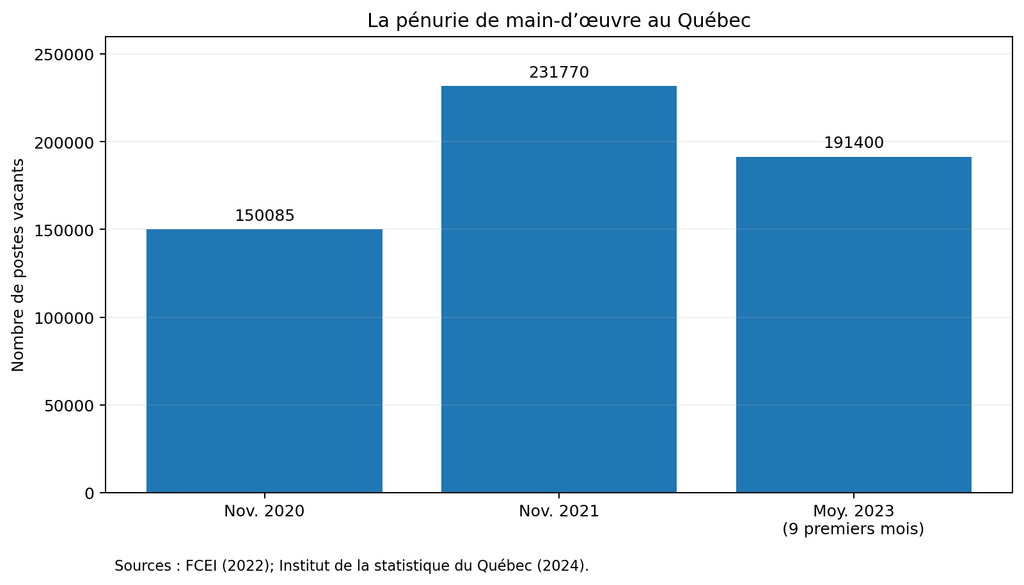
The number of vacant positions increases from 150,085 in November 2020 to 231,770 in November 2021In 2022, the job vacancy rate reached approximately 6%Even after a drop of more than 20% in 2023, there was still on average 191,400 job vacancies during the first nine months of the year. Quebec Institute of Statistics
Meanwhile, Quebec's unemployment rate is falling to 4.5% in 2023, its lowest level since 1976and the employment rate reached a historic high of 62.1%. Quebec Institute of Statistics
In other words, it was no longer simply a shortage of programmers, engineers, nurses or machinists.
He was starting to run out of workers altogether.
Even entry-level jobs were becoming difficult to fill.
This is probably one of the best indicators of the scale of the phenomenon.
At the beginning of 2022, 76.3% of accommodation and food service businesses anticipated a labor shortageIn the retail sector, the proportion reached 72.9%compared to 51% for all companies.
Recruitment difficulties affected 67.1% and 61.6% of companies in these two sectors respectively. Quebec Institute of Statistics
This is important because a considerable proportion of jobs in these sectors require relatively few formal qualifications or specialized training.
When even entry-level jobs become difficult to fill, The problem can no longer be explained solely by a mismatch between available skills and those required..
The most visible manifestation of the phenomenon was probably in the restaurant industry.
Some establishments have reduced their opening hours or services due to staff shortages. Some restaurants that were previously open 24 hours have stopped offering nighttime service.
They had the premises.
They had the kitchens.
They had the capital.
They had the customers.
They simply lacked the workers to produce.
And this shortage came at a cost.
This is where the figures become particularly interesting.
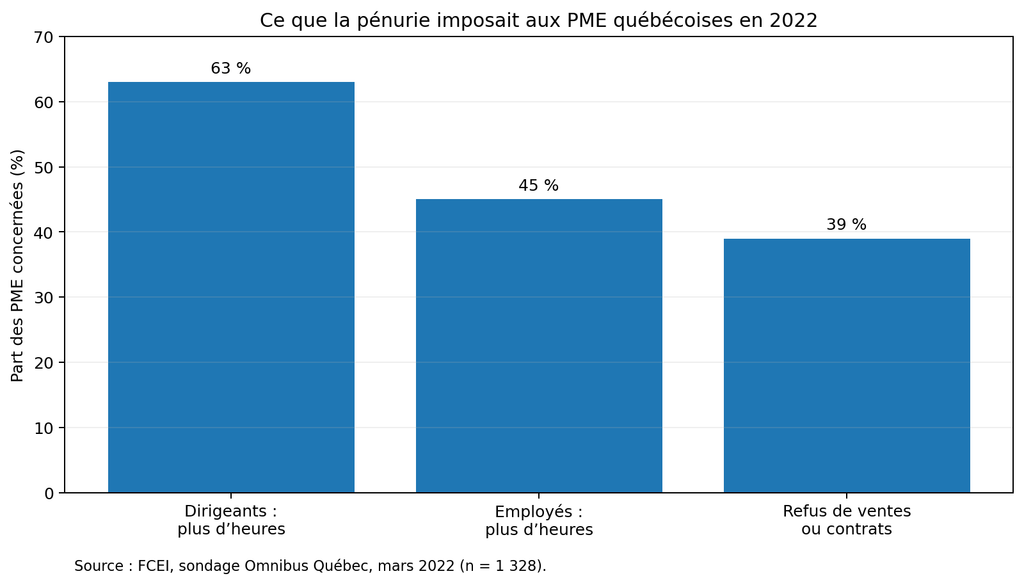
According to a CFIB survey conducted in March 2022, the lack of workers forced 63% of managers work more, 45% of their employees work more, and 39% of SMEs refuse sales or contracts. CFIB — Financial Impact of Labour Shortages in Quebec
Another CFIB survey indicated that 31% of SMEs cancelled or postponed business projects due to staff shortages. FCEI
So we are no longer simply talking about entrepreneurs complaining about the difficulty of recruiting.
The shortage actually reduced the economy's potential output.
A refused contract means a production that does not take place.
Removing an opening hour represents lost sales.
A deferred investment represents productive capacity that is not created.
The CFIB even attempted to measure part of it and estimated at more than .7 billion the revenue losses suffered by Quebec SMEs over a year due to contract refusals and delays related to labour shortages.
This figure should be taken for what it is: an estimate from the CFIB constructed from its surveys, and not a statistical measure Canada. CFIB — Methodology and Results
But the order of magnitude clearly shows that the problem was far from theoretical.
And meanwhile, the public sector was hiring
This is where our initial question becomes interesting.
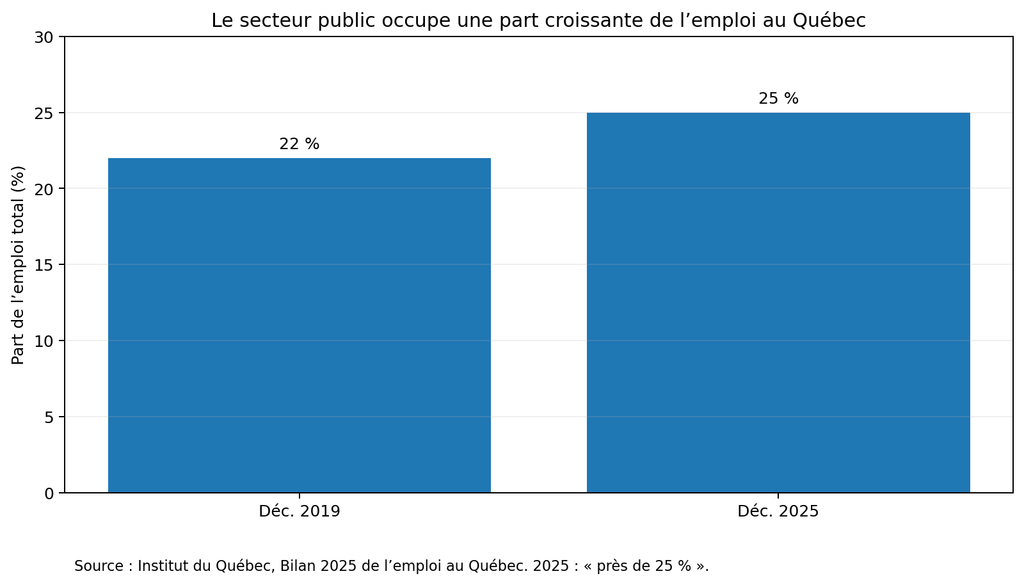
In December 2019, approximately 22% of Quebec jobs belonged to the public sector.
By December 2025, this proportion was approaching 25%.
According to the Institut du Québec, this trend accelerated during the pandemic and has continued since. Since 2019, education has seen the strongest growth, followed by public administration and healthcare. Quebec Institute — 2025 Employment Outlook for Quebec
Once again:
Simultaneity does not demonstrate causality.
Moreover, the private sector also created many jobs during part of this period. In 2023 alone, private sector employment in Quebec increased by 95,900 jobs.
But we can now ask a much more precise economic question.
When nearly 200,000 jobs are vacant, unemployment is at a historic low, and companies are refusing contracts due to staff shortages, where are the additional workers hired by the public sector coming from?
They cannot all come from a huge pool of unused workers.
This reserve no longer exists.
The opportunity cost of a public sector hire
This is probably the most important distinction in this article.
Let's assume that unemployment is at 10% and that hundreds of thousands of workers are actively seeking employment.
The government is hiring 10,000 people.
It is entirely possible that a large proportion of these workers would otherwise have been unemployed. The opportunity cost to the private sector may therefore be relatively low.
Now, let's take the exact same hiring scenario in an economy where unemployment is at 4.5%, where the employment rate is breaking records, and where companies are closing some shifts because they can't find anyone.
The situation is completely different.
To hire an additional worker, the public sector must compete more with other employers who are seeking the same scarce resource.
This does not mean that public sector hiring is necessarily bad.
An additional nurse in the emergency room can certainly produce greater social value than she would elsewhere. An additional teacher can improve public services.
THE crowding out This does not automatically mean that the state should not hire.
It means something much more mundane and much harder to circumvent:
Hiring has an opportunity cost.
The real question then becomes:
Is the additional public service produced by this hiring worth more than what we have given up elsewhere?
The state is also a formidable competitor.
At first glance, the Quebec administration does not appear to be particularly advantaged compared to the private sector.
In 2025, for comparable jobs studied by the Quebec Institute of Statistics, his salaries were on average 8.6% lower than those in the private sector.
But when pension plans, group insurance, paid leave and normal working hours are taken into account, the result is reversed.
The overall compensation of the Quebec administration was 4.5% higher than that of the private sector in 2025. It was 5.8% higher in 2024. Quebec Institute of Statistics — Remuneration of government employees
Therefore, comparing only salaries gives a misleading picture.
A company doesn't just compete with the state-offered wage. It competes salary, pension plan, insurance, vacation, leave, working hours and job security.
This obviously does not mean that all public sector jobs offer better conditions.
The health network perfectly illustrates the paradox: an advantageous overall remuneration can coexist with difficult hours, mandatory overtime and a work organization rigid enough to make some private sector jobs more attractive.
Therefore, higher overall compensation does not automatically mean better working conditions.
And it should also be specified that the preceding figures concern the Quebec administration, not the entire public sector.
Quebec businesses must also compete with the federal government, municipalities, and other components of the public sector. In 2025, the ISQ estimated that the overall compensation of the Quebec public administration would remain 17.8% lower than that of other public sectors for the comparable jobs studied.
Quebec is therefore not even necessarily the most generous public competitor.
A nurse is not a machinist.
However, we must resist drawing an overly simplistic conclusion.
Workers are not interchangeable.
A nurse hired by a hospital doesn't automatically deprive a factory of a machinist. A college professor isn't the cook the local restaurant is lacking.
This necessarily limits the direct crowding-out effect.
But the labor market is not made up of watertight compartments either.
Governments and businesses recruit directly from the same talent pools. IT, accounting, finance, engineering, administration, human resources, management, technical trades and professional services, among other things.
And the effects can be transmitted.
A government ministry is recruiting someone from a large company. The large company is recruiting their replacement from a small or medium-sized enterprise (SME). The SME, in turn, has to increase its job posting to find someone elsewhere.
The state therefore does not need to directly hire the restaurant's cook to increase pressure on an already extremely tight labor market.
Do you hate self-service kiosks?
Since the Luddite species is clearly still not threatened with extinction, order terminals and self-service checkouts have their detractors.
But their proliferation helps to illustrate another interesting consequence of the shortage.
When labor becomes scarcer and more expensive relative to capital, companies have a greater incentive to invest in technologies that allow fewer workers to produce more.
And Quebec companies have indeed reacted in this way.
In 2021, 33% of SMEs facing shortages had invested in automationand 81% of those who had adopted this strategy considered it to be effective. CFIB — Shortages and Automation
In 2023, among SMEs that were investing or considering investing in automation, 45% cited alleviating the labor shortage as one of their motivations., behind the productivity and the time saved. CFIB — Automation of Quebec SMEs
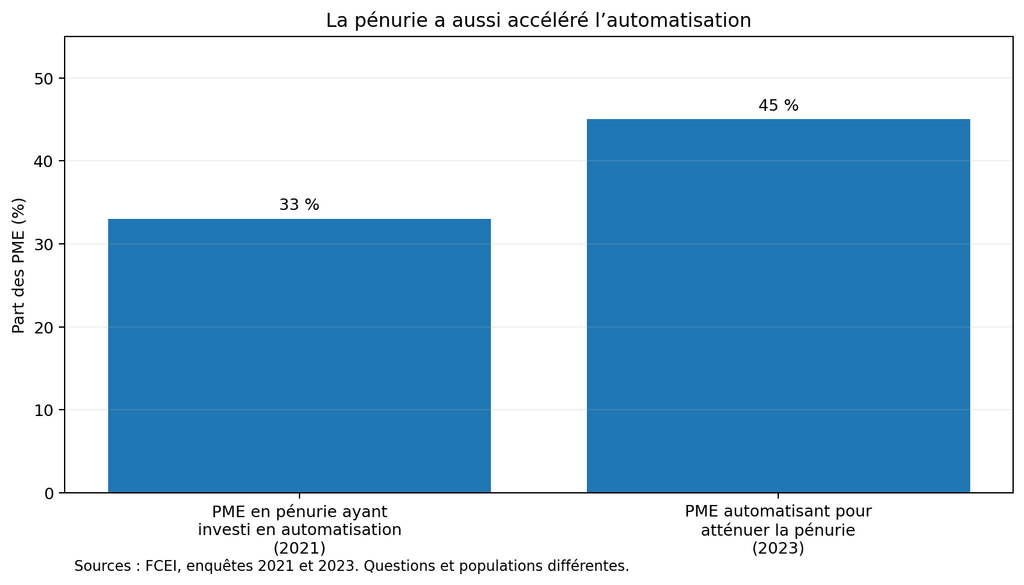
However, these two figures come from different surveys. They do not constitute a time series that allows us to claim that automation has increased from 33% to 45%.
Rather, they demonstrate two different things: companies in shortage did indeed resort to automation in 2021, and shortage was explicitly a motive for automation in 2023.
Self-service kiosks were obviously not invented because of the shortage in Quebec.
But the scarcity of workers increases their economic interest.
When a restaurant cannot find enough employees, it can increase wages, reduce hours, refuse customers, reorganize work, or invest in technology that allows available employees to serve more customers.
Automation is probably the most productive answer on this list.
Rather than simply producing less, the company increases the productivity of each remaining worker.
The next time you curse a command terminal, you will therefore understand a little better why it is in front of you.
So, has the state ousted the private sector?
We have not demonstrated that the expansion of public employment caused the labor shortage.
We have not demonstrated that an additional public sector job destroys a private sector job.
And we are unable to say that the expansion of the public sector has cost exactly 10,000, 50,000 or 100,000 private sector jobs.
Anyone who claimed to know this figure from the data we have just examined would have discovered a rather revolutionary econometric method.
But we have established something else.
Quebec knew a historic shortage of workers.
Companies were unable to hire.
Some were reducing their services, refusing sales and abandoning projects due to a lack of staff.
The public sector was growing simultaneously his share of the job.
The Quebec administration offered a Overall compensation sufficiently advantageous to compete with the private sector.
And in several professions, Both the public and private sectors recruited directly from the same pool of workers..
This does not demonstrate the extent of the crowding-out effect.
But this makes it rather difficult to argue that the state could substantially increase its own demand for workers in such a tight market. without imposing any opportunity cost on the rest of the economy.
The question is therefore probably not:
Did the state cause the labor shortage?
The answer would be far too simplistic.
The much more interesting question is:
Given that Quebec companies already lacked enough workers to reduce their production and investments, was it wise for the public sector to simultaneously and rapidly increase its own demand for this same scarce resource?
And most importantly:
What did we get in return?
Because if the expansion of the public sector makes it possible to obtain services whose value exceeds what the private sector has to forgo, the opportunity cost can be perfectly justified.
But if that's not the case, we have a much deeper problem than just a shortage of workers.
We have a problem resource allocation.
And when we begin to examine the size of the Quebec state, its taxation, its administrative structures, its subsidies and its interventions in the economy, a much broader question inevitably arises:
What if the real problem was the Quebec model itself?
About the Author