

The Quebec labour market has just sent us a signal that it would be unwise to sweep under the rug.
In August 2026, Quebec lost 18,500 jobsOver twelve months, the observation is even more striking: Quebec employment has decreased by 54,100 positions, or 1.2%During the same period, Ontario gained approximately 116,000, or 1.4%and Canadian employment has increased by 1.0%.
Quebec is even the only Canadian province where employment is lower than it was a year ago.
The first explanation that naturally comes to mind is obviously the trade war with the United States. Donald Trump is imposing tariffs on certain Canadian products, exporting companies are facing considerable uncertainty, and Quebec's manufacturing sector is suffering the consequences.
This explanation is perfectly legitimate.
It is simply incomplete.
Yes, the prices hurt.
Let's start by giving Caesar what belongs to Caesar, or in this case, Trump what belongs to Trump.
Trade uncertainty is truly weighing on the Canadian economy. A company will naturally hesitate more before investing or hiring if it doesn't know what conditions it will have access to its main market in six months.
And Quebec manufacturing is indeed suffering.
Between the average of May to July 2025 and that of May to July 2026, it lost approximately 11,000 jobs.
It would therefore be ridiculous to claim that American tariffs have nothing to do with the situation.
But here's the problem: Quebec is not the only Canadian province to trade with the United States.
Over twelve months, in August 2026:
Quebec: -1.2%
Ontario: +1.4%
Canada : +1.0%
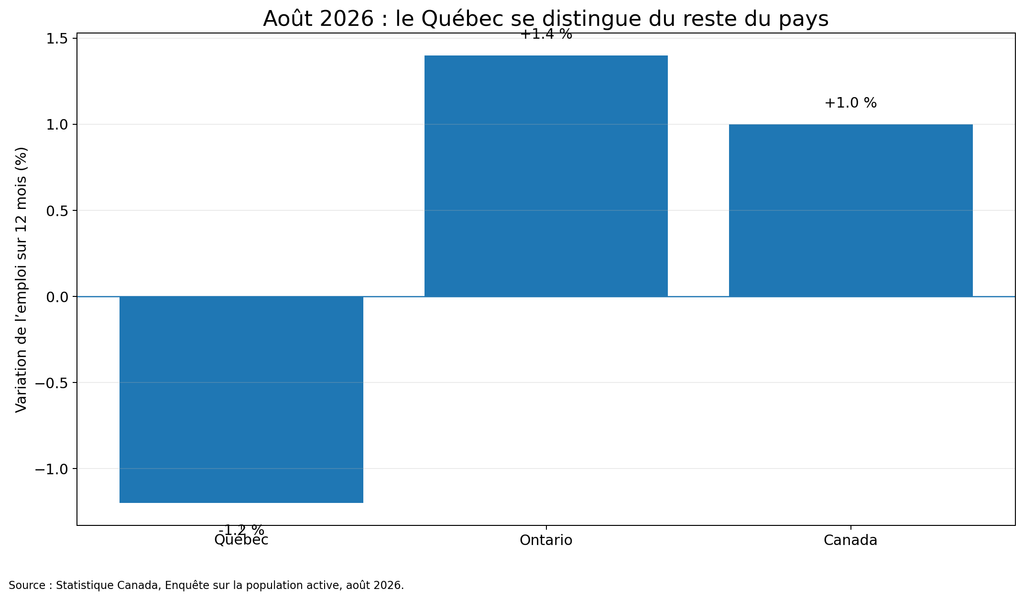
Ontario is also heavily integrated into the American market. It faces the same Donald Trump, the same trade tensions, and many of the same macroeconomic uncertainties.
However, his employment is increasing.
This obviously doesn't prove that Quebec government policies are responsible for the gap. But it does make it much harder to argue that American tariffs alone are enough to explain it.
It's not just the manufacturer
Let's now look at where jobs are disappearing.
Between the average of May to July 2025 and that of May to July 2026, losses are concentrated in four sectors in particular:
Wholesale trade: -27,000
Finance and insurance: -17,000
Production: -11,000
Construction: -11,000
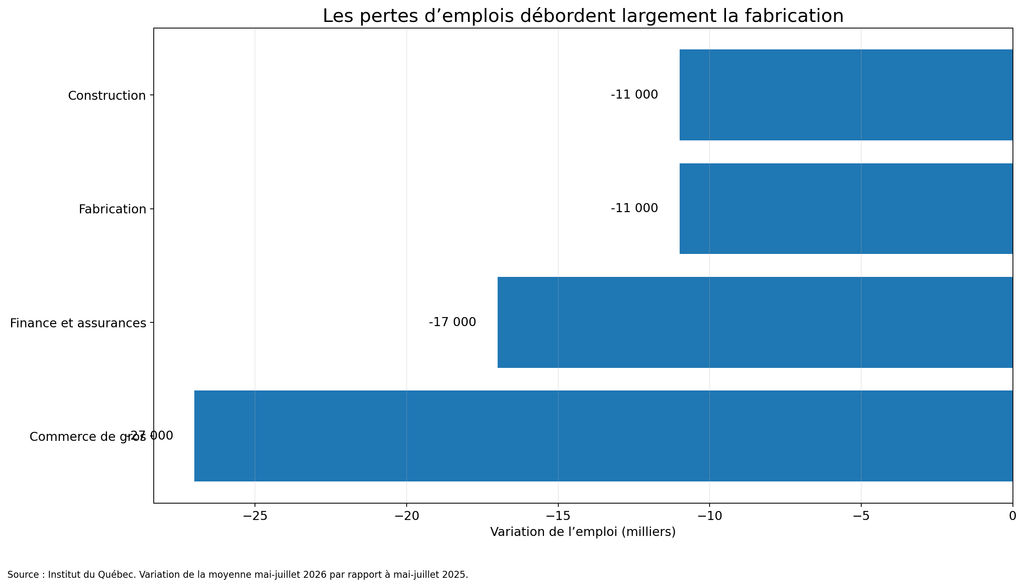
The manufacturer is indeed affected, but it is far from being alone.
Indirect effects of the trade war can certainly be found in wholesale trade or even in construction. An economy is a network, not a collection of isolated compartments.
But when significant losses are simultaneously observed in manufacturing, construction, finance, and wholesale trade, It becomes reasonable to wonder whether the trade shock is hitting an economy that was already showing some signs of weakness.
And that is precisely what the private sector employment data suggests.
The private sector was already showing signs of slowing down.
For several years, job creation in Quebec was accompanied by strong growth in public sector employment.
Between 2022 and 2025, public sector employment increased from approximately 1.027 million to 1.121 millionan increase of approximately 9%.
Meanwhile, private sector employment increased from approximately 2.866 million to 3.011 million, a growth of approximately 5%.
Private sector employment has indeed increased. It would be wrong to speak of permanent stagnation.
But Public sector employment grew almost twice as fast.
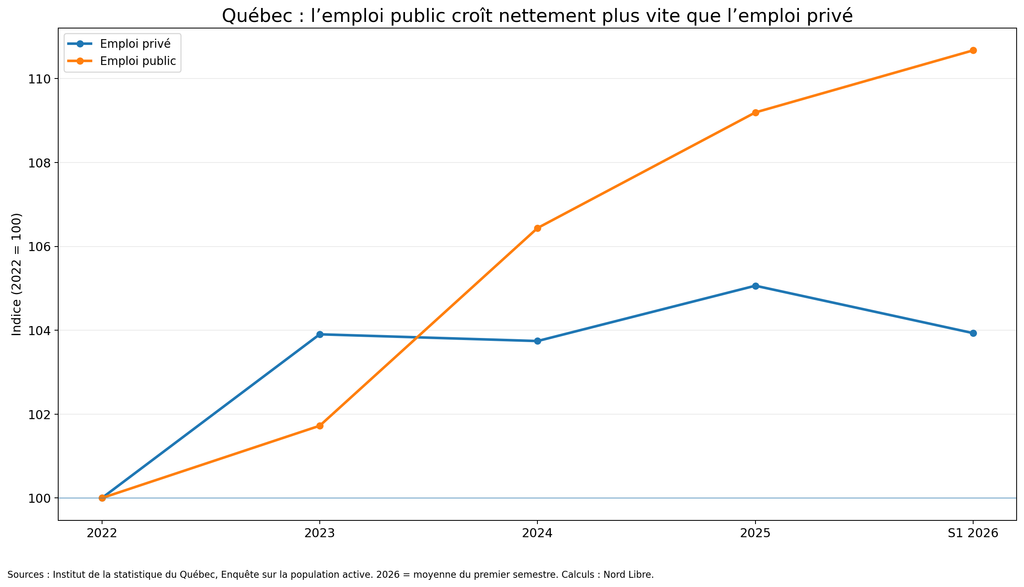
However, an important nuance must be introduced here. 2025 was not a bad year for employment in Quebec as a whole. On an annual average, Quebec has gained approximately 79,000 jobs, or 1.7%, a higher rate of progress than that of Canada.
The problem appears rather in the composition of this growth and the deterioration observed towards the end of the year.
Between December 2024 and December 2025, private sector employment in Quebec declined by 0.2%, while it increases by 1.4% in CanadaMeanwhile, public sector employment in Quebec is growing by 3.1%.
This is a particularly important element of our story:
The relative weakness of Quebec's private sector employment is therefore not apparent with the 2026 US tariffs. It was already clearly visible in 2025.
Trump may have exacerbated the problem.
He didn't necessarily create it.
And now, the public cushion disappears
For a time, therefore, the growth in public employment compensated for some of the relative weakness in private employment.
But in 2026, something changes.
In the first half of 2026, compared to the second half of 2025Quebec's private sector employment loses approximately 21,600 jobs.
Public sector employment, however, is practically stagnant: +300 jobs.
Then public sector employment also began to decline.
In August alone, Quebec loses approximately 16,900 private sector jobs and 16,300 public sector jobs, while self-employment increases by approximately 14,700.
Since this is monthly data from a survey, it's obviously important to avoid drawing any structural conclusions from a single month. However, it does reflect a trend that was already visible in the semi-annual data.
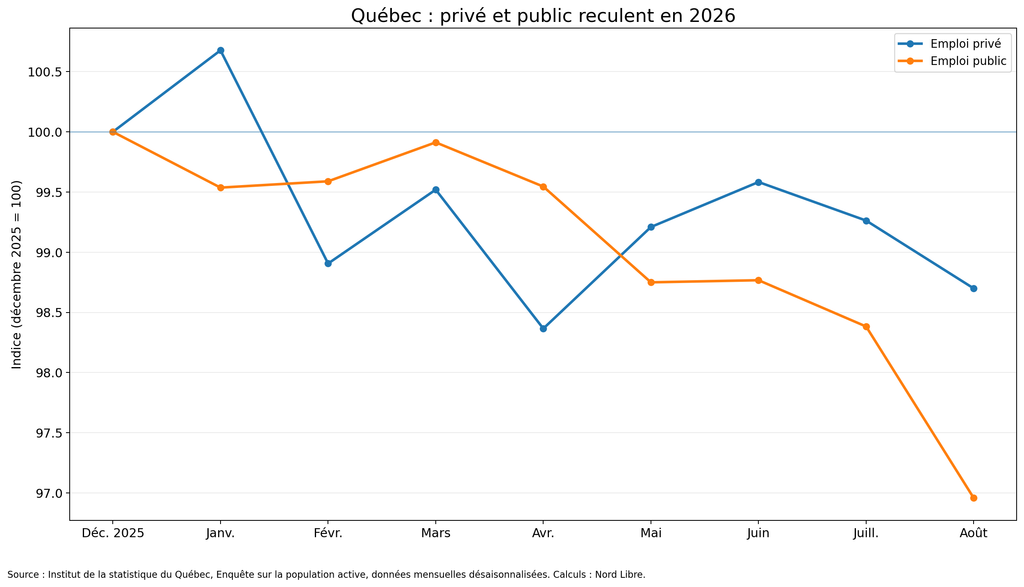
The phenomenon then becomes much more visible.
As long as public sector employment was growing rapidly, total employment could continue to present a relatively favorable picture despite the slowdown in the private sector.
When The private and public sectors simultaneously cease to create jobs., this cushion disappears.
And Quebec finds itself with fewer jobs than a year ago, while overall, the rest of Canada continues to create them.
But unemployment remains low
However, one fact must be acknowledged which seems to contradict everything above.
In August, Quebec's unemployment rate was only 5.6%, against 6.9% in Ontario And 6.4% in Canada.
So, where's the problem?
How can jobs be lost while maintaining a relatively low unemployment rate?
Because the unemployment rate does not measure the number of jobs. It measures the proportion of people present on the labor market who are looking for a job but can't find one.
However, Quebec's activity rate has fallen to approximately 64.2%.
And the phenomenon is far from negligible: between August 2025 and August 2026, Quebec's working population decreased by approximately 74,700 people, or 1.5%..
An economy can therefore lose jobs without immediately causing an explosion of unemployment if, at the same time, enough people leave the labor force.
Population aging, retirements, and changes in demographic growth then become important elements of the equation.
Quebec's low unemployment rate is good news.
But it does not eliminate job losses.
Is the problem deeper?
This brings us to a much more uncomfortable question.
For several years, Quebec experienced a significant labour shortage. However, during this period, the public sector increased its workforce much more rapidly than the private sector.
This raises a legitimate economic question:
Has the expansion of public sector employment itself contributed to making it more difficult to hire in the private sector?
The mechanism is plausible.
The government and businesses draw their workers from the same pool. When labor is scarce, the two sectors inevitably compete for a share of this resource.
But be careful.
We have here a hypothesis, not a causal demonstration.
Professions, required qualifications, working conditions, and regions vary. It would be far too simplistic to look at two curves and conclude that every public sector job created prevented the creation of a private sector job.
This question deserves its own investigation.
And we will come back to that.
Trump is a problem. But he may not be THE issue.
The data ultimately tells a more complex story than simply attributing Quebec's current difficulties to the trade war.
American tariffs are real. They cost jobs and create uncertainty.
But they are affecting all of Canada.
They do not explain why Quebec is the only province with fewer jobs than a year ago..
They explain even less why The relative weakness of private sector employment was already visible before the 2026 shock fully hit the economy..
For a time, the much faster growth of public sector employment helped to maintain a relatively favourable picture of the Quebec labour market.
Today, this cushion is also running out of steam.
Perhaps we are simply witnessing a bad year caused by a particularly unpleasant combination of tariffs, interest rates, demographics, and uncertainty.
Or perhaps these events are revealing a more structural problem in the Quebec economy.
It is this second possibility that we will examine in the following articles.
And if the problem is indeed structural, then a political question inevitably arises:
Would you trust the CAQ to solve it?
About the Author