
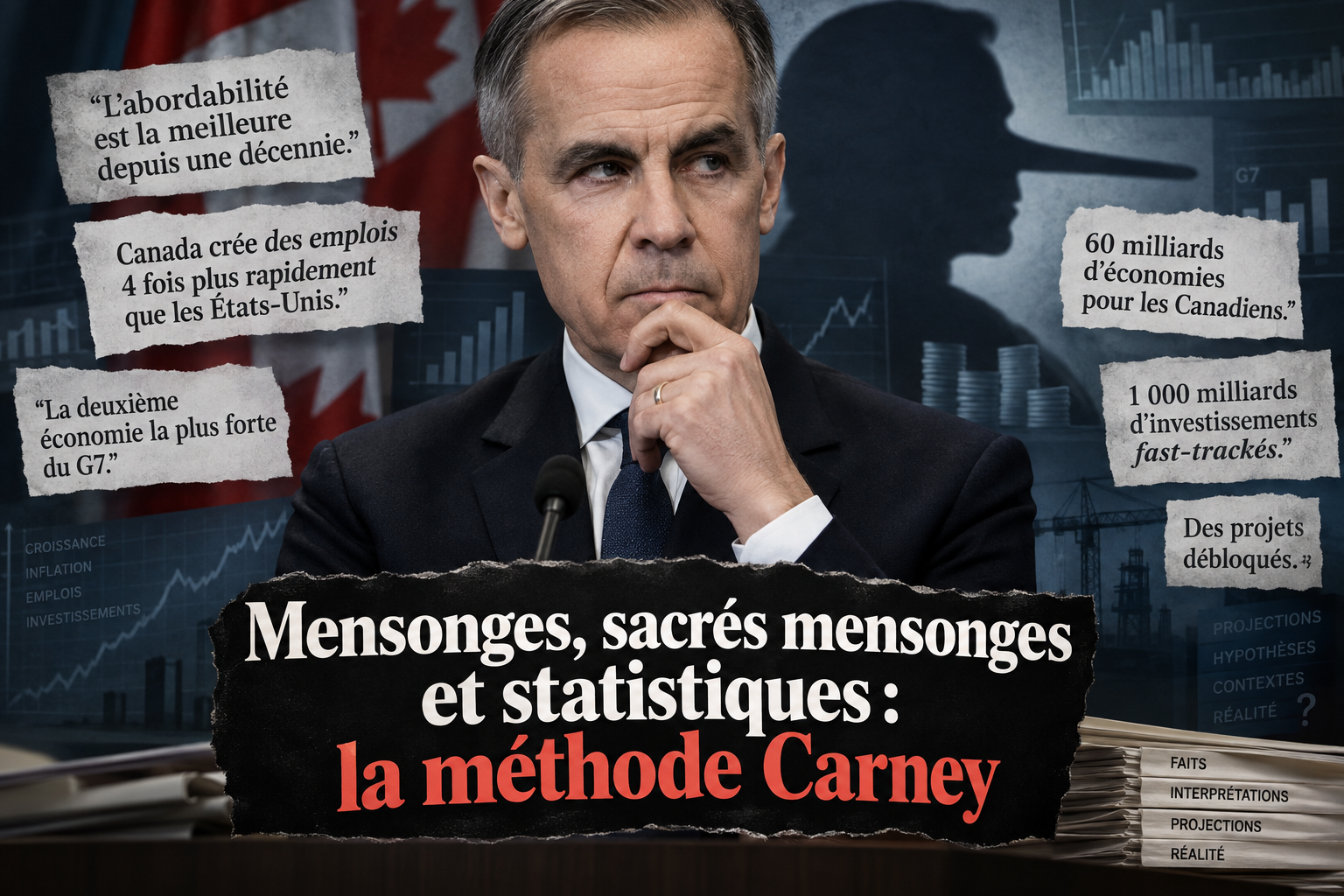
Lies, damned lies and statistics The Carney method
"There are three kinds of lies: lies, damned lies, and statistics."
A phrase popularized by Mark Twain
When I heard Mark Carney state that the Canada was creating jobs four times faster than the United States, my first instinct was simply to check if that was true.
I didn't think I'd be writing this article yet.
After all, four times the American pace is a lot. And above all, it's remarkably accurate.
The problem quickly became apparent: four times faster, since when?
Since January? Since the election? For three months? For twelve months? And according to which employment measure?
Carney doesn't say that.
But something else bothered me more. It wasn't the first time a dramatic economic statement from Mark Carney had raised my eyebrows.
I had already dedicated one fact-checking his claim that "affordability is the best it's been in over a decade"Some measures had indeed improved, but they certainly did not allow us to conclude that affordability, taken as a whole, was the best it had been in ten years.
Two spectacular statements. Both times, real data seemed to exist behind them. And both times, the wording went far beyond what the data readily demonstrated.
So I asked myself a question:
Is this simply a coincidence?
So I decided to check out other economic statements by Mark Carney.
And that's where things got interesting.
Affordability is the best it's been in a decade
On March 25, in the House of Commons, Mark Carney stated:
“Canadian wages have grown faster than the rate of inflation. Rents are at a 33-month low. Affordability is the best it has been in over a decade. »
Note well: he doesn't say rent affordability.
He said affordability.
A few weeks later, when confronted with this statement in the House, Carney replied:
“On March 25, I said that rent affordability was the best it had been in a decade. »
Except that's not what he said.
The official record of the House is there to confirm it.
And the statistic that seems to underlie his statement poses a second problem. Rentals.ca data did indeed indicate an improvement in rent affordability, but the rent-to-income ratio had reached its highest level since [date missing]. more than six years.
Six years.
Not ten.
Moreover, a few days after his initial statement, Carney himself used the much more precise wording that rent affordability was at its highest level since more than six years.
Let's summarize.
A statistic concerning the affordability of rents becomes a general statement regarding affordabilityThen, when it is challenged, it suddenly reverts to being a statement concerning only rents.
Curious.
Four times the American rate
Let's now turn to the statement that triggered this investigation:
“Canada is growing jobs at 4x the rate of the United States. »
First surprise: it's not necessarily wrong.
Between April and July 2026, approximately 181,000 jobs were created in Canada, representing growth of approximately 0.9%, while US job creation was particularly weak.
Depending on the period and the statistical series chosen, it is therefore possible to obtain a ratio that is extremely favourable to Canada, sometimes even greater than four.
So Carney is right?
Maybe.
And that's precisely the problem.
Carney does not specify the reference period, the statistical series being compared, or even how his "rate" is calculated.
We therefore have an extraordinarily precise figure. 4×without the information needed to reproduce the calculation.
Try to prove that he is wrong.
Take twelve months. The ratio doesn't work? Perhaps he meant six months. Still nothing? Try three months. Since January? Since the election? Since April?
As long as Carney does not tell us which window he is using, his claim is not reproducible and becomes virtually impossible to refute properly.
And yet, an economist knows perfectly well that a growth rate without a reference period is incomplete.
And no, these are not civil service jobs.
I also wanted to verify whether this strong job creation came mainly from the public sector.
That's not the case.
Between April and July, job growth was concentrated in the private sector and among self-employed workers, while public sector employment was declining.
On this point, the figures are actually favorable to Canada.
This clarification is important, because the goal is not to find figures at all costs that prove Carney wrong.
The goal is to know what the numbers really say.
The second strongest economy in the G7
Let's now consider another statement.
The economic forecasts that Carney refers to place Canada among the G7 economies expected to experience the fastest real GDP growth.
This is perfectly legitimate information.
But this forecast is regularly summarized in political discourse by a much more ambitious formulation:
“Canada will have the second-strongest economy in the G7. »
Do you see the slippage?
A forecast focusing primarily on the growth rate of real GDP becomes a statement concerning The second strongest economy in the G7.
It's not the same thing.
The strength of an economy can also be measured by the productivityGDP per capita, unemployment, investment, or real incomes. An economy can even experience rapid growth simply because its starting point is particularly weak.
Once again, the underlying data is real.
It is the conclusion that becomes much broader.
billion in savings for Canadians
Then there's this one.
Carney stated in the House:
“This government is on track to deliver billion in savings for Canadians. »
Sixty billion dollars in savings for Canadians.
Impressive.
But the budget documents behind this figure speak of government spending cuts, other savings and additional revenue for the government.
An additional source of revenue for Ottawa does not necessarily mean savings for Canadians.
If Ottawa takes an extra ,000 in taxes from me, the government effectively has an extra ,000. Personally, though, I would have some difficulty putting that amount in the "savings" column of my family budget.
The figure of 60 billion exists.
It is his transformation into "Savings for Canadians" which poses a problem.
Then the billions begin to multiply.
The same phenomenon can be seen in investment announcements.
The government is talking about approximately 0 billion capital expenditures and incentives that should help to mobilize more trillion in investments over the next few years.
In official documents, one finds perfectly reasonable words such as expected, enable And projected.
This is therefore a projection.
But in political speeches, the wording gradually becomes more forceful.
We are talking about:
“catalyzes trillion in investment”
then from:
“fast-tracking trillion of investment”.
The same phenomenon occurs with the Major Projects Office (MPO).
The government adds up the value of projects that have been referred to it for review and speaks of tens, then hundreds of billions of dollars of investments represented or "released".
One small detail:
At the time of writing, none of the projects referred to DFO have yet been designated as projects of national interest under the Building Canada Act.
Zero.
Nothing.
Several projects are still in development, in the regulatory process, seeking funding, or have not yet reached their final investment decision.
This obviously does not mean that they will never be achieved. But there is a substantial difference between a referred project, a designated project, a committed investment, and a completed investment.
When we add up the potential value of projects that have not yet received any designation and then talk about investments "unlocked"The word does a lot of work.
When Carney is right
However, it would be unfair to claim that all of Carney's economic statements are false.
Several withstand the test perfectly.
When he states that wages have recently increased about twice as fast as inflation, the figures bear him out.
When he points out that foreign direct investment has reached its highest level in nearly two decades, he is right.
His description of Canada's relatively advantageous fiscal position within the G7 is also defensible.
And, as we have just seen, the strong recent job creation came mainly from the private sector and self-employed workers.
Why mention these examples?
Because they are part of the problem.
Carney doesn't seem to be simply throwing around false figures at random. His statements mix perfectly accurate statistics with others that only become defensible by adopting a particular definition, an unspecified period, or a generous interpretation of the data.
This is what makes a half-truth much more effective than a blatant lie.
The lie can be refuted.
The half-truth contains enough truth to be defended when challenged, while leaving the listener with an impression that the facts do not necessarily justify it.
The problem is therefore not always that the starting figure is wrong.
It is sometimes true enough that no one notices the distance that separates it from the conclusion we are invited to draw from it.
A pattern is starting to appear
After examining these statements, four processes regularly recur.
The omission of context.
Canada is creating jobs four times faster than the United States. Over what period? That remains a mystery.
The broadening of a metric.
Rent affordability becomes "affordability." A GDP growth forecast becomes "the second strongest economy in the G7."
The transformation of a projection into near-reality.
Investments that should be mobilized become “catalyzed” investments, then “fast-tracked”.
The advantageous reclassification of a statistic.
Government savings and additional revenue become " billion in savings for Canadians".
Taken individually, each of these examples could be attributed to the normal simplification of political discourse.
Taken together, they begin to look more like a method.
The Carney method?
And this is where Mark Carney's career becomes impossible to ignore.
Carney is an economist. He headed the Bank of Canada and then the Bank of England. He spent a good part of his career analyzing economic statistics and choosing his words with enough precision for the financial markets to interpret them correctly.
He knows that a rate without a reference period is incomplete.
He knows the difference between a forecast and a result, between a potential investment and an actual investment, between GDP growth and the overall strength of an economy.
So how can we explain these formulations?
Two possibilities seem to present themselves.
One of the most experienced economists to have held the position of Prime Minister of Canada regularly makes basic inaccuracies when presenting economic statistics to the public.
Either these formulations are not entirely accidental.
I'll let you decide which one seems most likely to you.
After all:
"There are three kinds of lies: lies, damned lies, and statistics."
Perhaps we should simply add a fourth category:
half-truths.
About the Author





The art of politics? Carney isn't special. Politics and politicians have always been shrouded in secrets and mysteries, otherwise they wouldn't be in office. The more things change, the more they stay the same!