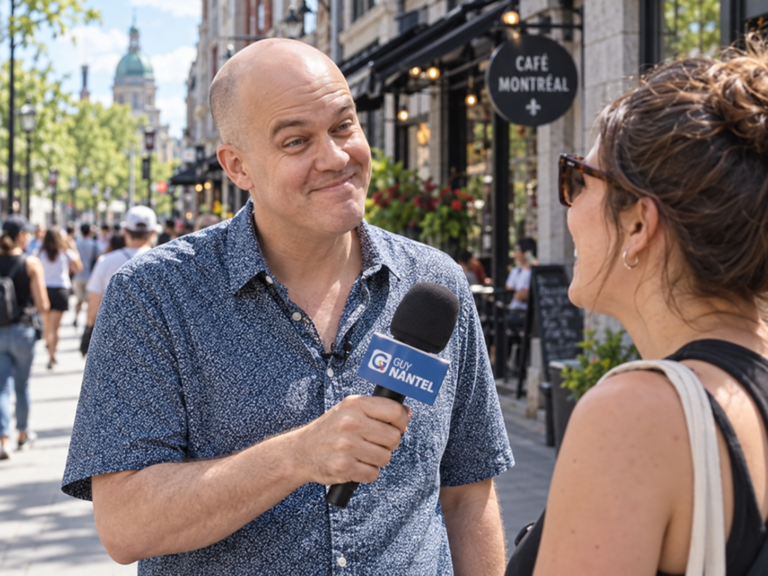


Radio-Canada offered us a rather interesting exercise last night: Five leaders, one electionNot a traditional debate where five politicians simultaneously try to speak louder than the other four, but five successive interviews allowing Christine Fréchette, Charles Milliard, Ruba Ghazal, Paul St-Pierre Plamondon and Éric Duhaime to present their vision of Quebec and answer journalists' questions.
The exercise primarily allows us to ask a much more interesting question than who had the best tie or the best line:
Which leader currently seems to be setting the terms of the Quebec political debate?
After carefully re-listening to the five interviews and subjecting their main claims to cross-checking, my answer may surprise some.
Christine Fréchette: Captain Quebec meets Captain Titanic
Christine Fréchette had a fairly obvious objective: to bring the campaign back to Donald Trump and the trade war as much as possible.
We understand why.
His government now has eight years of record to contend with. Healthcare, bureaucracy, public spendingSAAQclic, Northvolt, cost of living: every time the conversation moves away from Donald Trump, the past comes knocking at the door.
Ms. Fréchette is therefore attempting a particularly difficult political exercise. She wants to simultaneously convince us that the CAQ did a good job for eight years and that it now represents change.
Journalists were quick to point out this contradiction.
Ms. Fréchette can cite some real achievements. Her statement that real GDP per capita has increased by about 5% since the CAQ came to power is within the correct range. She can also rightly assert that her government recently reduced the number of public service jobs by several thousand.
The problem appears when the window is enlarged.
Public sector staffing levels have increased considerably since the CAQ came to power. To congratulate ourselves today on cutting a few thousand positions is a bit like congratulating the captain for starting to bail water after spending several years filling the hold.
Which brings us back to Charles Milliard.
The Liberal leader probably found one of the best expressions of the evening when he described Ms. Fréchette as "Captain Titanic".
Cruel?
Certainly.
But politically effective, because the formula directly turns against itself the image of "Captain Quebec" that it seeks to build.
The Trump problem
Let's be clear: American tariffs represent a real economic problem for Quebec. Certain industries are heavily exposed, and no one in their right mind suggests that the government should simply sit idly by.
But when Ms. Fréchette is asked how many Quebec jobs are actually threatened, she is unable to give a precise figure.
It becomes problematic when this threat becomes the central issue of the election.
More importantly, Ms. Fréchette advocates a dollar-for-dollar retaliatory tariff approach. However, counter-tariffs don't simply fall from the sky on American companies. They are first levied on imported goods. Canada and therefore also impose costs on local businesses and consumers.
The simplest image is probably this one:
Trump's tariffs are shooting us in the foot. Responding dollar for dollar is shooting ourselves in the foot to show him we won't be pushed around.
This certainly demonstrates our determination.
Our ability to walk afterwards is another question.
However, there is another strategy.
Instead of primarily seeking to inflict damage on Americans, we can seek to make the Quebec economy more resilient: reduce taxes, ease regulations, decrease costs imposed on businesses, promote investment, further exploit our resources and facilitate trade with the rest of Canada.
In other words, put on steel-toed boots and a Kevlar jacket.
This is essentially the approach proposed by Éric Duhaime.
A government's role is not to prove it is capable of retaliating. Its primary role is to protect its economy.
Charles Milliard: Captain Titanic wasn't his only good move
I must admit that Charles Milliard pleasantly surprised me.
The Liberal leader is probably not the one who will whip the crowds into a frenzy. He sometimes gives the impression that he could turn a revolution into a board meeting.
But he's serious.
His position regarding Trump is notably much more reasonable than the caricature one might make of it. He is not proposing capitulation. He is proposing negotiation, seeking common interests, and taking advantage of the extremely important economic integration between Canada and the United States.
Revolutionary concept: trying to find a mutually beneficial solution to a commercial dispute.
Its eventual target of 100,000 homes built annually is extremely ambitious and raises important questions about the availability of labor, regulations and the actual capacity of the construction sector.
But Milliard is consistent, methodical, and generally serious.
Its main weakness remains political: it still lacks a dominant proposition allowing voters to summarize in a few words why they should choose the PLQ.
However, it would be unwise for his opponents to underestimate him.
Ruba Ghazal: at least we know what she wants
Ruba Ghazal does not appear to be suffering from any political identity crisis.
Québec solidaire wants more government, more redistribution, more regulation and more direct government intervention in the economy.
Fifteen non-profit public grocery stores.
A minimum wage of an hour.
An annual tax of 1% on fortunes exceeding million.
The end of the three-tiered school system.
It's hard to accuse Ms. Ghazal of hiding her true intentions.
This orientation is also part of the party's history. Québec solidaire was born from the merger of Option citoyenne and the Union des forces progressistes, the latter having notably included the Communist Party of Quebec.
But ultimately, the label matters much less than the proposed economic mechanisms.
This is where the classic objections of Ludwig von Mises, Friedrich Hayek and Eugen von Böhm-Bawerk become interesting: economic calculation, dispersed knowledge, incentives, formation and allocation of capital.
Can a public grocery store sell for less?
Certainly.
But if it succeeds because taxpayers absorb its losses, it is not necessarily more efficient. It has simply shifted the burden.
Can the minimum wage be set at ?
Certainly.
But the government cannot abolish labor costs by decree. Businesses can respond with higher prices, fewer hours, fewer hires, or more automation.
Can we tax the very wealthy more?
Yes, again.
But we cannot assume that taxpayers with tens of millions of dollars will not change their behavior in any way in response to this new tax.
QS is therefore probably, along with the PCQ, the most ideologically coherent party in this campaign.
They simply give almost diametrically opposed answers to the same fundamental question:
What should be the role of the state in the economy?
PSPP: the right question, but still the revolver
Paul St-Pierre Plamondon also surprised me.
I expected the Trump issue to become her Achilles' heel. Christine Fréchette had an obvious opening: can we really afford another period of constitutional uncertainty when we are already engaged in a trade dispute with our main partner?
PSPP defused the issue rather well.
He clearly indicated that a Parti Québécois government would collaborate with Ottawa and the other provinces when Quebec's interests required it. He even pointed out that René Lévesque and Jacques Parizeau had done so with federal governments to which they were, nevertheless, deeply opposed.
Her position on counter-tariffs is also more nuanced than that of Ms. Fréchette.
The PSPP rightly recognizes that a dollar-for-dollar response risks inflicting significant damage on our own economy. It therefore proposes targeted and strategic counter-tariffs instead.
That's better.
But the fundamental problem remains.
While widespread counter-tariffs hurt our economy because we tax our own imports, making them more targeted does not eliminate this mechanism.
The difference between Ms. Fréchette's strategy and that of PSPP is therefore more like the choice of caliber than the choice of weapon.
Ms. Fréchette is essentially suggesting shooting herself in the foot with a .44 Magnum.
PSPP prefers a .22.
It will probably hurt less.
But we keep shooting ourselves in the foot.
This does not detract from PSPP's merit in identifying the problem of widespread retaliation. It simply means that its solution reduces it rather than eliminating it.
And this leaves Duhaime with a distinct political space: rather than choosing the caliber, he proposes to put away the revolver and strengthen our economy.
Eric Duhaime: winning without necessarily winning
We finally come to the leader of the Conservative Party of Quebec.
Perhaps the most revealing part of his interview comes when he is asked which proposal from a political opponent he would like to adopt.
His answer?
Several.
Because, according to him, the other parties have started to adopt his own.
He cites in particular the reduction of public staff, the reduction of spending and the new distrust of fiascos like Northvolt or SAAQclic.
Obviously, the PCQ didn't invent budgetary discipline. Adam Smith could demand a recount.
But Duhaime has a much more serious political argument here than it appears.
For several years, the PCQ has been insisting on the size of the state, public spending, taxes, regulation and subsidies to businesses.
Several of these issues are now at the heart of the campaign.
The CAQ is talking about reducing staff.
The other parties must demonstrate their budgetary credibility.
And after Northvolt, virtually no one seems particularly eager to announce the next gigantic government check to a multinational corporation.
Duhaime does not need to demonstrate that his opponents have photocopied his program.
All he has to do is ask a much more embarrassing question:
Why are they talking now about problems we've been talking about for years?
Its financial framework significantly strengthens this position.
The PCQ proposes approximately billion in cumulative savings over five years, accompanied by major tax cuts and an eventual return to a balanced budget.
Some of the assumptions are ambitious. Execution would certainly not be automatic.
But after subjecting this financial framework to a fairly rigorous adversarial examination, it is clear that it holds up much better than its opponents might wish.
This is not simply a collection of slogans accompanied by a decorative calculator.
And in the face of Trump, Duhaime now has a framework that is particularly easy to explain.
Fréchette wants to retaliate.
PSPP wants to respond more intelligently.
Duhaime wants reduce our vulnerability.
Less tax, less regulation, less external dependence, more exploitation of our resources and more domestic trade.
Steel-toed boots and a Kevlar jacket.
Each of these measures can be challenged.
But they form a coherent economic strategy.
Who really won?
If I had to rank the chefs solely based on this program, after subjecting their main claims to cross-checking, my ranking would be:
1. Éric Duhaime
2. Paul St-Pierre Plamondon
3. Charles Milliard
4. Christine Fréchette
5. Ruba Ghazal
But this ranking is almost secondary.
The much more interesting conclusion lies elsewhere.
Éric Duhaime may be winning a battle more important than this show: the battle for the ground on which the campaign is taking place.
When a fringe party proposes something, its opponents can simply ignore it.
When they start to address the same problems, adopt some of the same vocabulary, and sometimes move in the same direction, the situation changes.
The size of the state.
Public spending.
Taxes.
Subsidies to businesses.
The regulations.
Quebec's competitiveness.
The question is no longer simply how many MPs the PCQ will elect on October 5.
It becomes:
How many parties will be forced to campaign on the ground he helped to clear?
And if this trend continues during the debates, Éric Duhaime will have an extraordinarily simple question:
Why choose the copy when the original is on the ballot paper?
About the Author