
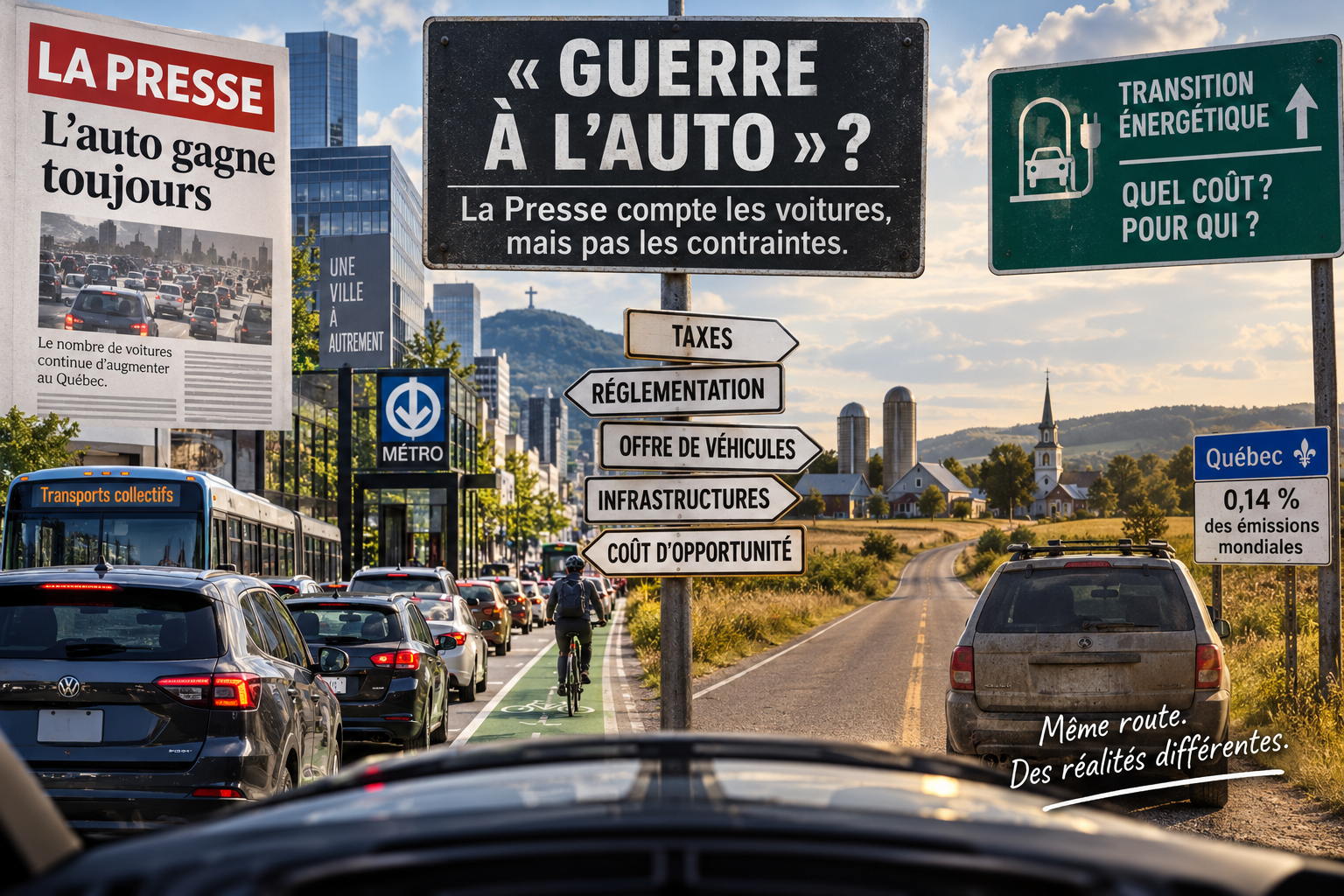
The number of cars on the road continues to grow in Quebec. However, this doesn't tell us whether public policies are gradually making car ownership more expensive, more restrictive, or less accessible. To answer this question properly, we need to measure the constraints, not just count the cars.
Éric Duhaime speaks of a "war on cars". The Press wanted to verify the claim and essentially concluded that, if there is a war, the automobile is still winning it.
The proof? The number of vehicles is increasing. Quebecers are buying more SUVs. Cars still occupy the majority of Montreal's roads. Governments continue to invest billions in roads.
All of this could be true.
And all of this answers the wrong question.
To determine whether public policies are becoming more restrictive towards cars, it's not enough to simply count how many cars are still on the road. We need to look at changes in taxes, usage regulations, the space allocated to different modes of transport, the standards that influence the vehicle supply, and the availability of truly accessible alternatives.
On that question, the picture becomes much less straightforward.
Counting cars does not measure public policy
In 2023, Quebec had 705 light passenger vehicles per 1,000 inhabitants aged 14 and over. Between 2006 and 2023, their number had increased by 30.1%, compared to 16.7% for the population.
But the persistent popularity of a good does not allow us to determine the direction of public policies towards it.
A population may become more dependent on the automobile while some administrations increase certain costs associated with its use, reallocate part of the road network or actively develop competing modes.
The two phenomena are in no way contradictory.
It is precisely the evolution of these constraints that should be measured.
Very real additional costs
Let's take something more concrete than an impression.
In Greater Montreal, the registration tax for public transit was in 2024. It increased to 0 in 2025 and then to 3.45 in 2026In several municipalities, a contribution towards public transit is added, for a total of 3.45 per vehicle.
The tax of 3.45 has therefore increased by a little over 160% in two years.
For a household with two vehicles, the increase in this tax alone since 2024 represents nearly An additional 9 per year.
These levies can be considered justified by the financing of public transport.
But we cannot simultaneously claim that they do not increase the cost associated with owning a vehicle.
Fuel also involves regulatory costs, particularly those associated with the Quebec carbon market. These costs vary with the price of emission units.
Conversely, some recent measures have reduced the costs borne by motorists. Quebec's regular gasoline tax, for example, has not been increased since 2013.
The honest picture, therefore, is not one of a uniform and perpetual increase in all automobile costs.
But it is certainly not that of a car to which no new financial constraints have been added.
Montreal is not Bellechasse
The problem becomes even more evident when you leave the city centre.
Montreal wants to significantly increase the share of public and active transportation in travel by 2050. This is an explicit planning choice.
In a neighbourhood served by the metro, the REM, several bus lines, bicycles and car sharing, reducing the relative space of the automobile can be compensated by several alternative solutions.
In Bellechasse or in much of rural Quebec, the equation is different.
An additional tax, a fuel price increase, or a usage restriction does not have the same impact on someone who can take the subway as it does on someone who has to travel dozens of kilometers to work, drive the children, or simply go grocery shopping.
Car ownership is not a lifestyle choice everywhere.
In much of Quebec, it is a personal infrastructure.
Quebec also regulates supply
The question becomes even more interesting when we look not only at the use of the automobile, but also at the vehicles offered to consumers.
Quebec maintains its VZE standard.
THE 26% in 2026, 51% in 2030 and 80% in 2035 are regulatory credit targets calculated based on the volume of vehicles sold or leased., and not necessarily identical proportions of fully electric vehicles.
The government explicitly explains, however, that the requirements are increasing in order to "increase the presence of electric vehicles on the Quebec market."
Therefore, it is not a simple ban on petrol engines.
But this is certainly not a neutral policy with regard to the composition of supply.
It is designed to modify it.
Ottawa changed the mechanism, not the direction
The federal government, for its part, has abandoned its standard directly imposing sales targets for zero-emission vehicles.
Instead, Ottawa wants to strengthen average GHG emission standards for light vehicles. The government itself states that this trajectory should lead to approximately 75% of vehicle sales will be electric by 2035 and 90% by 2040The new detailed standards still need to go through the regulatory process and consultations.
We are therefore abandoning the explicit quota.
We are maintaining a regulatory trajectory aimed at producing a strong electrification of sales.
This nuance will be of great interest to legal experts.
The consumer in front of the dealership will mainly notice which models are still available and at what price.
Where have all the toy cars gone?
This is precisely where another phenomenon becomes important.
The segment of small, affordable cars has practically emptied out in the Canada.
Ford Fiesta. Hyundai Accent. Nissan Micra. Honda Fit. Toyota Yaris. Chevy Spark. Kia Rio. Mitsubishi Mirage.
All gone.
The Nissan Versa has now also left the Canadian market.
It would be excessive to attribute this disappearance solely to environmental standards.
North American consumers have shifted massively towards SUVs and crossovers. Manufacturers generally make higher profit margins on more expensive vehicles. Equipment and safety standards also impose fixed costs that weigh more heavily on entry-level models.
Several subcompacts had already disappeared before the current federal policies.
The causality is multifaceted.
But for the consumer, the result is much simpler:
The very cheap new car has become an almost extinct species.
And this becomes particularly relevant when simultaneously accelerating a transition to vehicles whose initial price generally remains higher.
This does not mean that an EV necessarily costs more over its entire lifespan.
Electricity is generally cheaper than gasoline per kilometer, and an electric motor has far fewer mechanical parts requiring maintenance.
But first you have to be able to buy the vehicle.
For a household able to finance a more expensive EV, the future savings are perfectly relevant.
For those who cannot meet the initial price, they remain theoretical.
That's the difference between total cost of ownership and affordability.
And the battery?
The argument that EVs are systematically much cheaper to maintain also needs to be qualified.
This is generally true for routine maintenance: no oil changes, fewer mechanical parts, less brake wear thanks to regenerative braking.
But less expensive routine maintenance does not mean no major repairs.
Traction batteries are normally guaranteed for several years, and complete replacements are rare on newer vehicles. However, an out-of-warranty replacement can cost several thousand dollars.
It would therefore be absurd to fictitiously charge for a new battery for each EV in a cost comparison.
But it would be just as misleading to assign this risk a value of zero.
A serious analysis of the total cost of ownership should include the probability of a major repair or replacement multiplied by its potential cost, as one would do for a transmission or an internal combustion engine.
This question becomes particularly important in the used car market, where the condition of the battery, its remaining capacity and the remaining warranty can significantly alter the economic value of the vehicle.
An electric car doesn't run on political rhetoric.
It runs on electricity.
Hydro-Québec plans approximately 60 TWh of additional demand by 2035By 2050, the company estimates that Quebec may need an additional 150 to 200 TWhthat is almost double the current consumption.
To address the first stage of this growth, Hydro plans to add, among other things 11,000 MW of production capacity and about 5,000 kilometers of transport lines by 2035.
These figures give an idea of the scale of the project.
And 2035 is just a step towards 2050.
Electric cars will obviously not be solely responsible for this new demand. Buildings and certain industrial processes also need to be electrified while simultaneously fueling economic growth.
Exactly.
This is where the debate becomes much more interesting.
A kilowatt-hour cannot be used twice.
The same amount of electricity can be used to recharge a car.
It can also replace natural gas in a factory.
Heating a building.
To enable a new industrial activity.
Supporting economic growth.
Each megawatt of generating capacity, each power line, and each dollar spent on a given use therefore has an opportunity cost.
The relevant question is not simply:
Does automotive electrification reduce emissions?
In a largely hydroelectric network like Quebec's, the answer is generally yes.
The economic question is rather:
Is this one of the most efficient uses of the electricity, capital, and infrastructure needed to achieve this reduction?
Quebec accounts for approximately 0.14% of global emissions
In 2023, Quebec issued approximately 78 million tonnes of CO₂ equivalentTransport accounted for 44.8% of the total, and road transport alone 26 million tonnes, or 33.4% of Quebec's emissions.
Globally, annual emissions amount to tens of billions of tons.
Quebec therefore represents approximately 0.14% of global emissions.
Its road transport, approximately 0.046%.
This does not mean that Quebec should do nothing.
If each small jurisdiction used its limited size to justify inaction, the collective problem would remain unresolved.
But a jurisdiction responsible for such a small fraction of the global total should precisely pay particular attention to the effectiveness of every dollar spent on reducing emissions.
If one billion invested in one measure avoids three times more GHGs than one billion spent on another, the difference matters.
If one TWh of electricity can eliminate more emissions in an industrial application than in motor transport, the difference also matters.
Environmental objectives do not eliminate opportunity cost.
The real test: what is the cost of the tonne avoided?
Ultimately, this is the question that should dominate this entire discussion.
Let's calculate:
the additional cost of vehicles;
subsidies;
the terminals;
additional electricity production;
the transport and distribution of electricity;
fuel savings;
savings on routine maintenance;
the expected risk of major repairs;
the benefits associated with reducing local pollution;
and the emissions actually avoided over the life cycle.
Then let's compare the net cost per tonne with other ways of reducing emissions.
If a policy eliminates one tonne for 0, it is economically much more attractive than a policy that eliminates that same tonne for ,000.
It's not about being for or against the environment.
It's simply recognizing that a dollar spent here cannot be spent elsewhere.
So, is there a "war on cars"?
The word "war" remains a political formula.
It is reasonable to consider it excessive.
But the rhetorical nature of the term does not make the phenomena to which it refers imaginary.
Some levies associated with car ownership have increased sharply in certain regions.
Some cities are explicitly seeking to reduce the relative share of cars in travel.
Quebec uses a regulatory standard designed to gradually modify the composition of the automotive supply.
Ottawa is preparing emissions standards that, according to its own objectives, should lead to approximately 75% electric sales in 2035 and 90% in 2040.
And the consequences of all these policies are clearly not the same for a Montrealer living near a metro station and for a rural family needing two cars.
None of this is sufficient to literally demonstrate the existence of a "war on cars".
But this is more than enough to show why the expression cannot be refuted simply by counting the number of vehicles still in circulation.
The automobile may remain dominant today while public policies gradually change its cost, its place in certain cities and the composition of vehicles available tomorrow.
The real debate, therefore, is not whether the automobile has already lost.
It is important to know what constraints governments are actually imposing on it, how much the desired transformation will cost, who will bear the costs and whether the benefits obtained justify the resources mobilized.
Counting cars is easy.
Counting all the costs is much less straightforward.
But that is precisely where the analysis should begin.
About the Author