
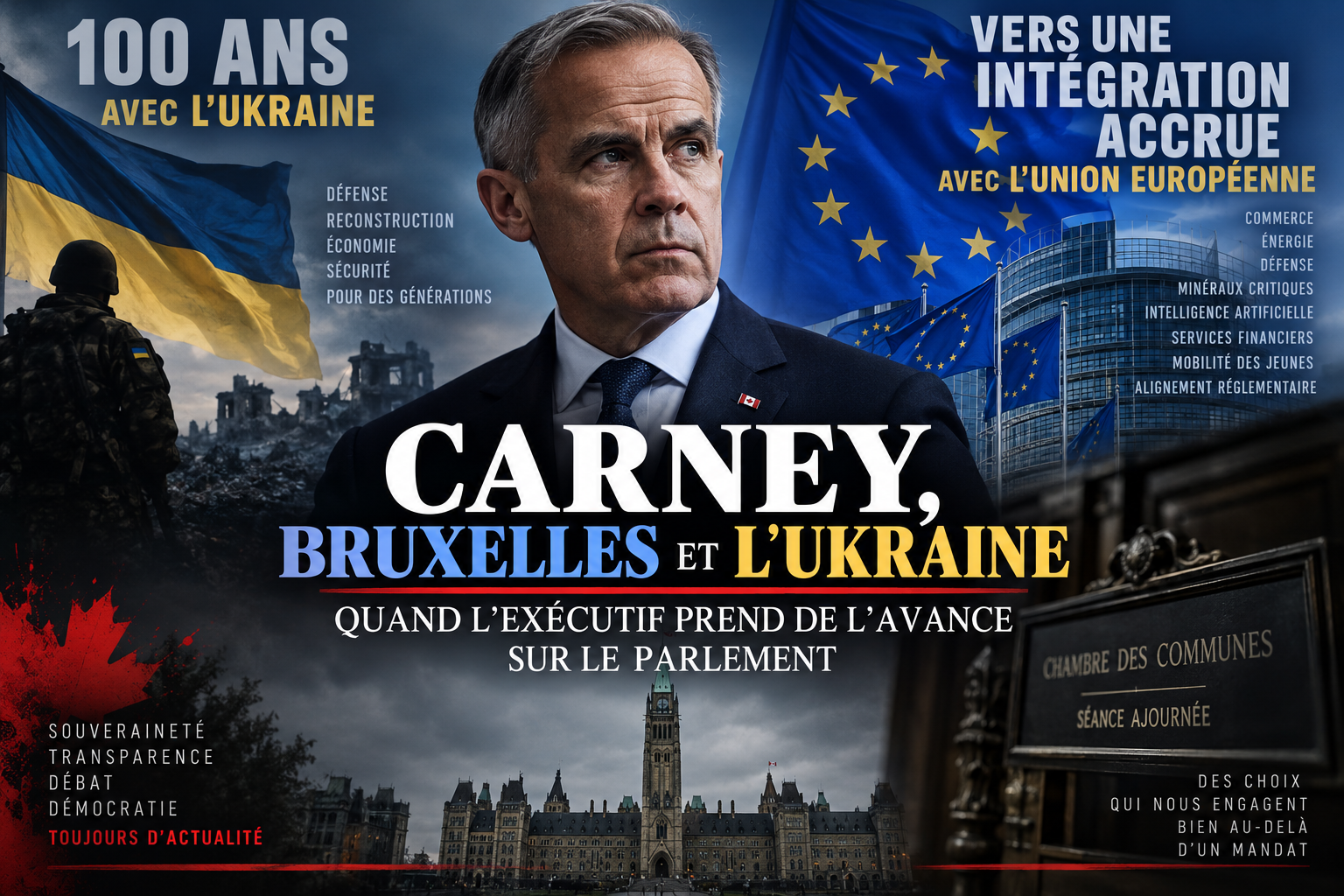
In just a few days, Mark Carney hired the Canada on two very long-term trajectories: a future 100-year partnership with Ukraine and unprecedented integration with the European Union. Both projects have merit. But when it comes to choices likely to outlast several governments, another question arises: at what point will Parliament and Canadians truly have their say?
In the space of a week, Mark Carney has taken two steps that could put Canadian foreign policy on a trajectory that will far exceed his own mandate.
On September 10, in Calgary, he signed a declaration with Volodymyr Zelenskyy aimed at establishing a Canada-Ukraine partnership for the next hundred years.
Six days later, Ursula von der Leyen proposed that Canada become the first "associate member" of the European Union. The following day, before the European Parliament, Carney welcomed this ambition and proposed a "much deeper and more integrated" Canada-EU relationship, covering areas such as defense, energy, critical minerals, artificial intelligence, payments, financial services, and digital trade.
Meanwhile, the House of Commons was not sitting.
It would be premature to claim that Carney has "handed Canada over to Brussels" or legally committed the country to Ukraine for a century.
The available facts do not allow us to say that.
But they allow us to ask a much more serious question:
How far can the Canadian executive politically commit the country to major strategic transformations before Parliament and the public know exactly what is being negotiated?
One hundred years with Ukraine
Let's start with what was actually signed.
The Canada-Ukraine declaration of September 10 is not yet the 100-year partnership agreement. Article 37 defines it as a "political expression of the common strategic intention" of the two countries.
But Article 35 is equally clear: both governments intend to conclude by December 2026 An agreement establishing a one hundred-year partnership. The declaration itself entered into force immediately upon its signature.
The legal distinction matters.
The political implications too.
The document covers defense, military-industrial cooperation, intelligence, cyber defense, the economy, reconstruction, mobility, and diplomatic coordination. A "2+2" strategic dialogue will also bring together the foreign and defense ministers of both countries.
Ottawa therefore explicitly presents this project as something intended to outlive current governments.
A century.
A lasting relationship with Ukraine can be considered to serve Canada's interests. However, some aspects of it can also be questioned.
That's not the point.
The subject is the process.
When a government plans to structure a military, economic, and diplomatic relationship for generations to come, why shouldn't Parliament be aware of the objectives, limitations, and commitments envisaged? Before that the executive branch has not already given its political word?
Then Brussels
The European case is even more interesting, because we still don't know what the proposed status would legally mean.
The "associate member" of the European Union is not currently an established legal category in the European treaties.
Carney himself did not use the title in his speech.
He did, however, state that Canada welcomed the ambition expressed by von der Leyen and proposed a new, much more integrated alliance.
And regarding the content, he was significantly less vague.
He wants to deepen cooperation in critical minerals, the defense industry, artificial intelligence, computing power, energy, space, and payment systems. He also proposes near-frictionless digital trade for non-agricultural goods and many services, greater mobility for young people, and the exploration of an integrated financial services market.
It is no longer simply the CETA with two annexes and a new photo in front of flags added.
But it is not membership in the European Union either.
We find ourselves precisely between the two.
And it is this in-between space that demands a debate.
The project did not begin this week.
Von der Leyen's spectacular proposal is not the beginning of rapprochement.
She rather publicly reveals the extent of it.
As early as June 2025, Canada and the European Union launched a new strategic partnership aimed at bringing the two groups closer together and signed a security and defence partnership.
Carney was already talking about an ever-closer partnership and better regulatory alignment.
Since then, Canada has become the first non-European country associated with the European SAFE military procurement program.
Then, a few days before von der Leyen's public announcement, the Wall Street Journal revealed that much more ambitious discussions were already underway.
So the newspaper didn't have a crystal ball.
He had sources.
Regulatory alignment is already on the table
This is probably the aspect that deserves the most attention.
Official Canada-EU documents explicitly mention a deepening of regulatory alignment.
Alignment does not mean submission.
Canada already harmonizes certain standards with its trading partners. This can reduce compliance costs, facilitate trade, and eliminate completely unnecessary duplication—an administrative specialty that no modern country seems to lack.
But there is a considerable difference between mutually recognizing certain standards and accepting a system in which the regulatory evolution of one partner ends up de facto determining the choices of the other.
We have no evidence that such a mechanism has been accepted.
We also don't know if it's being considered.
And that is precisely why the Canadian mandate deserves to be known.
Carney himself invokes sovereignty
Carney presents his rapprochement with Europe in the name of Canadian sovereignty.
His reasoning is not absurd.
In a world where trade, energy, technology, payments and supply chains can become instruments of pressure, excessive dependence on a single partner makes a country vulnerable.
His solution is what he calls "collective resilience".
Speaking before the European Parliament, Carney argued that diversifying partnerships would allow Canada to reduce the ability of a major power to dictate its choices. He also praised Europe's capacity to establish standards that are then widely adopted elsewhere.
The argument deserves to be taken seriously.
But this logically leads to a second question:
How much regulatory or institutional autonomy can be shared in order to achieve greater strategic autonomy without simply shifting dependence?
That's precisely the answer that's still missing.
In Canada, the executive branch has a great deal of latitude.
This is where the story ceases to be simply European.
In our constitutional system, the negotiation, signing and ratification of international treaties largely fall under the purview of the federal executive.
Parliament intervenes when a change in Canadian laws is necessary to implement the agreement.
Since 2008, the government has also followed a policy normally requiring treaties to be tabled in the House for 21 sitting days, accompanied by an explanatory memorandum.
The House can debate.
It can adopt a motion.
But it does not, however, have a general veto over ratification.
In other words, a government can conduct negotiations for months, conclude the process politically, create expectations among its partners and stake its international credibility before members of parliament necessarily have to vote.
Parliament retains real powers.
But it can happen relatively late in the story.
And when it happens, saying no no longer simply means refusing a proposal.
This potentially means going back on a commitment already negotiated with another government.
The difference is not insignificant.
For trade agreements, some safeguards exist.
Since 2020, Ottawa has applied more transparency to negotiations for new free trade agreements.
The government should normally inform Parliament before the formal start of negotiations, present its objectives and then provide an economic assessment.
It's a real safeguard.
But this brings us back to the question that still has no answer:
What exactly will be the legal nature of this new relationship with the European Union?
A new trade agreement?
A series of sectoral agreements?
A strategic treaty?
A political framework encompassing several separate agreements?
The detail may seem technical.
It is not.
The chosen form will partly determine which parliamentary mechanisms will need to be used.
London and Canberra do things differently
Canada is obviously not the only parliamentary system where the executive negotiates treaties.
The United Kingdom also operates according to this logic.
But since the Constitutional Reform and Governance Act 2010A treaty must normally be tabled in Parliament for 21 sitting days before ratification. If the House of Commons adopts a resolution against ratification during this period, a new 21-day period begins. The process can theoretically be repeated.
The mechanism is not perfect. In particular, the government is not obligated to provide the necessary time for a vote to take place. No treaty has yet been blocked by this procedure.
But the power exists legally.
Australia has chosen a different approach.
Major conventional measures are normally accompanied by a National Interest Analysis which sets out the treaty's obligations, its foreseeable economic, social and environmental consequences, its costs, its implementation and the consultations carried out. These are then examined by the Joint Standing Committee on Treaties.
The Australian executive branch also retains the final say.
Diplomacy therefore remains in the hands of the government.
But parliamentary oversight is more institutionalized.
The Canadian Parliament just had this discussion
And here's the detail that's hard to ignore.
On September 18, 2025, MP Mario Simard introduced Bill C-228, which aimed specifically to strengthen the prior review of treaties by Parliament.
The text reportedly called for a special examination of certain "major treaties".
The project died in its second reading on January 28, 2026.
32 votes in favor. 302 against.
The Canadian Parliament therefore had, less than eight months ago, the opportunity to strengthen its own role in the preliminary review of major international commitments.
He chose not to do it.
It is difficult, this time, to plead constitutional oversight.
Then comes the majority
In addition to this, there is a fundamental peculiarity of the Westminster system.
The executive and legislative branches are not separated as they are in the United States.
The government is formed by the parliamentary majority.
When a government has this majority and its caucus remains disciplined, it normally holds the votes necessary to maintain the confidence of the House and pass its main measures.
It is this concentration of power that gave rise to the provocative formula of "elected dictatorship".
Taken literally, it goes too far.
Canada has independent courts, a Senate, provinces with their own constitutional powers, competitive elections, a free press, and several agencies responsible for overseeing the administration.
We are not in a dictatorship.
But stating this obvious fact does not answer the real question:
How many of these checks and balances can actually stop a majority government that retains the support of its own caucus?
Guard dogs can bark
Parliamentary agents play a vital role.
They are investigating.
They document it.
They publish.
They can reveal what a government would have preferred to leave buried in a file.
But they don't govern.
They do not usually overturn a policy simply because they denounce it.
The consequences remain largely in the hands of Parliament, the courts or, ultimately, the voters.
And when a disciplined majority controls the Parliament responsible for overseeing the executive, control depends heavily on that majority's willingness to control its own government.
The guard dog can bark very loudly.
Teeth often belong to someone else.
Negotiation secret or secret about the destination?
It would be absurd to demand that all international negotiations take place live on CPAC.
A true negotiation requires initial positions, possible concessions, and sometimes sensitive information.
A government incapable of negotiating confidentially would be about as useful a diplomatic partner as a glass door on a submarine.
That's not the problem.
The important distinction is the one that separates the necessary secrecy surrounding the negotiation of destination kept secret.
Ottawa does not need to publish each of its concessions to Brussels to explain to Canadians what it refuses to concede.
The government can say whether the automatic adoption of future European standards is excluded.
It can specify whether joint institutions could obtain decision-making authority.
It can identify the provincial jurisdictions that may be affected.
It can guarantee that Canada will retain its freedom to enter into agreements with other partners.
He can explain the legal form being considered.
And he can commit to submitting any potential "associate member" status to an explicit vote by the House before its ratification, even if he is not legally obliged to do so.
These are red lines.
Not negotiation secrets.
The real problem is there
The story is not over yet:
"Carney delivers Canada to Brussels."
The facts do not support this conclusion.
But the story is certainly over:
"Nothing is happening. It's just ordinary diplomacy."
The Canadian government itself now describes the desired relationship with Europe as "much deeper and more integrated".
A few days earlier, he signed a declaration providing for the conclusion, before the end of the year, of a strategic partnership with Ukraine designed to last one hundred years.
Perhaps these two approaches will admirably serve Canada's interests.
Maybe not.
But when a government is considering commitments designed to outlive those who make them for decades, asking Canadians to know before the end of negotiations Determining what obligations, limits, and institutional mechanisms are envisaged is not an extravagant requirement.
This is the minimum one should expect from a parliamentary democracy that claims to take sovereignty seriously.
Mark Carney has the constitutional power to negotiate.
His government has considerable latitude in foreign policy.
And the Canadian system offers relatively few opportunities for Parliament to intervene before the process is already very advanced.
The question is therefore not simply what Mark Carney can legally do.
The question is what a prime minister should politically be able to do without first clearly explaining to Parliament in which direction he intends to take the country.
Because when we are talking about a hundred-year partnership with Ukraine and an entirely new form of integration with the European Union, discovering the destination once the journey has begun is a curious way to defend Canadian sovereignty.
About the Author



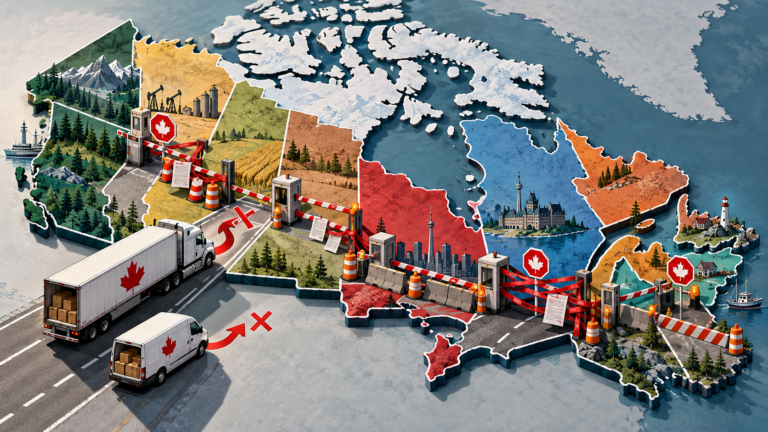

Excellent article! Several points could be raised. However, the fundamental problem with this description stems from the Canadian constitution since its inception, which has never truly functioned in practice, and the famous repatriation of 1982 brought absolutely nothing new, at least in practice. We are governed according to the norms of the British Empire, which grants all administrative powers to the executive branch. Moreover, the courts are never entirely impartial since judges are appointed by the government. On the other hand, the media are no longer the "fifth column" they once were, since they are all subsidized by the state. What about the barriers that exist between the provinces? The core of the problem will remain unresolved as long as Canada does not undertake a comprehensive reform "from coast to coast." And unfortunately, people prefer the more secure status quo, and in the West, many still revere King Charles III.
THANKS!