After eight years of "effective left-wing politics," the PCQ is starting to enter the lucrative zone.
For years, the Coalition Avenir Québec was presented as the right-wing party on the Quebec political scene.
I never really bought into that definition.
The CAQ has certainly occupied the electoral space from the right. It has recovered a good part of the former ADQ electorate. It has proposed some tax cuts, adopted more conservative positions on identity and secularism and cultivated the image of a government of managers rather than ideologues.
But occupying the space on the right and governing on the right are two different things.
After eight years in power, we no longer need to speculate about what the CAQ is. We can look at what it has done.
And two polls published this morning suddenly give this distinction considerable electoral importance.
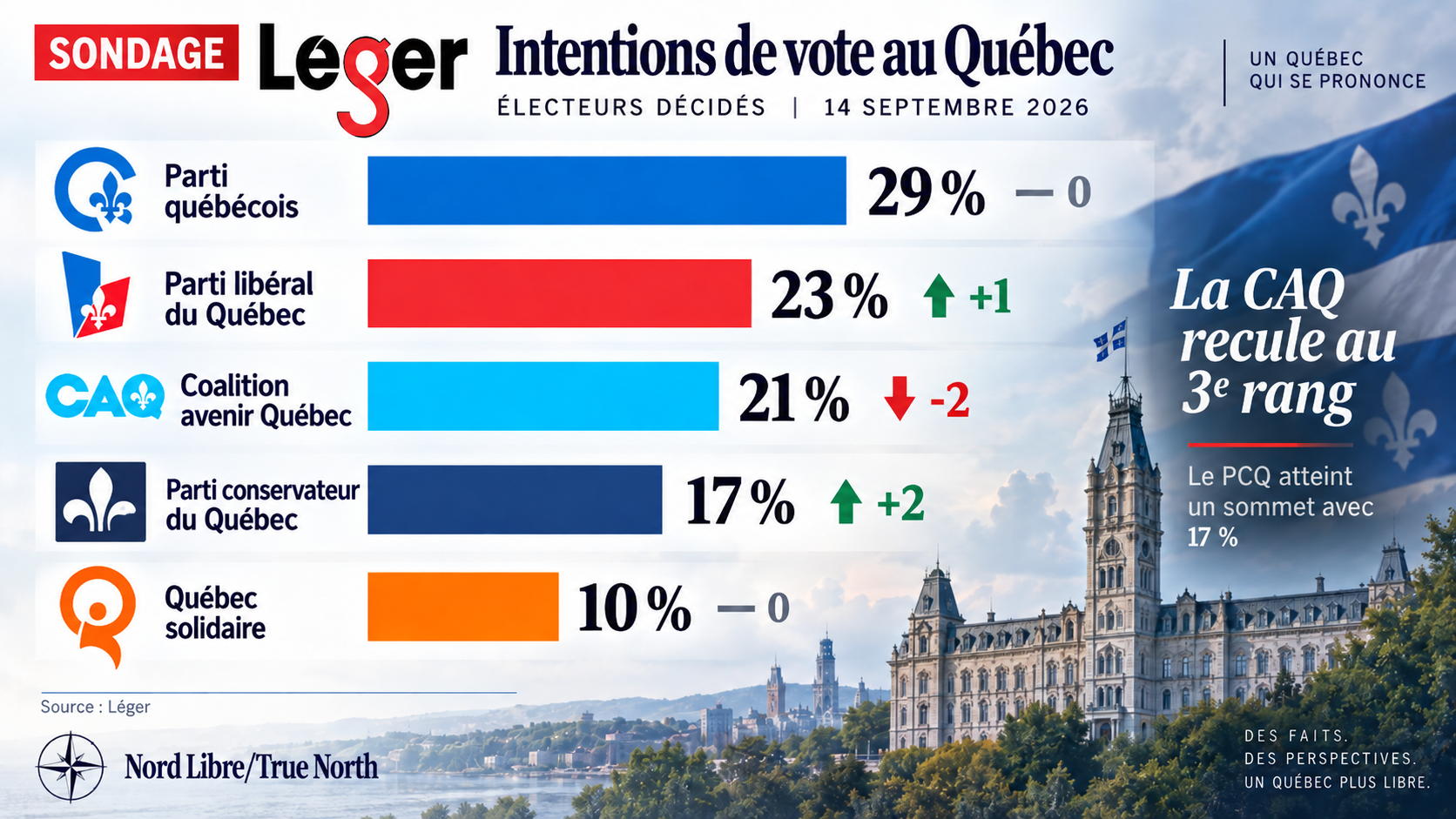
The most recent Léger poll – Le Journal – TVA places the Parti Québécois at 29%, the Liberal Party to 23%, the CAQ to 21%, the Conservative Party of Quebec to 17% and Québec solidaire to 10%.
The CAQ lost two points and slipped to third place. The PCQ gained two points and achieved its best result ever measured by Léger. The poll was conducted from September 10 to 13 among 1,013 Quebec voters.
The Synopsis survey conducted for The Press is less generous towards conservatives: PQ 28%, CAQ 24%, PLQ 22%, PCQ 14% and QS 11%But its evolution tells the same story. Since its previous poll, the CAQ has fallen by three points, the PQ remains stable, and the momentum associated with the trade war is fading. The fieldwork was also conducted from September 10 to 13, with 1,000 respondents.
Two polling firms. Two methodologies. Different figures.
But the same trend.
The Fréchette effect is losing steam.
And meanwhile, the PCQ is starting to enter a zone where its votes can finally turn into seats.
The "effective left"
François Legault, for his part, never really claimed to be a right-wing man.
When he was described in 2021 as a "conservative right-wing" politician, his response was particularly clear:
"An effective left! I have always defined myself as an effective leftist."
The expression was not new in his political vocabulary.
The idea is quite simple: maintain a generous state, but try to make it more efficient.
"Effective Left" has always seemed to me to be a particularly optimistic oxymoron, but let's leave this philosophical quarrel aside.
The real question is much more interesting:
What did the CAQ do once it came to power?
After eight years, the answer is starting to become quite clear.
A state that has not shrunk
Let's be fair.
The CAQ has actually reduced personal income tax. In the 2023 budget, the first two tax rates were reduced by 15% to 14% and 20% to 19%This is a genuine tax cut and he deserves credit for it.
But a tax cut is not enough to transform a government into an economically right-wing government.
The most revealing measure is the role of the state in the economy.
According to the Quebec's 2026-2027 budgetgovernment spending represented 24.4% of GDP in 2018-2019, the financial year in which the CAQ came to power.
They are planned to 25.6% of GDP in 2026-2027.
During the same period, the share of government revenues increased from 26.1% to 25.0% of GDP.
In other words, Quebec collects proportionally slightly less than when the CAQ came to power, but plans to spend proportionally more.
We must obviously take into account the pandemic, which has temporarily caused the public spendingThat's precisely why I'm not choosing 2020 or 2021 as a point of comparison. I'm comparing the CAQ's rise to power with its current budget.
Even so, the government anticipates that the state will occupy a larger share of the Quebec economy.
A curious way to practice economic right-wing politics.
Quebec Inc., government version
Then there is economic interventionism.
Under the CAQ, Quebec has certainly not adopted the philosophy that the government sets the rules of the game and then leaves it to entrepreneurs and investors to decide where to invest their money.
He wanted instead to become an entrepreneur, investor, banker and selector of industrial champions himself.
Northvolt.
Lion Electric.
Nemaska Lithium.
Flying Whales.
The battery sector.
These are not minor, anecdotal symbols.
In Northvolt, Quebec had spent 0 millionincluding a 270 million stake in the parent company and a 240 million guaranteed loan for the land. When the project was finally abandoned in 2025, the government acknowledged a loss of 270 million.
Government contribution to Nemaska Lithium now reaches .1 billion since 2020.
Quebec had also invested 50 million in the Lion Electric battery plant project.
And in Flying Whales, the government has multiplied its stakes, including 25 million euros in the company and 15 million euros in its Quebec subsidiary during a 2022 funding round.
These policies can be defended.
It can be argued that a small state must intervene to attract international investment, develop strategic sectors or create industrial sectors capable of competing with those of much larger countries.
That's a perfectly defensible position.
But let's call a spade a spade.
This is not economic liberalism. This is interventionist industrial policy.
In other words: the "effective left".
At least when it works.
The default right
Why then has the CAQ been identified with the right wing for so long?
Because politics is relative.
When Québec solidaire is very far to your left, the Parti québécois remains largely social-democratic and the Liberal Party has been hesitating for years between interventionism and economic liberalism, it is not very difficult to become the default "right-wing" party.
The demise of the ADQ had left a huge political vacuum.
The CAQ occupied it.
It attracted autonomist nationalists, taxpayers fed up with the old PQ-PLQ duopoly, some entrepreneurs, several more conservative voters and a lot of people who simply wanted a less dysfunctional state.
This coalition gave him two majorities.
But she never transformed the CAQ into an economic right-wing party.
She simply did the most right-wing choice among the parties likely to govern.
The difference is enormous.
Then comes the PCQ
That's why the 17% The measurement taken this morning by Léger is much more interesting than a simple gain of two points.
In the 2022 elections, the PCQ had garnered 530,786 votes, representing 12.91% of the vote, without electing a single member of parliament.
At this level, a voter could share several of Éric Duhaime's ideas while concluding that his vote was simply likely to disappear into the oddities of our voting system.
This objection is beginning to lose its force.
Even before incorporating this morning's Léger poll, QC125 projected the PCQ at 15.0% and 10 seats, with a range of 5 to 15.
Beauce-Nord and Bellechasse were already classified PCQ solidsBeauce-Sud, La Peltrie and Portneuf were Likely PCQsAnd several other ridings became close battles directly involving the Conservatives.
One detail immediately stands out when you look at this list: The vast majority of the most accessible seats in the PCQ are currently held by the CAQ.
And now here's Léger at 17%.
We are entering what I would call the paid zone.
Not because 17% is a magic number. Our voting system is far too perverse to allow for that kind of simplicity.
But because as the PCQ makes progress in regions where its vote is already concentrated, each additional point can swing several constituencies.
At 12.9% in 2022: zero MPs.
At about 15% in current projections: about ten.
At 17% in a national poll, the question is no longer really whether the PCQ can elect members of parliament.
It becomes:
How much?
This is the real danger for Christine Fréchette.
This is not a battle for "the right wing".
I would have once described the situation as a battle between the CAQ and the PCQ to see who will dominate the Quebec right.
I no longer believe that this is the right way to ask the question.
The real question is this:
Is the PCQ regaining the right-wing electorate that the CAQ had captured due to a lack of credible alternatives?
It's very different.
The PCQ does not necessarily need to convert massive numbers of PQ, Liberal or Québec solidaire supporters to continue its progress.
First, it has a much more natural base: the CAQ voters who wanted less government, less tax, less regulation and fewer subsidies to businesses, but who voted CAQ because no other right-wing party had a serious chance of winning seats.
At 10 or 12%, the argument of strategic voting could work.
At 17%, it becomes much less convincing.
And tomorrow, the debate
The timing could hardly be better.
THE TV Face-Off will take place tomorrow evening at 8 p.m., and two of its three main themes will be precisely "Economy under pressure" And "Our taxes, our services"The third will be "The future of Quebec".
Christine Fréchette will have to defend eight years of the CAQ's economic record.
Eric Duhaime will have to do exactly the opposite: convince voters that his vision of a smaller, less interventionist and less greedy state is a real alternative and not simply an opposition stance.
But the balance of power has changed.
At 12%, Duhaime could mainly denounce.
At 17%, voters are starting to ask him:
How would you govern?
Who would be the Minister of Finance?
Who would take Health?
Who would administer the state?
Who would make up the economic team?
These are much more demanding questions.
But for a party that aspires to move from protest to power, these are also exactly the questions that need to start being addressed.
We will come back to this after the debates.
The end of a monopoly
The CAQ does not suddenly become a left-wing party because the PCQ is rising in the polls.
It remains a pragmatic and nationalist coalition containing both center-right and center-left elements.
But after eight years in power, his record now makes it possible to settle a question long obscured by labels.
On the economic front, the CAQ has never really sought to fundamentally reduce the role of the state.
She instead sought to to better manage a large state, to use it as an instrument of economic development and to redistribute its resources differently.
François Legault had finally found a fairly accurate description.
The "effective left".
For eight years, this formula was able to occupy the electoral space of the Quebec right because no sufficiently powerful competitor could really take it away from them.
The two polls published this morning suggest that this era may be coming to an end.
The CAQ may not lose the Quebec right wing.
Perhaps she is simply discovering that she never truly represented it.
About the Author