
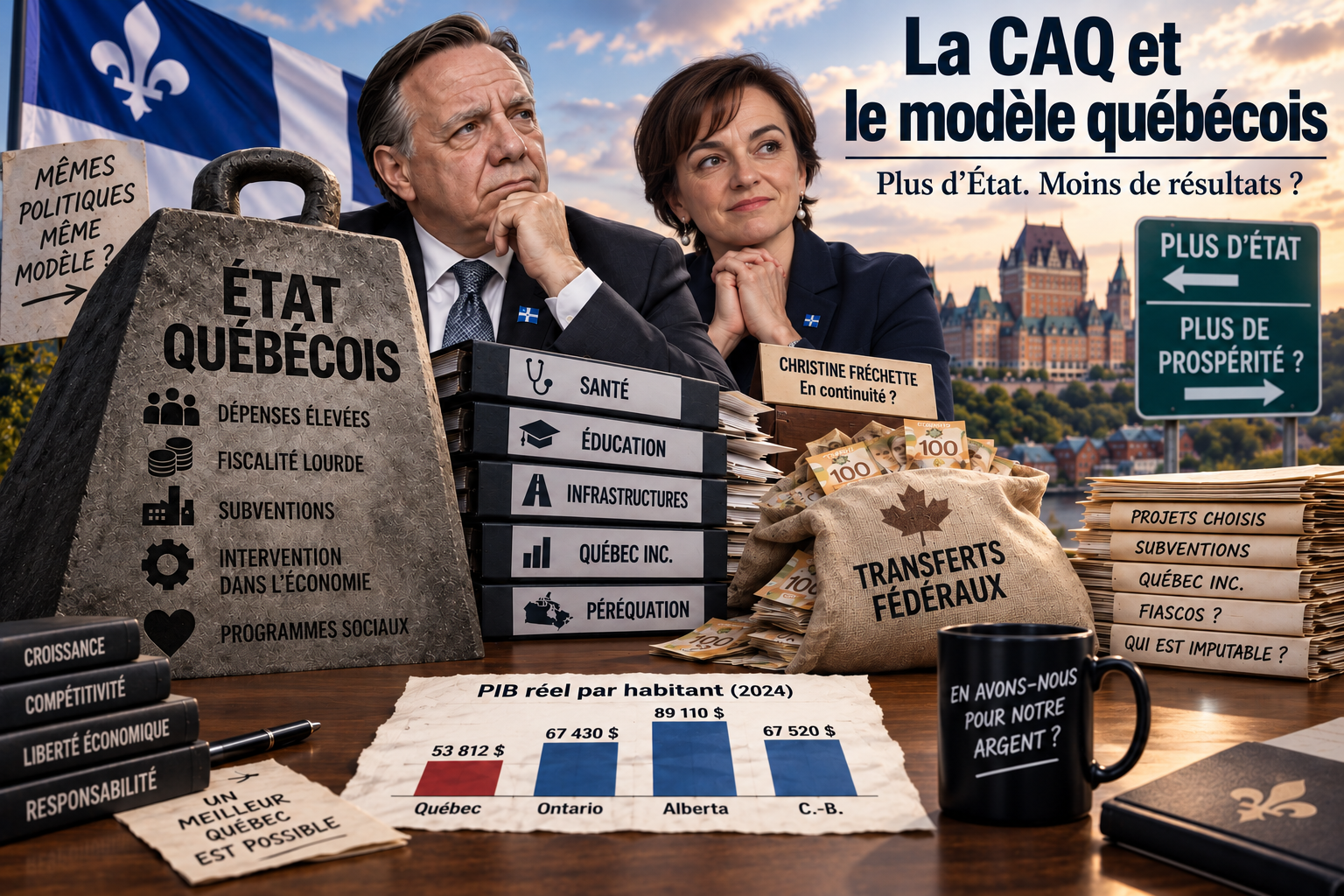
For a long time, the "Quebec model" was presented as a distinctive feature of which we should be proud.
A more present state. A taxation A heavier burden. More social programs. More intervention in the economy. A concept according to which the Quebec state should not simply provide certain essential services, but actively participate in the economic and social development of the province.
The CAQ had to change things.
When she came to power in 2018, she was neither the Liberal Party nor the Parti Québécois. François Legault promised a more pragmatic, more nationalist approach, more focused on the economy and the efficiency of the state.
Eight years later, one question arises:
Has the CAQ reformed the Quebec model or has it simply become its new manager?
To try and answer that, we did something rather unrevolutionary: we looked at the numbers.
And they tell a much more interesting story than the slogans.
An exceptionally heavy state
Let's start with the size of the state.
In 2024, provincial spending represented 30.44% of Quebec's GDP.
Let's compare.
In Ontario, they represented 18.58% of GDPIn Alberta, 15.69%In British Columbia, 21.62%.
These are not minor, marginal differences.
Quebec devotes a considerably larger share of its economy to its provincial government than the three other major provinces to which we compared it.
This does not automatically mean that Quebec is wasting its money. A population can perfectly well choose to pay more to receive more public services.
But this choice comes at a cost.
And when a government mobilizes nearly a third of the wealth produced in an economy, it becomes perfectly legitimate to ask what citizens get in return.
That's where things get less comfortable.
Plenty of resources, but always lagging behind
In 2024, Quebec's real GDP per capita reached ,811.95, in chained 2017 dollars.
Of the four provinces we compared, Quebec came in last.
And the problem doesn't end with this Canadian comparison. Quebec's level of prosperity remains low when placed within its North American economic environment.
That changes the perspective somewhat.
We are not simply discussing a wealthy province that chooses to dedicate a larger portion of its wealth to public services. We are talking about a relatively less prosperous economy in one of the richest economic areas on the planet, while still dedicating an exceptionally large share of its wealth to the state.
After decades of government intervention, high taxation, economic programs, subsidies and industrial policies, Quebec has still not caught up.
But an important nuance must be added immediately.
Because numbers don't always align with our preconceptions. That's their most irritating flaw.
Since 2000, Quebec's real GDP per capita has increased by approximately 24.5%Its relative performance has thus improved compared to several of our comparators.
However, one must be wary of the word "catch-up".
A relative improvement does not necessarily mean that Quebec is experiencing spectacular growth. It can also occur when the economies ahead of it are growing more slowly or are declining. Therefore, growth must be considered simultaneously. and the level of wealth achieved.
On this second criterion, the portrait is much less flattering.
Despite the improvement in its relative performance, Quebec remains last in our comparison group in real GDP per capita and its level of prosperity remains low in the North American context.
In other words, Quebec has reduced some of its lag.
He did not eliminate him.
It would also be quite strange to celebrate as an economic triumph the fact of getting closer to the runner in front of us when he himself slows down.
The question therefore remains entirely open:
Why does an economy that devotes so many resources to its state remain so far behind many of its North American neighbors?
And most importantly:
What do we get in return?
The price of the Quebec model
Taxation is obviously the other side of the equation.
By properly including social security contributions, the Quebec tax burden represented 21.151% of GDP in 2024, according to the measure used in our analysis.
Again, high taxation is not in itself proof of a bad model.
If Quebecers pay more taxes but receive significantly better public services in return, then the transaction can at least be defended.
That is why the real test of the Quebec model is not simply to measure how much the state collects or how much it spends.
We need to look what he produces with these resources.
A larger state should normally be able to demonstrate results proportional to the additional resources it absorbs.
However, our examination does not allow us to establish such a general superiority.
This does not mean that all Quebec services are bad. It simply means that the data does not allow us to conclude that the exceptional size of the Quebec government translates into exceptionally better results.
Because if we pay much more without clearly getting much more, the debate changes completely.
The question is no longer whether or not we like the "Quebec model".
The question becomes:
Are we getting our money's worth?
And what about Ottawa in all of this?
There is also one element that is sometimes preferred to be forgotten when praising the Quebec model: federal transfers.
In 2024-2025, Quebec received .354 billion under the Canada Health Transfer, 3.686 billion under the Canada Social Transfer and 13.316 billion through equalization.
This last figure deserves closer attention: Quebec is by far the province that receives the highest total amount of equalization payments. Canada.
For equalization alone, this represents approximately ,480 per Quebecer And 6.674% of Quebec government revenues.
However, we need to be precise about how the program works.
Alberta does not issue equalization payments to Quebec. The program is funded through general federal government revenues. Taxpayers in all provinces therefore contribute to Ottawa's funding, while only eligible provinces receive equalization payments.
Alberta, however, receives none.
The caricature would therefore be to say that "Alberta is paying for Quebec's social programs".
That's not how equalization works.
But the underlying question remains perfectly legitimate:
To what extent could Quebec maintain the same model if it had to bear the entire cost from its own fiscal capacity?
A more generous state can be politically advocated. One can prefer more public programs, more redistribution, and more public services.
But when a province presents its social model as a distinctive collective choice while being the main beneficiary in absolute value of a federal program specifically designed to compensate for fiscal capacity disparities, Equalization is necessarily part of the balance sheet.
This is not evidence against the Quebec model.
This is an expense that cannot be left out of the calculation.
The CAQ had to be different
Let's now return to François Legault.
The CAQ did not create the Quebec model.
She inherited it.
Therefore, he cannot be credited with the decisions made since the Quiet Revolution. But after eight years in power, the excuse of legacy is starting to lose its appeal.
The CAQ had a historic opportunity to question certain things.
She could have wondered whether the Quebec state really needed to continue to occupy such an important place in the economy.
She could have challenged the old policy of choosing which companies, sectors, and projects to support with taxpayers' money.
It could have sought much more aggressively to reduce the cost of government, improve its efficiency and leave more room for private investment.
In short, she could have called the model itself into question.
She didn't do it.
On the contrary, the CAQ seems to have gradually accepted its fundamental premises.
The state remains enormous.
Taxation remains heavy.
Economic intervention remains at the heart of the government's strategy.
And when an economic problem arises, the reflex often remains the same: to find a program, aid, a subsidy or a new government intervention.
The manager has changed. The model, much less so.
Québec inc., CAQ version
It is probably in its industrial policy that the CAQ's contradiction appears most clearly.
A government that wants to promote wealth creation might seek to create the best possible conditions for all Businesses: competitive taxation, reasonable regulation, available energy, efficient infrastructure and an environment conducive to investment.
The CAQ has too often preferred another approach: using the State as an investor, partner and selector of projects.
The problem is not that governments can make bad investments.
Private investors do it too.
The fundamental difference lies elsewhere:
in the consequences of the error.
When an entrepreneur invests their own money in a bad project, they bear the loss. If they make a series of bad decisions, they can lose their business.
When a business executive squanders millions of shareholders' money on a series of bad investments, his career can also suffer the consequences.
The market thus has mechanisms, imperfect but real, that penalize bad decisions.
When the state invests, the relationship between the decision and its personal financial consequences becomes much weaker.
The civil servant who recommends a bad investment doesn't personally reimburse the losses. Nor does the minister who authorizes it. And the taxpayer, who never chose to invest in the project, still ends up with the bill.
Even when a fiasco becomes politically embarrassing, individual accountability can be diluted among ministries, officials, agencies, offices and collective decisions.
Everyone was responsible.
Which, within the government apparatus, sometimes ends up meaning that No one really was.
This is where the fundamental problem of the entrepreneurial state lies.
It's not that politicians and civil servants are necessarily less intelligent than private investors. It's that they make decisions with someone else's money and that they personally bear only a small part of the financial consequences when they make a mistake.
The incentives are simply not the same.
And every dollar spent on a government-chosen company remains a dollar that cannot be left to taxpayers or companies that could have decided for themselves where to invest it.
This leads us to a fundamental premise of the Quebec model: the belief that the state can improve the allocation of capital by deciding where it should go, even though those making these decisions are largely protected from the direct financial consequences of their mistakes.
After eight years of the CAQ, this conviction has certainly not disappeared.
The CAQ did not simply administer the Quebec state.
She has fully embraced her role as an entrepreneur.
What the numbers don't show
It would be tempting to stop here and declare that the numbers prove that the Quebec model is a failure.
They don't prove it.
Our analysis does not demonstrate that a larger state automatically produces a less efficient economy.
It does not demonstrate that all of Quebec's economic difficulties are caused by its taxation or public spending.
Causality is much more difficult to establish.
And certain results from Quebec since 2000 require us to be cautious.
But this caution works both ways.
While the data does not allow critics of the Quebec model to claim that the size of the state alone explains our economic lag, it also does not allow its defenders to claim that all these additional expenses provide us with manifestly superior results.
The burden of proof should lie with those who want to justify the discrepancy.
If the Quebec government collects and spends much more than those of our main comparators, it should be able to show what this difference buys us.
The wrong question
For decades, the debate in Quebec has generally pitted two camps against each other.
On one side, those for whom the Quebec model is practically an established part of their identity.
On the other hand, there are those who would simply like to reduce the size of the state.
But that might not be the best way to frame the problem.
The real question is much simpler:
What do we get for our money?
If Quebec chooses to devote a much larger share of its wealth to the state than Ontario, Alberta or British Columbia, it should be able to demonstrate the corresponding benefits.
Not in theory.
Not in speeches.
In the results.
And if these results are not clearly superior, then it becomes perfectly reasonable to ask whether some of the resources currently controlled by Quebec would not be better used by those who produced them.
This is not an ideological issue.
It's a question of efficiency.
The CAQ, guardian of the Quebec model
This is ultimately the paradox of François Legault.
The CAQ was born promising to overcome old Quebec political divisions.
She was meant to embody change.
She had to be pragmatic.
She had to do things differently.
Eight years later, it seems above all to have demonstrated how the Quebec model is capable of absorbing those who promise to reform it.
The CAQ is no longer an external force seeking to transform this model.
She became one of its guardians.
After eight years of CAQ government, Quebec still has a considerably larger state than its main comparators. It continues to bear a significant tax burden. It remains last in our group in terms of real GDP per capita. Its level of prosperity remains low compared to other North American jurisdictions. And the state continues to play a central role in capital allocation and economic development.
This does not prove that the Quebec model is doomed.
But this amply justifies ceasing to treat it like a sacred cow.
After all, an economic model is not a national identity.
It's a tool.
And when a tool is very expensive, the least you can do is check if it does the job properly.
Article.
About the Author




1 thought on “The CAQ and the Quebec model“