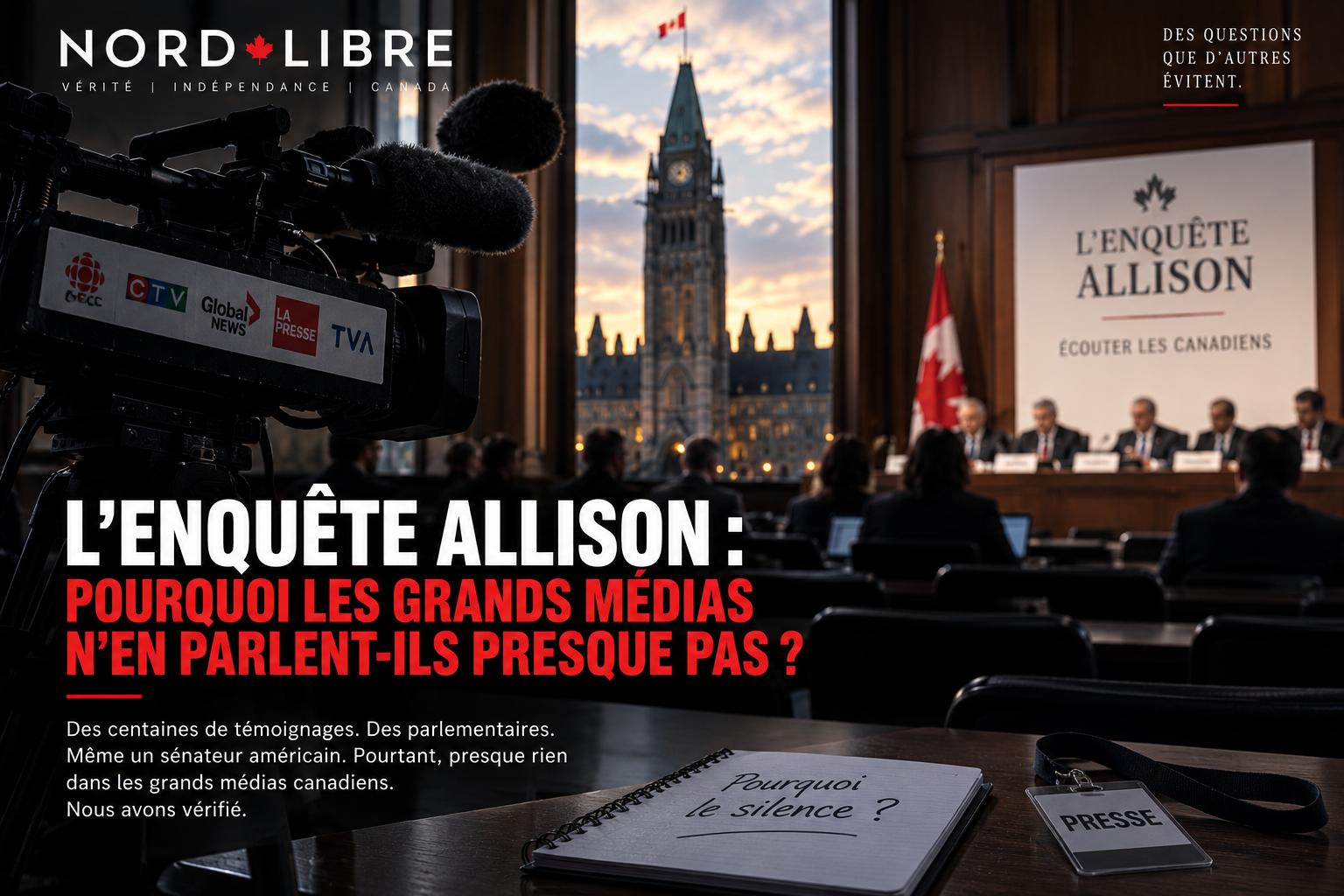
Something quite unusual is currently happening on Parliament Hill in Ottawa and, if you mainly get your information from major Canadian media outlets, there's a good chance you've never heard of it.
From September 8 to 11, dozens of Canadians testified before parliamentarians about health problems they attributed to their COVID-19 vaccination. The hearings took place in Room 415 of the Wellington Building and were even included on the parliamentary agenda. Canadian Parliamentary Press Gallery.
Doctors and other experts are also being heard and, as if that wasn't interesting enough to attract the attention of some journalists, an American senator even came to participate in the hearings.
Yet, almost nothing.
That's what piqued my curiosity.
So I wondered if this impression was real or if I was simply a victim of my own selection bias. Perhaps the major media outlets were indeed covering the event and I simply hadn't seen their reports.
There was only one way to find out.
We checked.
But first, what is the Allison Investigation?
The Allison Inquiry is an initiative chaired by federal MP Dean Allison whose main goal is to allow Canadians who claim to have suffered serious adverse effects after receiving a COVID-19 vaccine to publicly recount their experience to parliamentarians.
That's exactly how his own terms of reference define its mandate: to offer a forum for Canadians to share their experiences and also to allow certain experts to provide context.
Before going any further, let's immediately make something clear because the distinction is important: the Allison Inquiry is not a public inquiry commission created by the government, nor is it an official parliamentary committee.
It is organized in collaboration with the Covid Testimony Association and its own rules clearly define its powers and limits.
It does not have the power to subpoena witnesses, and those witnesses are not subject to the kind of adversarial process found in a court of law or certain commissions of inquiry. Third parties, in particular, do not have the right to cross-examine witnesses or present their own witnesses.
Most importantly, the Allison Inquiry's own rules state that its mandate is neither to establish facts nor to draw conclusions.
Therefore, if someone testifies that they became seriously ill after receiving a COVID-19 vaccine, this does not automatically prove that the vaccine is responsible for their illness.
After does not necessarily mean because of.
This distinction will be important for the rest of our coverage.
But it certainly does not mean that these testimonies should be ignored either.
According to the organizers, More than 1,400 Canadians have asked to testifyWhile just over fifty applications can be heard during the four days of hearings, organizers initially reported over 1,200 applications at the start of the hearings; they have since indicated that the number exceeds 1,400.
Some report serious illnesses, difficulties in obtaining a diagnosis, and problems with government mechanisms responsible for assessing and, where eligible, compensating for vaccination-related injuries.
Since April 1, 2026, the federal program has been called Vaccination Incident Assistance Program (VIA) and is administered directly by the Public Health Agency of Canada For an injury to be recognized for the purposes of the program, a medical assessment must conclude, among other things, that there is a probable causal link with a vaccine authorized by Health Canada, as well as a serious and permanent injury.
Were all these people actually harmed by a vaccine?
I don't know.
But that's precisely an excellent question that journalists could try to answer.
So, where are the journalists?
The lack of coverage could easily be explained if Dean Allison had conducted his investigation discreetly in the basement of a hotel somewhere in Ottawa.
But here's the thing: it takes place on Parliament Hill.
Its existence was no secret. As early as June 3rd, the Canadian Parliamentary Press Gallery published a notice from Dean Allison's office announcing a press conference for the following day entitled Member of Parliament to Announce Inquiry into Covid-19 Vaccine Injured Canadians.
And this week again, the four days of hearings appear on the official schedule of the Tribune, with the dates and the number of the room in the Wellington building.
The organizers also indicate that participation in the proceedings is reserved for accredited journalists, with other media outlets able to request an invitation from Dean Allison.
The explanation that the mainstream media were simply unaware of the existence of the Allison Investigation therefore becomes rather difficult to support.
I then decided to look for their cover story from the announcement of the investigation in June up to this week's hearings.
I found some in several independent media outlets. Juno News covered the investigation and the hearings, as did the Western Standard, which published a report as soon as it opened on September 8.
What about CBC/Radio-Canada, CTV, Global News, Globe and Mail, Toronto Star, National Post, La Presse, Le Devoir and TVA?
Virtually nothing substantial emerged from our research.
Let's still be careful.
I cannot say for certain that absolutely none of these media outlets ever devoted a single second or line to the Allison Investigation. Search engines are imperfect, some media archives are even more so, and it is always possible that a report has slipped through the cracks.
But while there is substantial coverage of the Allison Investigation by major Canadian media outlets, it is remarkably hard to find.
Meanwhile, several independent media outlets are monitoring the ratings.
The contrast is hard to miss.
The Canadian Press was at least aware of this.
There is also a rather interesting little detail.
During the June 4 press conference announcing the investigation, photographs of Dean Allison were taken by Sean Kilpatrick of The Canadian PressOne of these photographs accompanies the report published the same day by Epoch Times and clearly bears the credit The Canadian Press/Sean Kilpatrick.
A photographer from the agency was therefore present.
However, we found no substantial Canadian Press news reports devoted to the Allison Investigation.
Note that this does not mean The Canadian Press had prepared a story before mysteriously deciding to bury it. An agency can perfectly well send a photographer to cover an event without necessarily publishing a news report.
But claiming she was unaware of the investigation becomes quite difficult when her own photographer was in the room.
Apparently, the event was interesting enough to be photographed, but not necessarily interesting enough to be recounted.
Even one US senator is not enough
On September 8, the U.S. senator from Wisconsin Ron Johnson participated in the hearings.
Johnson is not simply a senator passing through. He currently chairs the Permanent Subcommittee on Investigations from the US Senate, as directly confirmed by the committee's official website.
He has been interested for several years in the policies adopted during the pandemic and, in 2026 alone, his subcommittee held hearings and conducted various inquiries regarding the monitoring of the safety of COVID-19 vaccines.
Perhaps you think Ron Johnson is right.
Perhaps you think he's talking nonsense.
Again, that's not really the point.
An American senator coming to Ottawa to participate in hearings before Canadian parliamentarians on such a controversial subject possesses in itself a certain journalistic value.
And covering an event does not necessarily mean approving what is said there.
A journalist can listen to the testimonies and then verify them. They can consult Health Canada, interview epidemiologists, compare the claims with Canadian pharmacovigilance data, examine the operation of the Immunisation Adverse Events Assistance Program and compare the studies cited by experts with other available research.
He might even discover that some testimonies are based on a misinterpretation of the facts.
That would be perfectly legitimate.
That's precisely what I expect from a journalist.
But to verify what is being said at the Allison Inquiry, one would have to start by taking an interest in it.
So why the silence?
Good question.
I don't have the answer.
And I refuse to simply invent one because it would confirm my own prejudices.
Perhaps the major newsrooms feel that the Allison Inquiry does not deserve much attention because it is not an official parliamentary commission.
It's possible.
Perhaps they feel that the adverse effects of COVID-19 vaccines have already been sufficiently covered.
That's also possible.
Perhaps they fear that by covering these testimonies, they are giving a platform to certain scientifically dubious claims.
Still possible.
Or perhaps there is a completely different explanation.
I don't know.
But I also know what the facts we have do not allow us to assert.
They do not allow us to conclude that there is an organized media blackout aimed at concealing vaccine-related injuries. To claim such a thing without evidence would be precisely the kind of intellectual shortcut we regularly criticize others for.
And it would be all the more pointless since there is already a much simpler question to ask:
Why is a four-day event bringing together dozens of Canadians, parliamentarians, and even a U.S. senator on Parliament Hill receiving so little attention from the major Canadian media outlets?
I think that's an excellent question.
Since no one seems very interested, let's go see for ourselves.
We therefore decided to follow the Allison Investigation.
But I'm going to establish the rules of the game immediately because this issue is polarized enough as it is.
I will not assume that the witnesses are right.
Nor will I assume that they are wrong.
When a person claims to have suffered an injury caused by a vaccine, we will distinguish the temporal association from medical causality.
When a claim can be compared to Health Canada data, we will look at the data.
When a witness speaks about the Immunization-Related Incident Assistance Program, we will examine how the program works and its results.
When an expert cites a scientific study, we will read the study rather than simply relying on what he claims it demonstrates.
And when a claim does not stand up to scrutiny, we will say so.
Even if it confirms what some of us would like to believe.
Conversely, if we discover that certain legitimate concerns have been minimized or ignored, we will also say so.
Even if it's inconvenient.
The COVID-19 pandemic has already given us enough certainties proclaimed with far too much confidence by all sides.
So we're going to try something a little more old-fashioned.
Examine the evidence.
Over the next few days, we will revisit the most important testimonies from the Allison Investigation and attempt to determine what they actually demonstrate.
Perhaps we will discover that some stories have been exaggerated.
Perhaps we will discover that some issues have long deserved much more attention.
I suspect we'll find a bit of both.
But before deciding what we should think of these testimonies, we should at least start by listening to them.
About the Author