
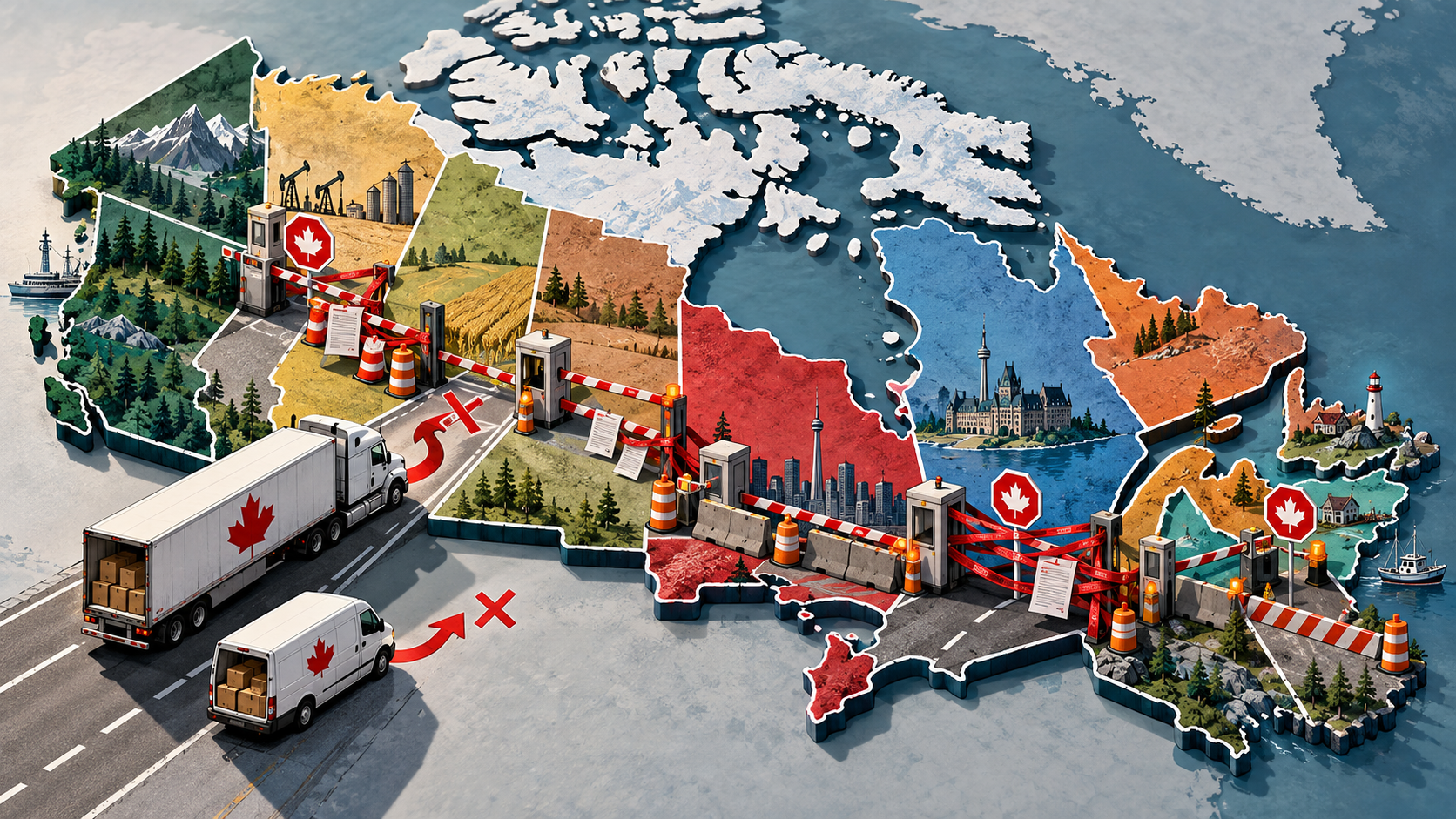
THE Canada likes to present itself as an economy open to the world.
We negotiate trade agreements with the United States, Europe, and Asia. We send delegations abroad. We are constantly seeking new markets for our businesses.
Meanwhile, a Canadian company may still discover that it is more complicated to sell certain products or services in the neighbouring province than abroad.
This is one of the strangest paradoxes of the Canadian federation:
We have spent decades negotiating free trade with the rest of the world without succeeding in creating a true common market at home.
And yet, the issue is far from marginal.
More than 0 billion worth of goods and services already cross provincial and territorial borders each year, representing nearly one-fifth of Canada’s GDP. Source: Government of Canada.
There has been real progress since 2025.
But the work is far from finished.
One country, multiple markets
Barriers to interprovincial trade take all sorts of forms.
Different permits. Incompatible technical standards. Additional approvals. Specific administrative requirements. Restrictions on certain products. Imperfect recognition of professional qualifications.
A company that already meets the rules of a province may therefore have to restart part of the process simply because it wants to sell elsewhere in Canada.
The federal government itself classifies these obstacles into several categories, including technical, administrative and prohibitive barriers.
What is new is that governments finally seem to be tackling the problem more seriously.
There has been real progress
Ottawa has adopted the Free Trade and Labor Mobility in Canada Act, effective from 1 January 2026.
Its principle is interesting: when a product or service meets a provincial or territorial requirement comparable to a federal requirement, Ottawa can recognize this compliance rather than imposing a second layer of federal regulation. A similar logic applies to certain federal professional licenses. Source: Government of Canada.
But this law does not eliminate provincial rules.
It therefore only solves part of the problem. Ottawa itself makes this clear: businesses and workers must still comply with applicable provincial and territorial requirements.
And it is precisely from the provinces that perhaps the most interesting approach appears.
Quebec has adopted a law based on a principle of Automatic unilateral recognition for Canadian products. Generally, it aims to reduce regulatory duplication when a product is already compliant elsewhere in Canada, while allowing Quebec to retain certain exceptions. Source: Government of Quebec.
The idea can be summed up in almost one sentence:
If a product is sufficiently compliant to be legally sold in another Canadian province, why would the entire regulatory process automatically have to be restarted in Quebec?
This is where the case becomes much more interesting than a simple matter of forms.
Recognize rather than standardize
When governments talk about reducing trade barriers, the natural reflex is often to seek harmonization.
Same standard everywhere.
Same procedure.
Same form.
Same certification.
Same definition.
And, with a bit of bureaucratic perseverance, probably the same committee responsible for determining the regulatory color of the paperclip.
But there is another approach:
mutual recognition.
Quebec can maintain its standards.
Alberta can keep its own.
British Columbia as well.
But each jurisdiction can accept that a product that legally meets the rules of another province does not automatically have to start the entire obstacle course again.
Therefore, regulatory diversity is not necessarily eliminated.
We reduce most duplication.
And this distinction is fundamental.
Federalism does not require uniformity.
There are good reasons why all Canadian standards will never be perfectly identical.
The climate is different.
The economies differ.
Political preferences too.
Certain health, safety, or environmental requirements may reasonably vary from province to province.
Mutual recognition therefore necessarily includes exceptions.
The real debate is more about the initial presumption.
Should a product from another province be required to demonstrate its acceptability a second time?
Or should we consider that it can circulate unless a specific and sufficiently important reason justifies an exception?
This second approach completely changes the logic.
It helps to preserve something precious in a federation: the possibility of having different rules without turning each difference into a trade obstacle.
Competition between jurisdictions
This is probably the most interesting aspect of mutual recognition.
It helps to reduce barriers to trade without necessarily standardizing provincial policies.
A province can adopt lighter regulations.
Another option is to choose more demanding rules.
The results then become comparable.
Companies can see the costs associated with the different models.
Citizens too.
Regulations that work well in one province can be imitated elsewhere.
Costly regulations that fail to deliver the promised benefits become harder to defend when neighbouring provinces achieve better results in other ways.
In other words, the provinces can serve as institutional laboratories.
Standardization reduces this experimentation.
Mutual recognition can preserve it while facilitating exchanges.
The same problem arises with workers
The reasoning does not stop at the products.
A skilled worker obviously does not lose their skills when they cross a provincial border.
However, permits, certifications and recognition procedures can still complicate professional mobility.
Governments are currently working to modernize labor mobility rules, including with a focus on faster processing of applications and digital systems for verifying qualifications. Source: Government of Canada.
Again, the right question is not to eliminate all professional requirements.
It's simpler:
If a person has already demonstrated their competence in a Canadian province, under what circumstances is it really necessary to ask them to demonstrate it a second time?
Recognition can become the norm.
Duplication is the exception.
The almost comical case of alcohol
If an illustration of the Canadian problem were needed, alcohol would be hard to beat.
By 2025, several provinces and territories had committed to further facilitating direct sales between producers and consumers in other provinces.
The goal was to move the project forward by 2026.
On May 29, Ottawa was still urging the provinces and territories to finish the job. Source: Government of Canada.
Some jurisdictions have made progress, but the mere fact that we still need special agreements to allow a Canadian to directly purchase a bottle produced by another Canadian pretty much sums up the absurdity.
Yet we call it a national market.
Somewhere, Adam Smith must be looking for the appropriate tab on the Service Canada website.
Why do these barriers persist?
This is where public choice theory becomes useful.
A trade barrier does not usually distribute its effects equally.
Let's take a rule that protects a few dozen companies from outside competition.
For each of them, this protection can be worth a lot of money.
They therefore have every interest in defending the rule.
Let's now suppose that this same protection costs several million consumers a few dollars a year.
The total cost can be considerable.
But for each individual consumer, it remains relatively low.
Who will have the most incentive to phone the minister, hire lobbyists, prepare briefs, and participate in consultations?
Probably not the consumer who just paid three dollars more for their product.
Here is the classic mechanism:
Profits are concentrated, while costs are dispersed.
Those who take advantage of a barrier know exactly what they risk losing.
Those who collectively pay the price often don't even know it exists.
This is how ineffective regulations can survive for a very long time without requiring either conspiracy or corruption.
Incentives are sufficient.
Protectionism sometimes simply changes its guise.
A customs tariff is easily recognizable.
It is visible.
A government imposes 10%, 20% or 25% on a foreign product.
A regulatory barrier is much more discreet.
An additional certification.
A different license.
A repeated inspection.
An administrative delay.
A local rule that prevents a product that is legal elsewhere from being sold.
Obviously, not all of these mechanisms are identical, and some regulatory differences pursue legitimate objectives.
But when a rule unnecessarily creates a barrier to entry, its effects can resemble those of protectionism:
Less competition, less choice and higher costs.
Protectionism simply becomes harder to recognize when it wears a regulation tie rather than a customs officer's uniform.
The American context changes everything
The question becomes even more relevant since the return of trade tensions with the United States.
Ottawa explicitly cites the need to reduce Canadian dependence on the American market to justify some of its domestic trade reforms. Source: Government of Canada.
Seeking new opportunities in Europe or Asia makes perfect sense.
But there is already a market of tens of millions of consumers right here that Canadian companies should be able to access more easily.
In 2026, governments will continue their work on the mutual recognition of services, professional mobility, construction materials, prefabricated housing, certain health and safety requirements, and food trade. An agreement in principle on model legislation for mutual recognition is also among the objectives announced for the end of the year. Source: Government of Canada.
This represents real progress.
But governments should be judged on results rather than on the number of intergovernmental meetings.
Canada has a remarkable ability to transform an economic reality into an administrative process long enough for a child to be born, complete their studies and start a business before the final protocol is signed.
A true Canadian market
The real choice is not necessarily between thirteen different regulations and a single national regulation.
There is a third possibility.
Different jurisdictions may retain their own rules while also recognizing more of those of others.
This approach does not eliminate disagreements or legitimate exceptions.
Rather, it changes the presumption:
Traffic returns to normal; the obstacle must be justified.
This is an important distinction.
It allows for more domestic trade without necessarily requiring more centralisation.
Canada can continue to seek new clients in Europe, Asia and elsewhere.
Alright.
But before seeking new markets on the other side of the world, there is a much closer anomaly to address.
Canada could start by becoming a market for itself.
About the Author





Mom is often right! How many times have I said that? We don't need AI to know that. Just a little observation of what's happening in this world.
https://ici.radio- Canada .ca/nouvelle/2289163/tarifs-hydro-quebec-centres-donnees
Happy Friday, world!
Une excellente analyse « journalistique » et non historique. Une barrière entre le Quebec et les autres provinces? Règle no. 1: Le Canada est bilingue donc toutes les provinces sauf le Quebec qui est français. Toutes province ou compagnie qui veut engager des affaires au Quebec doit le faire en français, pas seulement le parler mais sur les étiquettes de produits, sur la publicité, etc., etc. M. Trump peut bien affirmer qu’il n’a rien contre le français, dans les sens que si tu veux parler français chez-vous… good! Mais, si tu veux faire affaire avec moi, nous le ferons en anglais et je ne traduirai pas mes étiquettes de produits en français. Comme M. Trump l’exprime si bien: « Les USA n’ont pas besoin du Canada ». C’est toujours le plus fort qui l’emporte. Et qu’a révélé la dernière élection? Le français est encore plus exigeant. Je le répète, le Quebec est une poule pas de tête.