
In the first article of this series, "Health economics: the market cannot be abolished"We have established something that should be commonplace, but which sometimes seems like heresy when discussing health:
The laws of economics continue to operate at the hospital door.
Doctors, nurses, operating rooms, imaging equipment, medications and, above all, time are scarce resources.
When their price is not paid directly by the patient, their cost does not disappear. It is simply transferred elsewhere.
So we have to ration in one way or another.
Through prices. Through taxes. Through insurance. Through waiting lists. Through administrative criteria. Or, most often, through a combination of several of these mechanisms.
This is where Singapore becomes particularly interesting.
Not because this small city-state has discovered a magic formula to make healthcare free.
There are none.
But because its health system was built explicitly taking into account the economic problems we have just described.
Neither medical socialism nor libertarian paradise
Singapore is sometimes presented by market advocates as a demonstration that a largely private system can deliver excellent results.
On the left, the general response is that the Singaporean state intervenes massively in its healthcare system.
Both observations contain a grain of truth.
And both become misleading when pushed too far.
Singapore is certainly not a little libertarian paradise disguised as a hospital.
The state heavily regulates the sector, operates a significant portion of the hospital network, subsidizes care, mandates compulsory medical savings and basic insurance, and maintains a safety net for people unable to pay their bills.
But Singapore also rejects a principle to which we are accustomed in Canada : the idea that the patient should be almost completely isolated from the cost of the service he/she consumes.
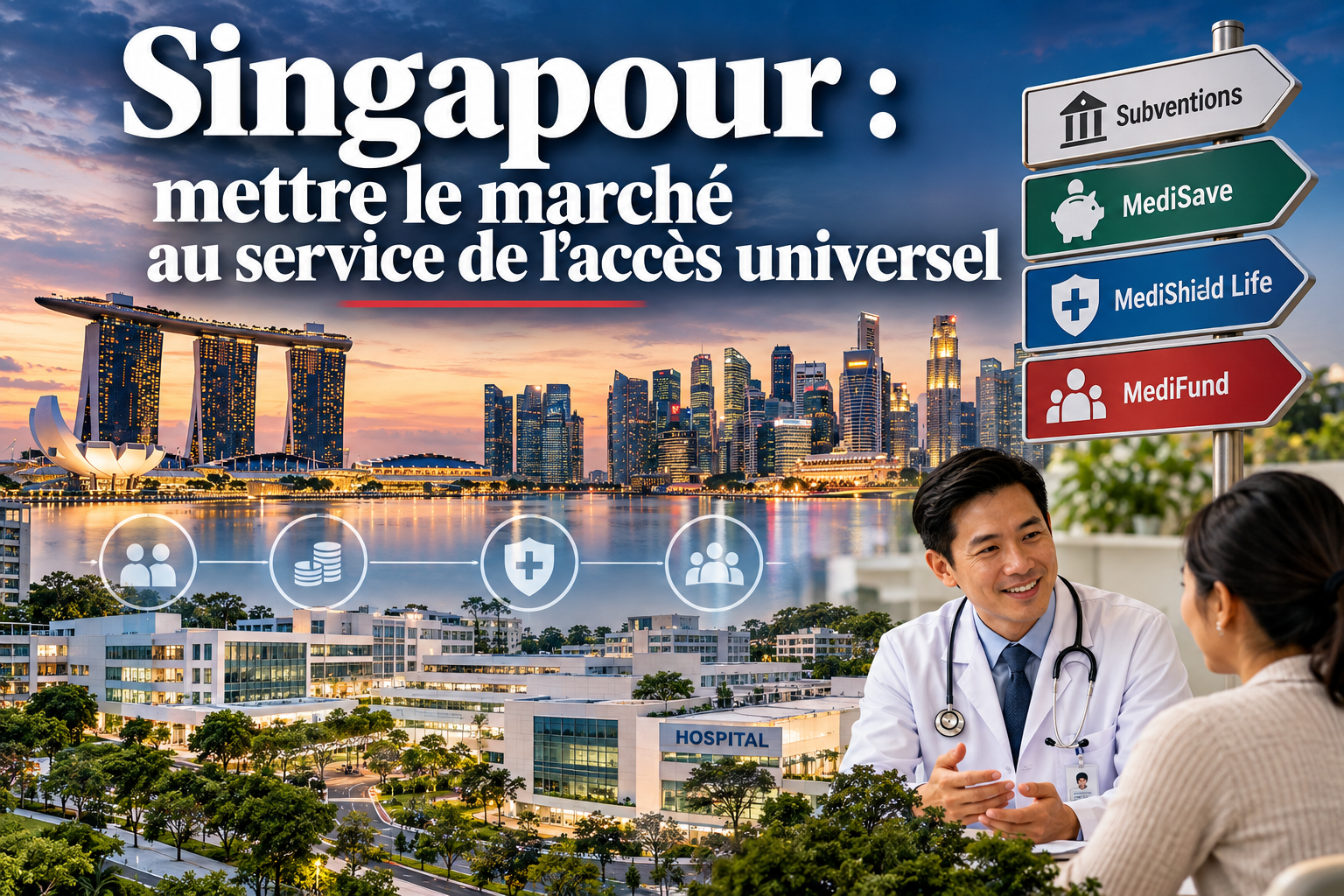
Its financing architecture is called S+3M :
- government subsidies;
- MediSave;
- MediShield Life;
- MediFund.
These four elements are designed to work together. The Singapore Ministry of Health explicitly states that no one should be deprived of appropriate care due to their inability to pay.
Therefore, it is neither a purely free market, nor a fully socialized medicine.
It's a hybrid system.
And that's precisely what makes it interesting.
First floor: subsidies
The state begins by subsidizing a significant portion of healthcare costs.
Subsidies directly reduce patients' bills in the public network, their size varying according to income and the category of care used.
This should already dampen the enthusiasm of anyone who would like to present Singapore as a stateless medical market.
But unlike the Quebec model, the subsidy does not generally seek to completely eliminate the link between the patient and the cost of the service.
It reduces the bill.
She does not claim that the invoice does not exist.
This difference seems subtle.
It is fundamental.
Second floor: MediSave
MediSave is probably the part of the system that is most unfamiliar to a Quebecer.
This is a mandatory national medical savings scheme.
Part of the income is accumulated in an account that can be used to pay for certain hospitalizations, day surgeries, outpatient treatments, age-related needs, and insurance premiums. The funds can also be used, under certain conditions, for certain family members. The Ministry of Health describes how it works here..
Why is this important?
Because with MediSave, the money spent on care remains identifiable as a resource belonging to the patient.
It doesn't necessarily mean taking out your credit card in front of the surgeon.
But the money spent today will no longer be available tomorrow.
The expenditure therefore retains a visible opportunity cost.
This is not a minor accounting detail.
It's an incentive.
Third floor: MediShield Life
Personal savings can finance current expenses and some predictable expenses.
It becomes much less adequate when cancer, major surgery, or prolonged hospitalization results in a huge bill.
That's where MediShield Life.
This is a basic health insurance covering Singaporean citizens and permanent residents throughout their lives, including when they have pre-existing health conditions.
It is particularly aimed at large expenditures.
But it's not designed to pay every last dollar of every bill.
A portion remains the patient's responsibility, through deductibles, co-payments, MediSave, or direct payment. The ministry also details the claim and cost-sharing mechanism.
And this choice is not accidental.
This brings us directly back to incentives.
The four ways to spend
Milton Friedman had proposed a remarkably simple way of thinking about this problem.
He distinguished four ways of spending money.
You can spend your money for yourself.
You then monitor both the price and what you get.
You can spend your money for someone else.
You always keep an eye on the cost, since it's your money, but you know less about the preferences of the person receiving it.
You can spend someone else's money for yourself.
You then have a great deal of interest in what you get, but considerably less in what it costs.
Finally, you can spend someone else's money for someone else.
In the latter case, both disciplines are weakened: the one who decides on the expenditure does not directly bear either its cost or the personal consequences of his choice.
It obviously does not follow that all public spending is useless or wasted.
That would be a caricature.
The lesson is much simpler:
Behaviors change depending on who pays and who receives the benefit.
And health is almost an ideal laboratory for observing this phenomenon.
Moral hazard is not an abstract theory
When a patient knows that every extra dollar will be paid for entirely by a third party, their incentive to consider the cost diminishes.
And the problem doesn't just come from the patient.
The supplier also knows that price is less likely to influence the decision.
This results in what economists call the moral hazard.
Singapore now has a particularly interesting demonstration of the phenomenon.
Some policyholders had purchased additional coverage that reduced their financial contribution to almost zero.
According to the Singapore Ministry of Healththese insured persons were 1.4 times more likely to file a claim and the average amount of their claims was also 1.4 times higher than that of people without this additional protection.
The government has therefore tightened the rules applicable to new supplementary insurance in order to preserve a deductible and a minimum contribution from the patient.
It is no longer just an economic theory.
The Singaporean system observed the actual behavior of patients and providers when financial participation became almost non-existent.
Then he corrected the architecture.
When someone else pays virtually the entire bill, behavior changes.
One might prefer that human beings function differently.
Unfortunately, human nature has this bad habit of not reading our political programs.
Fourth floor: MediFund
The essential question obviously remains.
What do we do with someone who cannot pay?
That is the role of MediFund.
MediFund provides a safety net for citizens who still have difficulty paying after subsidies, insurance, and MediSave. The aid depends of the financial, medical and social situation of the patient and his family.
The system therefore tries to maintain two principles simultaneously:
the patient should normally retain some awareness of the cost;
but
Financial incapacity should not become a barrier to receiving necessary care.
This is a much more interesting distinction than our eternal opposition between "free" and "private".
Competition also affects supply
So far, we have mostly talked about the patient's behavior.
But incentives also exist on the other side of the counter.
When patients can compare prices, choose between several providers and retain a financial interest in that decision, the producers themselves come under pressure.
They must justify their prices.
They need to control their costs.
They must convince the patient that a price difference actually corresponds to a difference in value.
This is the ordinary competitive mechanism.
And Singapore is explicitly trying to preserve it.
Clinics must make information about potential costs readily available and clearly display their fees. The ministry presented this transparency as a way to help patients make informed decisions and allow market forces to operate more efficiently.
It seems almost trivial.
However, in order for a patient to compare two providers, they first need to know what they charge.
A market where prices are hidden resembles a treasure hunt with a stethoscope more than a market.
This is not specific to health
In almost every market, when several producers want to attract the same consumers, when their offers are comparable and the customer can easily go elsewhere, they experience pressure on their prices and quality.
A supplier who asks for more usually has to offer something in return.
Better quality.
Better service.
More convenience.
A specialized expertise.
Otherwise, he risks losing the customer.
Health obviously has certain particular characteristics.
An unconscious patient being transported by ambulance is not shopping around for the price of their cardiac intervention.
The information asymmetry between doctor and patient is real.
And several treatments involve an uncertainty that does not exist when you buy a television.
But that does not mean that competition ceases to function everywhere in the system.
For non-urgent consultations, diagnoses, certain planned interventions, medications, insurance and many other services, choice and comparison can exert a very real economic discipline.
Private does not automatically mean more expensive
This leads us to an extremely common objection:
"If it's private, it's going to cost more."
This reasoning confuses the supplier's ownership with the rules by which it operates.
A private clinic benefiting from a guaranteed contract, without real competition, without price transparency and without risk of losing its clientele can perfectly well become very expensive.
Conversely, many suppliers forced to display their prices and compete to attract patients are under constant pressure to offer more value.
The relevant question is therefore not simply:
"Is it public or private?"
But rather:
"What incentives govern the supplier?"
Should it attract the patient?
Could he lose it to a competitor?
Are its prices visible?
Does its funding depend on the number of patients it treats?
Does he retain the gains when he improves his productivity?
A private supplier protected from all competition can behave like a monopoly.
A public institution subject to patient choice and funded according to its activity may, on the contrary, be subject to pressures very similar to those of a market.
We will return to this distinction later in this series.
Many hospitals in a very small area
Singapore, however, benefits from an advantage that Quebec will never be able to replicate: its geography.
In 2025, the city-state had 20 acute care hospitalsincluding 11 public, 8 private, and one private non-profit institution. It also had 10 community hospitals, according to the ministry statistics.
All of this is concentrated in a tiny area.
This density greatly facilitates patient choice, equipment sharing, specialization, and competition between institutions.
Quebec is facing an almost opposite situation.
We need to maintain services across a vast territory, including in areas where the population is too small to support several competing establishments.
A Montreal patient may sometimes have a choice between several providers.
A patient from the North Shore or Abitibi will obviously not always have this possibility.
This constitutes a real limitation when trying to draw lessons from Singapore.
A remarkably efficient use of resources
Singapore also does not achieve its results by having an extraordinary number of doctors.
In 2024, it had approximately 2.9 doctors per 1,000 inhabitants And 8.3 nurses and midwives per 1,000 inhabitantsaccording to the official data on health workforce.
These figures should be compared with caution between countries.
And geography once again gives Singapore a huge advantage.
The same ratio of doctors per capita does not have the same meaning when the entire population is concentrated in a city-state as when it is necessary to provide services over a territory like that of Quebec.
But observation remains important.
You cannot evaluate a health system solely by counting its doctors, nurses, or beds.
You should also ask:
How much care does he produce with the resources he has available?
In other words, we need to talk about productivity.
Organizational.
Use of equipment.
Regarding the division of labor.
And, once again, incentives.
What Singapore does not prove
However, one must resist temptation.
Singapore does not prove that it would be enough to simply copy its system in Quebec.
That would be exactly the kind of simplistic reasoning we are trying to avoid.
Singapore is a city-state.
Its population is dense.
His government plays a considerable role.
Medical savings are mandatory.
Insurance is heavily regulated.
The subsidies are important.
Public institutions occupy a major place.
And its cultural, demographic, and institutional realities are different from ours.
In other words, it would be as ridiculous to transform Singapore into a libertarian paradise as it would be to claim that it is simply a traditional public system given exotic names.
What's interesting is not its label.
That's its architecture.
Copy the principles, not the system
Quebec cannot copy Singapore.
And he probably shouldn't try.
But the institutions are local.
Economic principles, however, are much more universal.
Rarity remains rarity.
Opportunity cost remains opportunity cost.
Behaviors change when someone else pays.
A visible price conveys more information than a hidden price.
A provider who risks losing their patients faces different incentives than a provider who is assured of retaining them.
Insurance against catastrophic expenses does not produce exactly the same behaviors as insurance that pays down to the last dollar.
And a social safety net for those who cannot pay does not necessarily require making the cost invisible to everyone.
This is what Singapore can teach us.
Not how to build exactly the same hospitals.
Not how to replicate MediSave down to the last dollar.
It's not about how to import its geography, its institutions, or its political culture.
But how do we build a system that recognizes that behaviors respond to incentives?
The real lesson of Singapore
Singapore is finally trying to solve a problem that we have too often presented as unsolvable.
How can we preserve access to healthcare without removing all the economic constraints that allow the system to function?
His response combines several mechanisms.
The state provides subsidies.
The citizen saves.
Insurance protects against major risks.
The patient retains a certain financial contribution.
The prices are visible.
Suppliers can compete with each other.
And a safety net comes into play when everything else is no longer sufficient.
The result is not a free market for healthcare.
It would be absurd to claim that.
It's more of an attempt to to put certain market mechanisms at the service of a goal of universal access.
And that brings us right back to the first article in this series.
We can ignore the laws of economics.
They cannot be repealed.
The question, therefore, is not whether a health system will ration its resources.
He will do it.
The real question is:
How will he ration them, what incentives will he create, and what consequences will those incentives have?
In the next article, we will bring this question back home.
Because in Quebec, one of the most important characteristics of hospital funding produces a rather strange result:
In many circumstances, an additional patient is not an additional source of income for the institution treating them. They are primarily an additional expense.
And when you build an entire system around this reality, it should perhaps not be so surprising that you end up with queues.
About the Author





Very interesting! If only we, collectively, had the clarity and courage to admit that we had given birth to a white elephant ruining our health and public finances to the point of making us champions of medical assistance in dying and not of healthcare for all.
Thank you for your comment. With the PCQ now represented in the National Assembly, I am hopeful that one day we can improve things.