
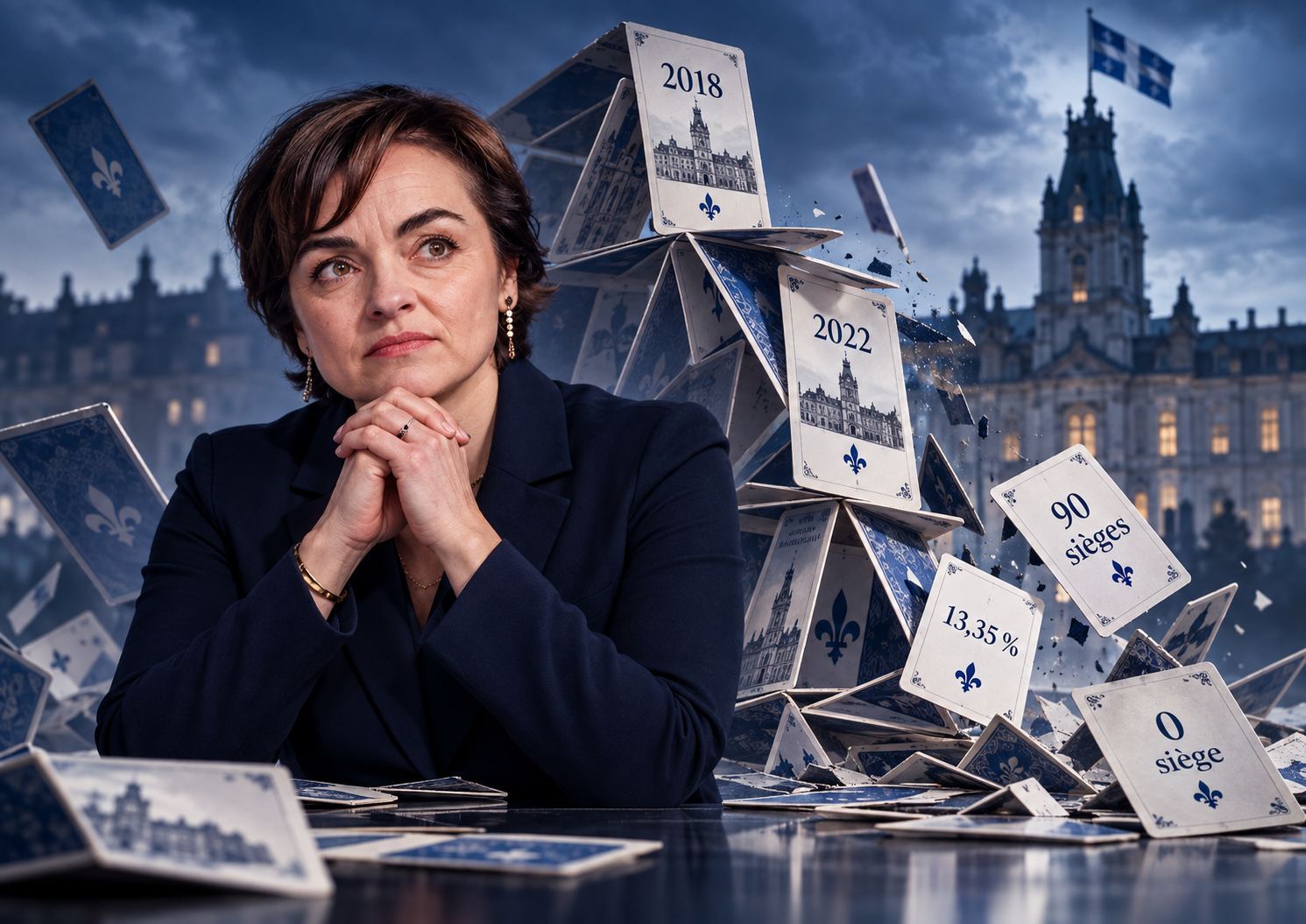
There are electoral defeats. There are drubbings. And then there is what happened to the Coalition Avenir Québec on October 5, 2026.
Four years earlier, François Legault won 90 seats with 40.98% of the vote. The CAQ seemed to have succeeded where several parties had come before: to permanently replace the old duel between Liberals and Parti Québécois with a coalition broad enough to dominate Quebec. Quebec Elections
By Monday evening, not a single member of parliament remained.
Zero.
The CAQ garnered 571,520 votes, or 13.35% of the valid ballots cast. More than half a million Quebecers voted for it, but it did not win in any of the 127 ridings. The PQ won 59, the PLQ 40, the PCQ 19, and Québec solidaire nine. 2026 Election Results
Christine Fréchette herself was defeated in Trois-Rivières. The following day, she announced her resignation as leader of the CAQ. Global News
This is no longer just a simple defeat.
It's a parliamentary mass extinction.
A catastrophe of this magnitude, however, defies simple explanations. One can always find an ill-advised statement here, a poor strategy there, a botched debate, or a badly managed controversy. But no single campaign incident can explain how a party can plummet from nearly 41% to 13% of the vote and from 90 seats to none in just four years.
The campaign probably did not destroy the CAQ.
She revealed how far her electoral coalition had already disintegrated.
A coalition that had a reason to exist
To understand the fall, we must first remember why the CAQ had succeeded.
François Legault had found a huge political space between the old parties.
One could be a nationalist without being a sovereigntist.
It was possible to demand more autonomy for Quebec without adhering to the traditional federalism of the Liberal Party.
One could wish for more efficient management of the state without necessarily adhering to a resolutely right-wing economic program.
This ambiguity was not a weakness.
She was a formidable electoral machine.
It allowed the CAQ to bring together former PQ members, nationalists tired of the referendum question, centre-right voters, former Francophone Liberals and a significant portion of the regions and suburbs.
Everyone could see something similar to themselves in the CAQ.
But its dominance also rested on a factor external to the party: the relative weakness of its opponents.
In 2018, the CAQ faced a worn-out Liberal government and a fragmented opposition. It won 74 seats with 37.42% of the vote. The PLQ fell to 31 seats; the PQ and Québec solidaire each obtained only ten. The PCQ garnered a mere 1.46% of the vote. Quebec Elections, 2018
In 2022, the situation was even more favorable for him.
The PLQ obtained 14.37%. Québec solidaire, 15.43%. The PQ, 14.61%. The PCQ, 12.91%.
Four opposition parties shared the electorate while the CAQ, the only party capable of uniting several political families at once, garnered 40.98% and 90 seats. Quebec Elections, 2022
The CAQ was strong.
But it also thrived in an environment where no adversary was able to take over the different components of its coalition separately.
By 2026, both of these conditions had disappeared simultaneously.
The orphans of the Quebec right
To understand the shift of part of the electorate towards the Conservative Party, we need to go back much further than this campaign.
For a very long time, right-wing voters in Quebec were political orphans.
After the collapse of the Union Nationale, no major party established itself permanently in this space. The Liberal Party could occasionally adopt more market-oriented policies, but it remained a broad federalist coalition rather than a party structured around a coherent right-wing philosophy.
Then came the Democratic Action of Quebec.
For a portion of this electorate, the ADQ finally represented something different.
Mario Dumont spoke about competition, the role of the private sector in healthcare, reducing the size of the state, and reforms that traditional parties addressed much more timidly.
The ADQ also proposed a different way of thinking about the national question.
Dumont refused to be pigeonholed into the labels of sovereigntist and federalist. He advocated for autonomy: remaining within the Canadian federation while gaining more powers for Quebec. As early as 2006, he explicitly stated: "We are an autonomist party." National Assembly of Quebec
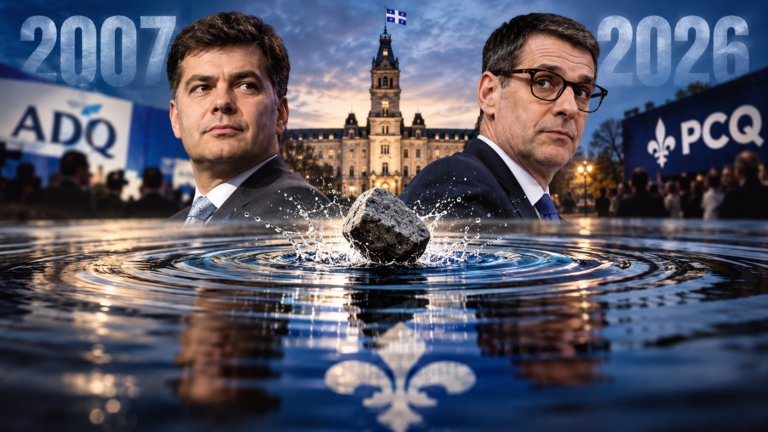
In 2007, the ADQ obtained 41 seats and became the official opposition. National Assembly of Quebec
It was also at this time that his contradictions became much more visible.
The party was less ideologically homogeneous than its image might suggest. Some proposals were frankly market-oriented; others much less so. Mario Dumont's shifting positions even became a political weapon so frequently used that Jean Charest ended up calling him "Quebec's national weather vane" in the National Assembly.
On October 16, 2007, President Michel Bissonnet demanded the withdrawal of the word and declared it anti-parliamentary. Journal of the debates
A parliamentarian with access to a dictionary could probably have tried "virevent".
The presidency would probably have ended up banning it as well.
Beyond the folklore, the problem was real.
Becoming the official opposition forced the ADQ to clarify its position daily. Inconsistencies that were tolerable in a protest party became more difficult to conceal in a party aspiring to government.
One year later, the 41 deputies had dwindled to just seven.
I must make a personal aside here.
The ADQ's flip-flopping exasperated me. I wasn't even a party member. Yet, when the merger project with the Coalition Avenir Québec came about, I campaigned against it.
What I wanted to preserve was not necessarily the ADQ as it existed.
It was the very existence of a distinct vehicle for a Quebec right wing that had already spent decades in political limbo.
The merger was finally confirmed in February 2012. National Assembly of Quebec
Some right-wing voters nevertheless hoped that the ADQ transplant would pull the CAQ towards the centre-right.
They were soon to be disillusioned.
The CAQ had absorbed the ADQ.
It had not become the ADQ.
The first crack was already visible in 2022
For many right-wing voters, François Legault's first term had already been enough to cause disappointment.
The significant reduction in government size they hoped for never materialized. Major structural reforms did not become the government's defining characteristic. On the economic front, the CAQ would even gradually adopt a highly interventionist approach.
In 2022, part of this electorate turned to Éric Duhaime.
The PCQ obtained 530,786 votes.
12.91%.
Zero members of parliament.
That was his main problem.
One might prefer his program, but voting Conservative could still resemble a protest gesture without parliamentary representation.
This weakness indirectly protected the CAQ.
By 2026, this barrier had largely disappeared.
The PCQ had four additional years to build its organization, develop its program, recruit candidates and convince enough voters that a Conservative vote could now produce a caucus.
The question posed to the right-wing voter was no longer the same.
In 2022:
Am I dissatisfied enough with the CAQ to vote for a party that still risks electing no one?
In 2026:
Why would I still vote for the CAQ if the party that better matches my ideas can now win?
The PCQ ultimately obtained 20.67% of the votes and 19 seats.
The right wing had found a house.
And it was no longer the CAQ.
Autonomism also had competition
The loss of this electorate was compounded by a second problem.
Nor did the CAQ have a monopoly on autonomy.
François Legault did not invent this third way. Mario Dumont had already placed it at the heart of the ADQ's identity long before the creation of the CAQ.
Legault then took up this idea and made it an essential component of his nationalism.
For a while, the formula worked admirably.
For the former PQ voter, still a nationalist but who no longer wanted to relive the constitutional battles of the 1980s and 1990s, the CAQ was almost the ideal political product.
Quebec could be defended without preparing a referendum.
We could demand more powers from Ottawa without having to immediately decide whether Quebec should leave the Canada.
And most importantly, one could vote nationalist without voting PQ.
But by 2026, the CAQ was now being attacked from both sides of this position.
The Parti québécois could argue that autonomism had reached its limits and that it was necessary to go further.
The Conservative Party could respond in exactly the opposite way: autonomy remained the right path, but it had to be accompanied by a smaller state and a different economic orientation.
The PCQ had, in fact, devoted a significant portion of its 2023 congress to autonomy and still made it an explicit focus of its 2026 platform. This continuity with the ADQ legacy was already visible in our comparison with 2007. Conservative Party of Quebec
The CAQ was therefore no longer simply stuck between federalists and sovereigntists.
She now had a competitor who was challenging her on her own constitutional ground.
And after eight years in power, she could no longer defend autonomy as a promise.
She had to defend it as a record of achievement.
The PQ is taking back the nationalist ground
While the PCQ was attacking the CAQ on its right, the Parti Québécois was carrying out a spectacular reconstruction.
In 2022, the PQ obtained only 14.61% of the votes and three members of parliament.
Four years later: 28.02% and 59 seats.
However, it would be too simplistic to explain this result by a resurgence of sovereignism.
Support for independence remains around 30%, far from a majority. Reuters
Clearly, not all Parti Québécois voters are buying exactly the same product.
For convinced sovereigntists, Paul St-Pierre Plamondon obviously offers a PQ that fully embraces its raison d'être.
For other nationalists, the appeal may also lie in language, immigration, national affirmation, or simply in the feeling that a party clearly knows what it stands for.
And that's where the contrast with the CAQ became dangerous.
One can either approve of or dislike the PSPP program.
But it's difficult not to know what he wants.
The CAQ, on the contrary, had to explain why it remained necessary between a PQ that had once again become vigorously nationalist, a PCQ that was also claiming autonomy, and a PLQ that was clearly occupying the federalist ground. This divide between independence and reform of the model was already at the heart of our previous analysis.
In 2018, the CAQ could be everything that the other parties no longer were.
By 2026, the other parties had regained an identity.
When the State wanted to create the market
In addition to this ideological disintegration, there is the economic situation.
The CAQ came to power with the image of a party of managers.
François Legault was a former businessman. Pierre Fitzgibbon also came from the private sector. The implicit message was powerful: these people knew how the economy works.
But their concept of economic development would prove to be much more interventionist than some centre-right voters had anticipated.
The government did not simply want to create a business-friendly environment.
He wanted to identify sectors of the future, choose strategic sectors, attract certain companies, invest directly in them and sometimes stimulate demand for their products.
Quebec was becoming, in a way, an industrial laboratory.
The state was funding producers.
He was subsidizing buyers.
He set regulatory objectives.
He was building the infrastructure.
This strategy has a logic. A new technology can suffer from a start-up problem: volumes are low because prices are high, prices remain high because volumes are low, and infrastructure is slow to appear because there are few users.
The state may decide to try to break this cycle.
The problem arises when demand is not only slow to materialize.
What happens if consumers simply don't want the product in the anticipated quantities?
An electric school bus may be eligible for government targets and subsidies.
An electric snowmobile has yet to find someone who actually wants to buy it.
In 2021, Quebec granted a million loan to Moteurs Taiga to industrialize, among other things, the manufacturing of snowmobiles, electric personal watercraft and battery packs. Government of Quebec
Technology can be fascinating.
This does not guarantee the market.
The product must be suitable.
That its price be acceptable.
That its autonomy, weight and performance meet the needs.
And above all, that there are enough customers to support profitable industrial production.
Northvolt and the model limit
Northvolt became the ultimate symbol of this philosophy.
The battery industry was based on the assumption that rapid electrification of transportation would generate immense North American demand for batteries and their components.
Quebec wanted to get ahead.
But getting ahead also means taking the risk of being right too soon.
Or simply wrong.
On September 2, 2025, Christine Fréchette, then Minister of the Economy, herself announced the end of funding for the Northvolt project in Quebec.
The government had spent 0 million: a guaranteed loan of 0 million for the land and 0 million invested in the parent company. This 0 million was considered lost. Government of Quebec
Northvolt is obviously not enough to invalidate all industrial policy.
But this case raises a fundamental question when a government claims to be able to identify the technologies and businesses of tomorrow:
How does he know that consumers will want tomorrow what he is funding today?
An entrepreneur who makes a mistake quickly receives a warning.
His products are not selling.
He loses his capital.
It modifies its product, reduces its production, or disappears.
When the state intervenes simultaneously on the producer, consumer, regulatory, and infrastructure sides, this signal becomes more difficult to read.
For right-wing voters already disappointed at never having seen the economic turnaround they hoped for, the frustration was obvious.
But the problem went far beyond the right wing.
A voter can perfectly well accept government intervention while demanding that the bets be good.
However, the CAQ had built part of its identity around managerial competence. The question of the size of the state and its effects on prosperity had also been examined in greater detail in our analysis of the Armey curve in Quebec.
When a government claims it knows how to pick winners, its successes become its arguments.
His failures also become his own.
The center rejoins the PLQ
While the right wing found the PCQ and the nationalists found the PQ, a third piece of the coalition became vulnerable.
The federalist center.
In 2022, the Liberal Party had practically hit rock bottom: 14.37% of the vote and 21 seats.
In 2026, it rises to 24.22% and 40 seats.
Post-election studies will be needed to determine precisely how many of these voters came from the CAQ.
But the political environment had clearly changed.
The PLQ was once again easy to define.
He occupied the federalist ground.
The CAQ, for its part, was specifically created to overcome the old sovereignist-federalist opposition.
This ambiguity had been a strength when the referendum question seemed to belong to the past.
It became more difficult to defend when the PQ spoke openly again about sovereignty.
This is the fundamental problem with the catch-all coalition.
During its best years, everyone could imagine that the part of the CAQ they preferred constituted its true nature.
Then one must govern.
After eight years, voters no longer need to imagine.
They have a balance sheet.
The house of cards
This is where the fundamental difference between 2022 and 2026 appears.
In 2022, the PCQ had voters, but no members of parliament.
The PQ had three.
The PLQ experienced its worst historical result in the popular vote.
The opposition was fragmented.
By 2026, the PCQ had become strong enough to elect 19 members of parliament.
The PQ had once again become the main vehicle of sovereignist nationalism.
The PLQ was once again clearly occupying the federalist space.
Even Québec solidaire maintained its geographic concentrations.
The political vacuum that the CAQ had taken advantage of no longer existed.
In retrospect, his domination therefore resembles less a fortress than a remarkably well-constructed house of cards.
As long as the opposition remained weak, fragmented or disorganized, the structure held.
The CAQ was able to keep right-wing voters, nationalists, autonomists, centrists and moderate federalists under one roof because no opponent was strong enough to attract them separately.
By 2026, the wind had changed.
The PCQ was taking over part of the right wing.
The PQ was regaining the nationalist ground.
The PLQ was regaining its federalist function.
Not all the cards had changed.
But what held them together had disappeared.
The CAQ had not only lost its coalition.
She had lost the luxury of facing a disorganized opposition.
And when the wind of opposition finally regained its strength, the house of cards collapsed.
Christine Fréchette: changing without being able to break
It is in this context that Christine Fréchette takes over the leadership of the government.
His mission contained a contradiction from the outset.
She had to convince Quebecers that the CAQ had changed.
But also that the previous eight years had not been a mistake.
She had to distinguish herself from François Legault without disavowing him.
She was expected to embody renewal while defending the record of a government in which she herself had participated.
Each promise of change naturally prompted a question:
Why haven't you done it already?
And each defense of the record served as a reminder that it belonged precisely to the government that a significant portion of voters wanted to turn the page on.
She was too much of a CAQ supporter to fully embody the break.
But new enough that it's impossible to personally take ownership of the entire past record.
Strange place to run a campaign.
The Carney Temptation
The CAQ strategy, however, had an extremely appealing precedent.
A year earlier, Mark Carney had accomplished at the federal level something very similar to what Christine Fréchette dreamed of in Quebec.
Taking the helm of a worn-out party after nearly ten years in government.
To present oneself as a new beginning.
And shift the focus from the ballot box to an external threat: Donald Trump.
For Carney, it had worked.
The Liberals won 167 seats in April 2025 after appearing doomed just months earlier. Justin Trudeau's resignation, American tariffs, and Trump's comments about the "51st state" had profoundly altered the electoral dynamics. Reuters
But the similarities quickly ended.
Carney had never been a minister under Trudeau, nor had he ever held any elected political office, before becoming prime minister. This distance from an unpopular government was part of his advantage. Reuters
Fréchette did not have that luxury.
There was also a difference in curriculum vitae.
Carney had led the Bank of Canada from 2008 to 2013 before taking the helm at the Bank of England. His career thus allowed him to present his experience in managing international economic crises as a direct response to the tariff threat. Bank of Canada
Fréchette also possessed relevant experience in international trade and economics.
But the political history was different.
Carney could say:
I have already dealt with crises of this nature.
Fréchette had to demonstrate:
My government will know how to protect the Quebec economy from the shock.
And that's precisely where his record came back to haunt him.
Trump didn't make people forget the record. He reminded them of it.
It would be unfair to claim that Quebec was powerless in the face of American tariffs.
Ottawa is negotiating directly with Washington, but the Quebec government has levers to help affected businesses, promote market diversification, support investment and mitigate the impact on employment.
Fréchette could therefore reasonably propose a division of tasks:
Ottawa will negotiate with Trump. I will protect the Quebec economy from the consequences.
The problem was that this proposal relied entirely on trust in the government's economic management.
And there was Northvolt coming back into the room.
With Lion.
Taiga.
The Blue Basket.
The battery sector.
The more Christine Fréchette wanted to turn the election into a test of economic competence, the more she indirectly forced voters to evaluate the economic competence of the CAQ.
Carney could use Trump to distance himself from Trudeau.
Fréchette risked using Trump to remind people of his own record.
The strategy was similar.
The conditions were not.
A campaign unable to pick up the pieces
The trade war ultimately never managed to overshadow all other concerns.
There was always health.
The cost of living.
Immigration.
The economy.
The national question.
And above all, the wear and tear of a government that has been in power for eight years.
It would therefore be too easy to conclude that Christine Fréchette simply ran a bad campaign. Our campaign review already showed that several of the decisive dynamics predated the last few weeks by a considerable margin.
She was trying to solve in a few weeks a problem that had been eight years in the making.
No debate could spontaneously bring back the right-wing voters who had left for the PCQ.
No slogan could erase the bad industrial bets.
No press conference could restore the CAQ's monopoly on nationalism.
And no new leader could simultaneously embody change and fully defend the government she was replacing.
The campaign did not cause the collapse.
She failed to stop him.
And our voting system would take care of the rest.
13% of the vote, zero seats
There is one last irony in this story.
In 2022, the Conservative Party obtained 12.91% of the vote.
530,786 voters.
Zero members of parliament.
Four years later, the CAQ is hitting virtually the same wall.
13.35%.
571,520 voters.
Zero members of parliament.
The mechanism is the same.
Quebec does not elect its Assembly in proportion to the provincial vote.
It organizes 127 separate local elections.
So you can receive more than half a million votes and lose everywhere.
Conservative voters existed in 2022.
They were simply too spread out to produce enough first-place finishes.
In 2026, the CAQ discovers the same arithmetic.
His voters have not disappeared.
They are simply no longer numerous enough in the same place.
In some ridings, the PQ is ahead.
In others, the PCQ.
Elsewhere, the PLQ.
Added together across Quebec, the CAQ votes still represent more than one in eight voters.
Added up constituency by constituency, they do not produce a winner.
The CAQ has not disappeared from the Quebec electorate.
It has disappeared from first place.
And in our voting system, it's the only position that pays.
The mirror of 2022
The comparison with PCQ is almost perfect mathematically.
2022: PCQ, 12.91%, zero seats.
2026: CAQ, 13.35%, zero seats.
Politically, however, the stories are opposite.
In 2022, the PCQ was a growing party that had not yet managed to convert its popular vote into local victories.
In 2026, the CAQ experienced the opposite phenomenon.
She had possessed those concentrations.
She had a huge number of them.
Four years earlier, they had produced 90 members of parliament.
Then they collapsed simultaneously.
That is why "parliamentary mass extinction" describes the phenomenon quite well.
The CAQ was not starting from scratch when it tried to enter the National Assembly.
It started with 90 seats.
She had ministers.
Well-known members of parliament.
Local organizations.
Constituencies held for several elections.
A political apparatus built over more than a decade.
And despite all this, no local parliamentary population survived.
Depending on one's point of view, there is even a certain poetic justice in this result.
In 2022, several observers were surprised that a party could collect nearly 13% of the votes without obtaining any representation.
Four years later, the CAQ is hitting virtually the same wall.
This can be seen as a mechanical consequence of the majority voting system.
Or a particularly well-crafted historical irony.
The electoral system did not cause the defeat
However, we must resist drawing too easy a conclusion.
The voting method did not cause the CAQ to fall from 40.98% to 13.35%.
This part belongs to the political sphere.
To right-wing voters who switched to the PCQ.
To the nationalists who have returned to the PQ.
To the federalists who have returned to the PLQ.
To the wear and tear of power.
In economic terms.
To industrial bets.
To a third way that no longer had the same monopoly.
To the reconstruction of the opposition.
And to a campaign unable to put all these pieces back together.
The majority vote then takes place.
He takes this massive loss of support and amplifies it until he produces the spectacular image we see before us:
90 seats become zero.
The system did not create the collapse.
He gave it its final form.
A place in history
Quebec had already experienced extraordinary debacles.
In 2007, the ADQ had 41 members elected. A year later, it only had seven.
At the federal level, the Progressive Conservatives had gone from 169 seats in 1988 to only two in 1993.
And there is an even closer Canadian precedent: in New Brunswick, Richard Hatfield's Progressive Conservatives were completely eliminated in 1987 despite a still substantial popular vote.
But the CAQ has just combined two phenomena rarely observed simultaneously: a massive drop in the popular vote and a complete parliamentary elimination.
It's not just one government that has lost.
It's practically an entire parliamentary infrastructure that disappeared in one evening.
And now?
That is why the result of October 5 cannot be summed up as a bad campaign.
The CAQ had built its success by bringing together under one roof several electorates that did not necessarily share the same vision of Quebec.
For a time, this coalition had a reason to exist.
And above all, she was facing opponents who were too weak or too fragmented to pick up the pieces.
Then the conditions changed.
The right wing has found the PCQ.
Part of the nationalists have rejoined the PQ.
Federalism has found its way back to the PLQ.
Autonomism itself no longer belonged exclusively to the CAQ.
Meanwhile, the image of the managerial party was damaged by several of its major economic bets.
Christine Fréchette attempted to rebuild a common reason to stay, notably by using the American threat and presenting herself as a new beginning.
But it simultaneously inherited the brand, the record, and the contradictions of the previous government.
In the end, there wasn't enough glue left.
For eight years, the house of cards had held.
Then the wind picked up.
On October 5th, it collapsed.
And our electoral system accomplished the rest with its usual delicacy.
The CAQ still has an organization, activists, and over half a million voters. An automatic demise would therefore be far too simplistic a conclusion.
But rebuilding will be far more difficult than changing leaders.
The problem is that the political spaces that allowed the birth and rise of the CAQ are now occupied.
To rebuild the castle, it will not be enough to simply put the cards back in the same order.
A decision will need to be made regarding which cards to keep.
The question left by this election is therefore perhaps not how the CAQ managed to lose 90 seats in four years.
It is more fundamental.
Without François Legault, without the political vacuum that gave rise to him, and with his former voters now having other homes, what does the CAQ want to be?
And most importantly:
Why should anyone still vote for her?
As I write these last lines, a certain song is playing in my head. Many will recognize it.
About the Author



Excellente analyse, à laquelle j’aimerais ajouter mon grain de sel :
Ce sont les débats qui m’ont poussé à me pencher sur THE programme du PCQ. Éric Duhaime a été THE seul à proposer une refonte réelle du réseau de la santé au lieu de simplement « patcher » THE système. Sa formule frappait juste : THE véritable joyau, c’est la carte d’assurance maladie, pas THE monopole d’État. Recourir au privé quand les coûts sont moindres ou que les délais explosent est une solution de bon sens qui aurait dû être adoptée depuis des décennies.
La déconfiture de la CAQ me réjouit particulièrement. C’est THE juste retour des choses après avoir renié leur promesse de réformer THE mode de scrutin.