
With just hours to go before the election, Éric Duhaime is not in a position to become premier. He could, however, be the one who has most profoundly disrupted the dynamics of this final stretch of the campaign.
For several weeks, the election seemed to boil down to one question: Would the Parti Québécois form a majority or minority government?
Then the Conservative Party of Quebec started to rise.
Recent polls suggest the PCQ is polling at around 20%. Such a convergence, of course, doesn't guarantee the same result at the ballot box. Converting voting intentions into seats is yet another perilous exercise.
But this surge is enough to raise a question that would have seemed much less relevant at the beginning of the campaign:
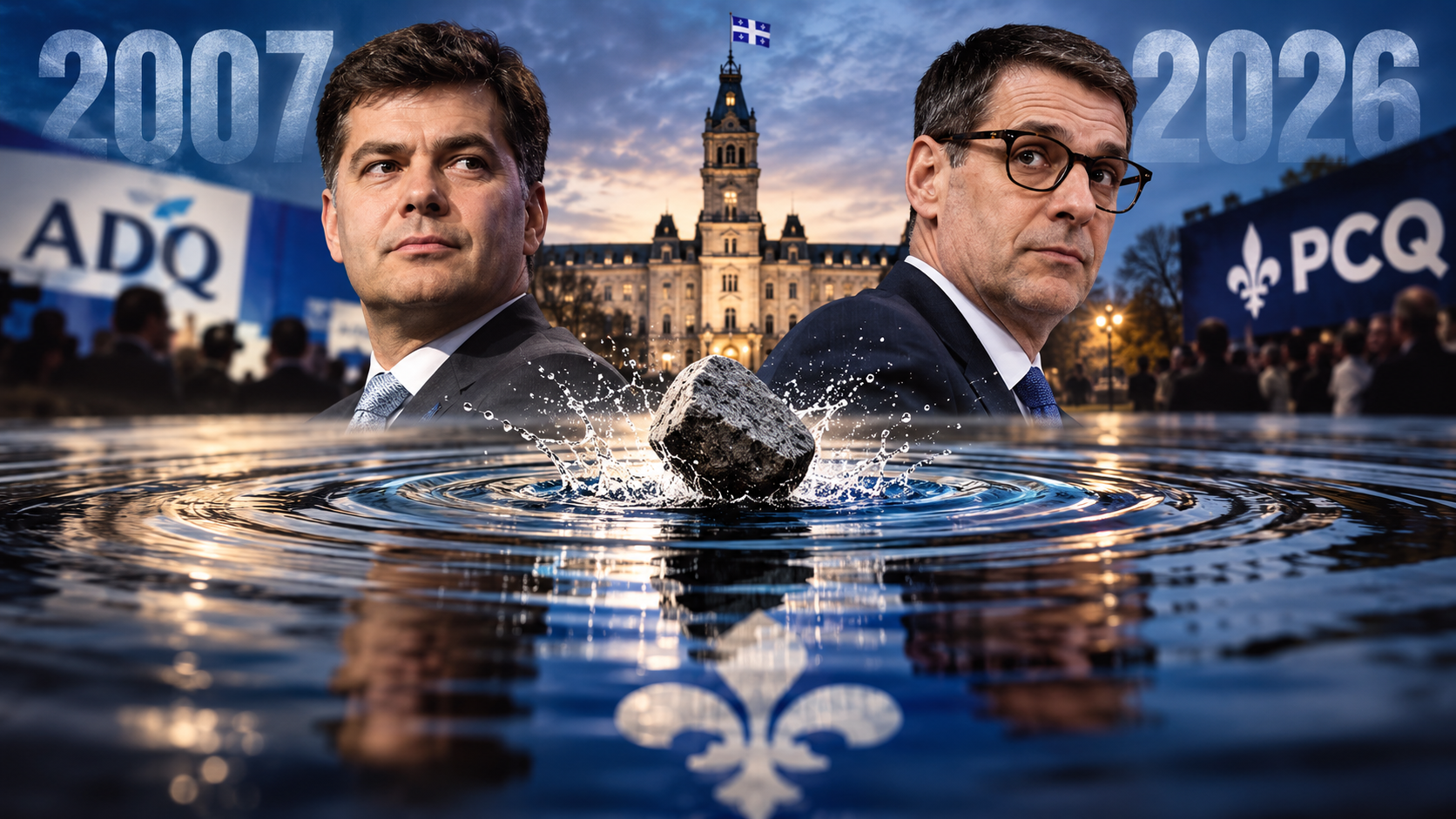
What if Éric Duhaime is playing a role in 2026 that, in some ways, resembles that of Mario Dumont in 2007?
The precedent from 2007
Comparisons have their limits.
In 2007, Mario Dumont's Action démocratique du Québec (ADQ) garnered 30.84% of the vote and elected 41 members of the National Assembly. The ADQ finished just a few points behind Jean Charest's Liberal Party, which won 48 seats, while the Parti Québécois was relegated to third place with 36 members.
Dumont had become leader of the official opposition.
The PCQ of 2026 is not there yet.
Twenty percent is not 30.84%. The electoral geography is different, the party system has changed, and the PCQ does not have the local presence that the ADQ had managed to build at its peak.
To claim that history is simply repeating itself would therefore be risky.
But the interesting parallel with 2007 may lie elsewhere.
It lies in the ability of a party that has hitherto been peripheral to modify the very terms of the campaign.
When others start talking about your topics
Mario Dumont had understood an elementary rule of politics: a third party truly begins to disrupt a campaign when the dominant parties stop ignoring it and start answering its questions.
Even before the 2007 election was called, Dumont had seized upon the debate on reasonable accommodation. The issue already existed, of course, but the ADQ leader had managed to position himself clearly enough to become one of the main protagonists of the debate.
The creation of the Bouchard-Taylor commission by Jean Charest, a few days before the start of the elections, demonstrated the political importance the issue had taken on.
Dumont, however, did not limit himself to reasonable accommodations.
Family, abolition of school boards, the role of the private sector in health, Quebec autonomy: the ADQ put forward proposals that gradually shifted the debate away from the traditional confrontation between federalists and sovereigntists.
The proposed abolition of school boards had in particular generated enough reactions from other parties to help keep education among the main issues covered during the campaign.
This is perhaps the best definition of political agenda control:
Controlling the agenda doesn't mean your opponents will adopt your ideas. It means they have to dedicate part of their campaign to explaining why they reject them.
From Dumont to Duhaime
Something similar happened in 2026.
Size of the state, spending cuts, the role of the private sector in healthcare, the third link, tramways, natural gas development, taxation : several themes strongly associated with the PCQ provoked repeated responses from other groups.
The Conservative fiscal framework probably provides the most striking example. Duhaime is proposing approximately billion in cumulative spending cuts over five years. Christine Fréchette responds by accusing the PCQ of wanting to dismantle the Quebec state.
On the third link, the opponents must explain their position and its funding.
Regarding the tramway, the mayor of Quebec City intervenes directly in the debate.
Regarding the exploitation of gas resources, the other leaders must clarify how far they would be willing to go to reopen an issue that many believed had been settled.
Then, in the final stretch, Duhaime shifts his message towards the balance of power and the possibility of a third referendum.
This does not mean that the PCQ alone controls the campaign agenda. The cost of living, healthcare, US tariffs, and sovereignty each have their own dynamics.
But the phenomenon is recognizable.
Perhaps the most telling sign isn't that your opponents are adopting your ideas. It's that they can no longer campaign without talking about them.
Mario Dumont had moved the agenda in 2007.
Éric Duhaime seems to have succeeded, at least in part, in doing something similar in 2026.
It remains to be seen whether this shift in the agenda will result in a shift in the seats.
Duhaime does not need 41 MPs
This is where the parallel becomes paradoxical.
Duhaime may not need to replicate Dumont's spectacular result to produce a major political effect.
On the eve of the election, projections placed the Parti Québécois around the border separating majority and minority government.
However, several constituencies that could determine which side of this border the PQ will fall on are precisely those contested by the PCQ.
Arthabaska–L'Érable, Champlain, Charlevoix–Côte-de-Beaupré, Daniel-Johnson, Drummond–Bois-Francs, Laviolette–Saint-Maurice, Louis-Hébert, Marie-Lacoste-Gérin-Lajoie, Mégantic and Nicolet-Bécancour are among the key ridings where the PQ and PCQ are in direct competition.
Arithmetic is ruthlessly simple.
When a riding changes from the PQ to the PCQ, it's not just another Conservative MP.
That's simultaneously one less PQ member of parliament.
In an Assembly where a few seats can separate the majority and minority, this dual effect becomes considerable.
Mario Dumont had transformed the structure of the National Assembly by getting 41 ADQ members elected.
Duhaime could alter the balance with much less.
And this is precisely where the referendum comes into the equation.
The true threshold may not be the one we think it is.
The Parti Québécois has pledged to hold a referendum on independence during its first term.
A PQ majority would obviously give a Paul St-Pierre Plamondon government a much greater degree of parliamentary leeway to pursue this approach.
A conservative surge sufficient to deprive the PQ of this majority would therefore considerably change the context.
But it wouldn't necessarily solve the problem.
Because the PQ is not the only sovereignist party in the National Assembly.
Québec solidaire also proposes a path to independence. During this campaign, QS proposed a constituent process leading to a referendum on a constitution for an independent Quebec. Ruba Ghazal also confirmed that her party would campaign in the Yes camp if a referendum were called.
This does not mean that QS would automatically support the PQ's referendum strategy. The two parties differ on the method, the conditions, and a good part of the political project that should accompany independence.
But they share the goal of sovereignty.
And that's where arithmetic becomes interesting.
Qc125's central projection on the eve of the election gave 62 seats to the PQ and eight to Québec solidaire.
Seventy sovereignist deputies.
An addition is obviously not a coalition. Nor does it constitute 70 guaranteed votes in favour of Paul St-Pierre Plamondon's referendum initiative.
But it shows why simply depriving the PQ of its majority would not necessarily be enough to upset the balance of power surrounding a possible referendum.
To do that, you need to look a few seats further back.
Seven seats that change the equation
Let us take this central projection only as a starting point for an exercise in sensitivity, and not as a prediction.
PQ: 62 seats.
QS: 8 seats.
Total for both sovereignist caucuses: 70.
Let us now suppose that the PCQ wins three ridings which would otherwise have elected a PQ member.
The PQ falls to 59.
With eight MPs in solidarity, the total remains at 67.
Five net gains for the PCQ at the expense of the PQ?
57 + 8 = 65.
Seven?
55 + 8 = 63.
Eight?
54 + 8 = 62.
Somewhere between these scenarios, the nature of the problem changes.
It's no longer just a matter of preventing the PQ from obtaining its own majority. The question is now whether The two sovereignist caucuses together would hold a majority of seats in the National Assembly.
And there is a second variable.
Québec solidaire itself holds several contested seats.
Hochelaga-Maisonneuve, Rosemont, Sherbrooke, and Taschereau are among the PQ-QS swing districts, while Laurier-Dorion and Saint-Henri–Sainte-Anne are contested between QS and the PLQ. Jean-Lesage even features a race involving PQ, QS, and PCQ.
Therefore, it is not necessary for all movements to originate from the PQ.
Let's take another simple mathematical scenario:
57 PQ + 6 QS = 63.
Or :
56 PQ + 6 QS = 62.
These are not predictions.
They actually reveal something that the PQ's national figure alone conceals: The balance of power surrounding a possible referendum could be decided a few seats below the sole boundary between the majority and minority of the Parti Québécois.
The bombshell dropped during the referendum
This would not make holding a referendum legally impossible.
A minority government is not automatically paralyzed either.
But a minority Parti Québécois government that could not even count on a majority of deputies from the two sovereignist parties would operate in a parliamentary environment radically different from a majority government.
That is why some seemingly local constituencies could have a reach that extends far beyond their borders.
And this is also why the conservative push is suddenly acquiring a dimension that goes beyond taxation, the size of the state, or the third link.
Éric Duhaime does not need to win the election to profoundly change the referendum equation.
He just needs to win enough seats in the right places.
A strange referendum campaign
There is, in fact, something ironic about this end to the campaign.
The PCQ devoted a good part of the election to talking about the size of the state, taxation, public spending and economic reforms.
Then, just days before the vote, the party found itself presenting its candidates as a possible parliamentary obstacle to a third referendum.
The sovereignist-federalist axis that Mario Dumont had helped to relegate to the background in 2007 is thus coming back to knock on Éric Duhaime's door in 2026.
But this time, the PCQ is trying to use it to its advantage.
Perhaps this is where the two campaigns cease to be similar.
And that's precisely what makes the comparison interesting.
A fragrance from 2007
History never repeats itself perfectly.
Mario Dumont arrived in 2007 with a different background, in a different partisan system and in a different context.
Its result of 30.84% and its 41 MPs remain very far from the voting intentions currently measured for the PCQ.
But there is nevertheless a familiar scent.
A leader who was initially peripheral to the main battle.
These are issues that he gradually manages to place at the center of the conversation.
Opponents who are devoting an increasing part of their campaign to responding to him.
A rise in the polls.
Then there's the electoral map where a few constituencies can profoundly transform the balance of the National Assembly.
In 2007, Mario Dumont had shaken up a political system that seemed firmly established.
In 2026, Éric Duhaime doesn't need to remake Mario Dumont.
Perhaps all he needs to do is move a few stones to the right place.
And when these stones are found precisely on the path leading to a Parti Québécois majority, they could very well become a a bombshell in the referendum debate.
About the Author



1 thought on “A whiff of 2007: Duhaime, a bombshell in the referendum debate?“