
The leaders' final debate was noisy, sometimes confusing, and often filled with statistics. But once the claims were verified, five very different visions of Quebec emerged: on health care, public finances, demographics, the role of the state, and the national future.
The final leaders' debate at times resembled a competition to determine how many statistics, interruptions, and slogans could be crammed into two hours of television.
But once the noise has died down, the sound bites have been forgotten and the main claims have been scrutinized, something much more interesting emerges.
The five chefs are not simply offering five variations of the same Quebec.
They offer, to varying degrees, five different conceptions of the State, the economy, health, demography and the national future of Quebec.
That's probably the key takeaway from this last debate.
Healthcare: "Private" does not mean "American"
The debate on health quickly turned around Quebec Health and the role of the private sector.
Christine Fréchette defended Santé Québec, arguing that the agency had already contributed to improving the functioning of the healthcare system. Paul St-Pierre Plamondon and Éric Duhaime, on the other hand, want to abolish it. Fréchette and Duhaime also advocated for increased use of private providers funded by the health insurance card, while Charles Milliard aptly summarized his position: the private sector is a tool, not an ideology.
But first we would need to agree on what "private" means.
When Duhaime talks about private healthcare, he's not proposing to abolish public health insurance and turn Quebec into a branch of the American system. He's proposing more private services financed by the RAMQ, an institutional arrangement found in various forms in several European systems.
This is not a minor detail.
The Ontario example cited by PSPP to argue that "the private sector has siphoned off" resources from the system must therefore be handled with caution. While documented problems of staff displacement to private agencies and competition for labour do exist in Ontario, the Ontario experience cannot be directly applied to the broader reform proposed by the PCQ.
The same caution applies to the figure that some private surgeries cost around 35% more.
An analysis by the Quebec Ministry of Health concluded that some surgeries outsourced to private clinics cost more than their equivalents in the public system.
The figure exists.
But to go from there to "private costs 35% more" is like doing with a statistic what some people do with a buffet: taking what we like and ignoring the rest.
It all depends on what you're comparing: type of intervention, complexity of cases, real estate costs, administrative expenses, staff remuneration, complications, productivity accounting rooms and methods.
The real debate is therefore not "public or private".
It is rather: Who finances, who insures, and who provides the care?
These are three different questions that the Quebec debate too often insists on bundling into the same word.
The budget barrier: everyone has a calculator, but not the same one.
The budget block provided the most material for fact-checking.
Eric Duhaime reiterated his objective of achieving approximately billion in gross savings over five years, notably through a reduction in subsidies to businesses, attrition in the public service and the modernization of the state.
Its framework is explicit about the mechanisms it intends to use. The uncertainty therefore lies less in the existence of the measures than in their actual effectiveness after implementation.
This is an important distinction.
It is obviously impossible to demonstrate today exactly how much a reform that has never been implemented will yield. However, it is possible to verify whether the mechanisms have been identified, whether the assumptions are consistent, and whether the orders of magnitude are plausible.
The definitive proof would necessarily come from execution.
Asking for more would be tantamount to demanding the results of a policy before it exists, an exercise still poorly served by economic science.
The PCQ also makes a notable budgetary choice: it retains all of the billion in contingency provisions planned in the government's scenario.
The CAQ is making a different choice.
Its frame recovers approximately 5 billion of these provisions, leaving only about 3 billion as a buffer. This mechanically improves the budget balance, but it is neither a new source of revenue nor a structural saving.
This is a decision to reduce the safety margin.
If everything is going well, all the better.
If the economy slows down, if tax revenues disappoint, or if an unexpected expense arises, there will simply be less cushion left to absorb the shock.
The CAQ also registers approximately .4 billion in additional federal transfers which still need to be negotiated with Ottawa.
The PLQ adopts a comparable approach on certain points. It retains approximately 4 billion in contingency provisions, plans staff reductions and also counts on additional federal transfers.
The PQ is focusing more on reducing bureaucracy. PSPP, however, exaggerated a figure when he spoke of approximately 50,000 office workers who would not provide services.
The order of magnitude of the increase in staff is real. By adding certain management categories and "office staff, technicians and similar," we effectively arrive at approximately 50,000 additional FTEs since the arrival of the CAQ.
But this category also includes health, education and social service technicians who directly provide services.
Therefore, labeling this entire group as "bureaucrats" is a simplification.
A convenient shortcut, certainly. But a shortcut nonetheless.
For Québec solidaire, the main budgetary risk lies elsewhere: in the yield of the proposed new tax revenues.
QS estimates that it can obtain approximately billion per year of a wealth tax. The figure is based on an identifiable estimate of the tax base, but its real yield would necessarily depend on behavioral reactions, asset valuation, tax optimization, taxpayer mobility and administrative costs.
In short, all parties are taking risks.
They simply don't use the same ones.
For the CAQ and the PLQ, part of the funding relies on future revenues and a reduction in the budget buffer. For the PCQ, it relies primarily on the implementation of structural reforms. For the PQ, on the ability to achieve the announced administrative savings. For QS, on the actual revenue generated by new taxes.
This is already much more instructive than sticking the word "austerity" on everything that moves slower than the State.
“Austerity”: QS’s rhetorical Swiss Army knife
Ruba Ghazal argued that all other parties were committed to austerity.
The problem is that the word has become so broad that it can now refer to just about any policy that does not automatically provide for more public spending.
Reducing spending nominally, reducing it in real terms, decreasing per capita spending, eliminating administrative positions, or simply slowing the growth of the state are, however, five different things.
Québec solidaire generally uses the term to encompass several policies aimed at reducing staff or limiting the expansion of the public apparatus.
Politically, it's effective.
Economically, it lacks a certain resolve.
Economic insecurity: jobs saved in the parallel universe
Christine Fréchette defended her government's intervention during the tariff crisis, stating that Quebec had avoided a "massacre" of jobs.
The government has indeed put in place several support and diversification measures since the beginning of trade tensions with the United States.
And job losses have sometimes been less severe than some pessimistic scenarios.
But claiming that government programs "prevented a massacre" raises a classic problem of causality.
To demonstrate this, we would need to know what happened. in the absence of these programs.
This scenario is not observable.
Without a study to isolate the effect of government policies, the assertion therefore remains more of a political interpretation than a proven result.
We can count the jobs lost.
Counting those who might have disappeared in another timeline requires a bit more imagination.
Birth rate: "too many children or not enough?" is a false contradiction
The debate on birth rates has also given rise to a revealing shortcut.
Ruba Ghazal confronted PSPP on what appeared to be a contradiction: does Quebec have too many children, since schools and services are under pressure, or not enough, as pronatalist policies support?
But the two problems can perfectly coexist.
Quebec may lack daycare spaces and have overcrowded schools today while experiencing insufficient fertility to ensure the natural renewal of its population in the long term.
These are not the same populations, nor the same places, nor the same time horizon.
Quebec's fertility rate is near its historical low, and deaths now exceed births.
The pronatalist question raised in particular by PSPP and Duhaime therefore goes beyond the simple total number of inhabitants.
It also touches on the demographic continuity of the historical French-Canadian population, from which French-speaking Quebec culture largely originates.
With a low birth rate and population growth increasingly based on immigration, the relative weight of this historical population tends mechanically to decrease.
This obviously does not mean that Quebec culture will disappear at the same rate. A culture can be transmitted, adopted, and enriched by people from diverse backgrounds.
But to claim that there is no demographic challenge would be to respond to the figures with a shrug.
The Future of Quebec: Two Breaks with the Past
The national question also revealed a deep divergence between PSPP and Duhaime.
The PQ leader proposes a constitutional rupture.
He asserts that a Parti Québécois government would hold a referendum during its first term, even if the polls remained unfavorable.
The debate also showed that the claim that "70% of Quebecers do not want a referendum" is more fragile than it seems.
Polls generally show around 60 to 65% for No before allocation of undecided voters and nearly 70% after allocation.
But saying No to independence is not exactly the same as refusing to allow a referendum to be held.
Duhaime, for his part, proposes more of a economic and institutional breakdown within Canada.
Reducing the size of the state, private provision of certain public services, tax reforms, deregulation and changes in transportation policies constitute a challenge to the Quebec model rather than to the Canadian constitutional regime.
Both projects therefore speak of a break.
They simply don't want to break with the same thing.
This is probably one of the most interesting divisions in this campaign.
Third link: two solutions to two different problems
The exchange between Duhaime and PSPP on the third link also suffered from confusion.
The Parti Québécois project essentially aims for a public transportation link.
The conservative project is road-based and aims in particular at the transport of goods and the redundancy of the network.
These are two partially different objectives.
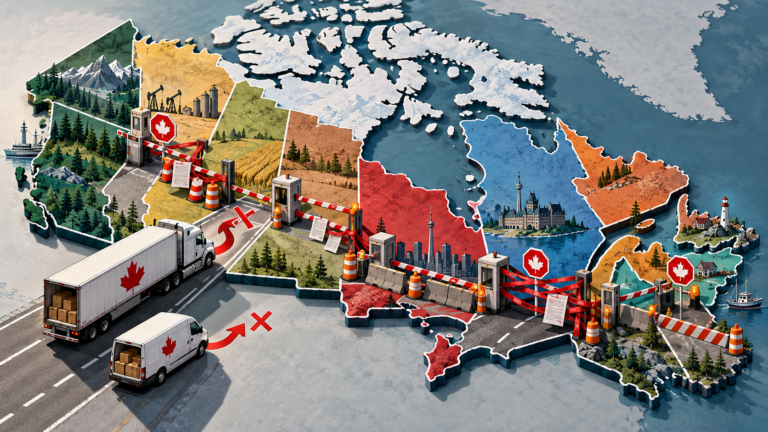
The closure of the Pierre-Laporte bridge also provided a concrete demonstration of the redundancy problem: heavy goods vehicles had to make a detour via Trois-Rivières.
This does not demonstrate that a third road link is necessary at any cost.
But this demonstrates that a real logistical problem exists.
The PCQ's project is more clearly defined, with a route and an estimated cost of .7 to billion. However, this estimate comes from the party and will eventually need to be independently verified.
The PQ's project remains more at the concept stage and its total cost is not yet clearly established.
Therefore, comparing only prices would be misleading.
A train and a motorway bridge do not become the same project simply because they both cross the river.
The "war on cars": a slogan, certainly. But policies do exist.
The expression used by Duhaime is intentionally provocative.
But the policies he groups under this label do indeed exist: zero-emission vehicle sales standards, carbon market, fuel taxation, registration fees and policies promoting public transport.
The relevant question, therefore, is not whether constraints exist.
They exist.
The question is whether their environmental and mobility benefits justify the additional costs or restrictions they impose on motorists.
The intentions are open to debate.
Bills, however, have the unpleasant habit of being measurable.
Behind the noise
This latest debate ultimately did not feature five politicians proposing different variations of the same model.
He revealed several frankly different conceptions of Quebec.
The CAQ largely defends the continuity of an interventionist state which it wishes to make more efficient, while assuming more risk in its financial framework.
The PLQ is banking on the modernization of the state, federalism and a combination of market and public intervention.
The PQ wants to reduce certain administrative structures while making sovereignty the means to obtain new political, economic and demographic levers.
Québec solidaire wants to consolidate or expand public services and is counting more on taxation of high incomes and wealth to finance them.
The PCQ proposes the most thorough questioning of the current functioning of the Quebec state, focusing more on competition, private provision, spending reduction and individual choice.
These differences are far more fundamental than the sound bites that dominated the initial reactions to the debate.
After three debates, voters now have a relatively clear contrast.
The question is no longer so much:
"Who won the debate?"
It is rather:
"What kind of Quebec does each of these projects seek to build?"
About the Author