TAll parties know how to make a spreadsheet reach zero. The real question is what needs to happen for the real world to arrive at the same result.
A financial executive is a strange beast.
We add up incomes, subtract expenses, add some savings, sometimes a few billion in economic growth, a hoped-for check from Ottawa, and miraculously: somewhere at the bottom of the table appears a beautiful zero.
Excel, however, never protests.
The real question, therefore, is not whether the five Quebec political parties are capable of producing a trajectory towards balance. They all manage to do so, one way or another.
The interesting question is rather this:
What actually needs to happen for their zero to materialize?
It is from this perspective that I examined the financial frameworks of the CAQ, the Liberal Party, the Conservative Party, the Parti Québécois and Québec solidaire.
I am not trying to crown a winner here. What interests me is separating what the government actually controls, what it plans to save, what it expects from a third party, and what it assumes the economy or taxpayers will do in response to its policies.
And the differences are considerable.
A common starting point
The common point of reference is the 2026 Pre-Election Report from the Ministry of Finance.
The Auditor General concluded that, overall, the assumptions and projections in this report were plausible for 2026-2027 to 2028-2029. However, she emphasizes that the challenges are increasing rapidly and that the planned spending reductions require significant and sustained budgetary efforts.Auditor General of Quebec)
In other words, no party starts the exercise with a few billion forgotten under the couch.
This is the common problem that everyone tries to solve in their own way.
The PCQ: many measures identified, but many economic effects yet to be achieved
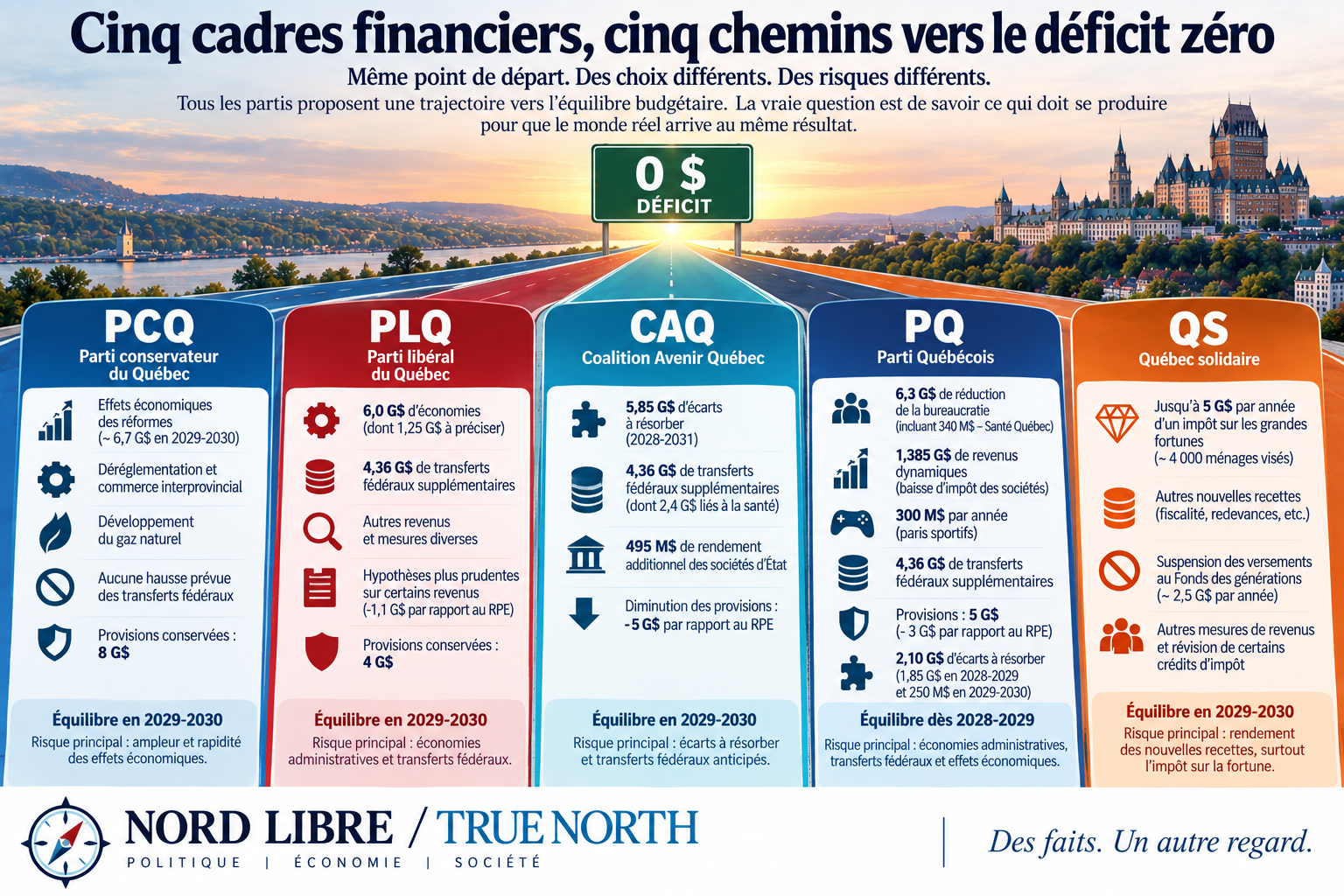
The Conservative Party's financial framework includes 84 pagesIt projects a balanced budget in 2029-2030, does not incorporate any hypothetical increase in federal transfers, and fully retains the 8 billion in contingency provisions The baseline scenario maintains payments to the Generations Fund and does not use any "gap to be addressed" line items. Its budget balance reaches 336 million in 2029-2030 and then 1.89 billion in 2030-2031.
This does not mean that the framework is risk-free.
A significant portion of the expected revenue depends on the economic effects of the proposed reforms.
For the single year 2029-2030, the PCQ registers 4.05 billion of revenues attributed to liberalization and deregulation, 2.52 billion to reducing barriers to interprovincial trade and 85 million to natural gas production. This represents approximately 6.655 billion in revenue that year linked, to varying degrees, to projected economic effects.
The document provides sources and models to support these assumptions. For interprovincial trade, it cites work by the IMF, Deloitte, and Trevor Tombe, and explicitly discusses the boundaries between unilateral opening and multilateral liberalization.
But an economic model remains an economic model.
A reform can produce favorable effects without the tax revenue reaching exactly the amount and time expected.
As a simple test, a 25% shortfall in the projected 6.655 billion for 2029-2030 would reduce the balance by approximately 1.66 billion that year. This is not a forecast. It simply helps to identify where a significant portion of the framework's sensitivity lies.
The PLQ: Modernizing the State and Counting on Additional Revenue
The Liberal Party plans 11.9 billion in commitmentspreserves 4 billion in contingency provisions and completely eliminates the 5.85 billion "gap to be filled" from the pre-election scenario. It reaches a balance of 9 million in 2029-2030 and 136 million the following year.
The PLQ plans 6.025 billion in savings over five years.
Approximately 4.25 billion comes from the modernization and efficiency of the State, 525 million from the refocusing of the Economic Development Fund's intervention capacity, and 1.25 billion from a line item very clearly titled "saving measures to come".
This latter amount is not a "gap to be filled" as defined in the pre-election report. The party presents it as a cost-saving commitment within its platform.
But the precise measures corresponding to this 1.25 billion have not yet all been described.
The PLQ also plans .36 billion in additional federal transfers over the last four years of the framework.
Quebec can claim this money, negotiate with Ottawa, and have excellent arguments. However, it cannot unilaterally decide the outcome.
This distinction becomes particularly important for the Canada Health Transfer. The current guarantee of minimum growth of 5% applies until 2027-2028. Thereafter, the formula reverts to the three-year moving average growth of nominal GDP, with a guaranteed floor of 3%.Government of Canada)
The PLQ has also reduced its own self-generated revenue forecasts by approximately 1.1 billion compared to the pre-election report to account for tariff risk. This is an explicitly more cautious assumption than the baseline scenario on this point.
Finally, the famous independent verification must be presented correctly.
The commissioned firm essentially confirms that the inputs match the information examined and that the tables correspond to the outputs of the Ministry of Finance's simulator. It expressly states that it does not validate the assumptions, does not carry out independent verification of the revenue or savings estimates, and does not comment on their economic or administrative feasibility.
Therefore, it is not a guarantee that the assumptions will be fulfilled.
The CAQ: a significant portion still needs to be addressed.
The CAQ framework retains a particularly visible characteristic: significant amounts remain listed under the heading "gap to be closed".
We still find there 1.85 billion in 2028-2029, Then 2 billion in 2029-2030 and again 2 billion in 2030-2031. (Coalition Avenir Quebec )
Either 5.85 billion based on three exercises.
A gap to be closed is not an additional deficit. It is an assumption that future measures will improve the balance of this amount.
But until these measures are defined, it is unclear exactly what will be reduced, postponed, reorganized, or taken more from.
Let's take 2029-2030.
The framework shows an accounting surplus 879 millionthen adds a gap to be filled by 2 billion, pays 2.79 billion to the Generations Fund and finally arrives at a balance of +89 million. (Coalition Avenir Quebec )
Without the two billion still to be absorbed, the same calculation gives approximately -1.91 billion.
The CAQ also adds .357 billion in additional federal transfers495 million in additional returns from state-owned enterprises and releases 5 billion by reducing contingency provisions compared to the baseline scenario.Coalition Avenir Quebec )
The document specifies that the planned increase in federal transfers includes approximately 2.4 billion stemming in particular from the renewal of health agreements and the maintenance of TCS growth at 5% after 2027-2028. The balance, approximately billion, corresponds to advance reimbursements of expenses related to asylum seekers.Coalition Avenir Quebec )
However, the federal floor of 5% is currently only guaranteed until 2027-2028.Government of Canada)
These sums can therefore be obtained, but they do not all constitute revenue that the Quebec government can decree unilaterally.
The PQ: the phantom PDF held a few surprises.
After a remarkably promising career in digital secrecy, the Parti Québécois' financial cadre has finally surfaced.
And the full document significantly qualifies the presentation of the return to equilibrium.
The PQ shows a balance of +49 million in 2028-2029But before closing the gaps, his own table shows -1.801 billionThe frame then adds 1.85 billion gap to close to reach 49 million positives.
In 2029-2030, there is still 250 million to be absorbed. This line will only disappear in 2030-2031.
However, the PQ presents substantial and quantified savings.
Reducing bureaucracy should generate 500 million, then 1 billion, then 1.6 billion per year, for a total of 6.3 billionThe abolition of Santé Québec adds 0 million in savings over five years.
His tax reform is also interesting to analyze.
The gradual reduction of the corporate tax rate from 11.5% to 9.5% costs 8.89 billion according to the framework. The PQ exactly offsets this amount with an equivalent reduction in the Economic Development Fund and business subsidies. The static cost of the operation is therefore zero in its model.
The party then adds 1.385 billion in additional revenue attributed to the economic effects of this tax cut, an amount that reaches 2 million per year in 2030-2031. It also notes 300 million annually royalties from sports betting sites.
The PQ also incorporates .357 billion in additional federal transfers, with practically the same trajectory as that of the CAQ.
Finally, its provisions are maintained at 1 billion per yearthat's a total of 5 billion. But the pre-election scenario projected 8 billion. The PQ therefore reduced it by 3 billion the original cushion over five years.
The document also quotes economist Antoine Noël of Laval University, who says he analyzed the framework and judged its financial forecasts and debt evolution to be plausible in their material aspects. However, the PDF does not describe in detail the procedures he used to arrive at this assessment.
The PQ framework therefore combines several types of risk: administrative savings to be made, expected economic effects, federal transfers to be negotiated and gaps still to be closed during part of the period.
Québec solidaire: the risk lies mainly in the new recipes
Québec solidaire is taking a very different path.
The most important pillar of its new revenue is a wealth tax. The party claims that approximately 4,000 Quebec households possess more than million in net worth and anticipates that this measure will generate up to billion per year. (Newswire)
The framework increases this revenue from 4.51 billion to 4.67, then 4.83 and finally 5 billion per year.
This is not the only source of additional revenue. QS also plans changes to personal income tax, an increase in taxes for certain corporations, additional royalties, a tax on financial institutions, and various other fiscal measures.
But a revenue of five billion from a single new measure certainly deserves special attention.
The difficulty, moreover, lies not only in determining whether some taxpayers will change their residence. An annual wealth tax must also contend with the valuation of private companies, illiquid assets, and the various ways in which wealth is restructured.
Our stress test therefore does not claim to predict actual performance.
He is simply stating an arithmetic reality: If projected revenue of 5 billion falls by 10%, the annual balance deteriorates by approximately 500 million..
QS also makes a budgetary choice distinct from the other four parties: its framework provides for suspending payments to the Generations Fund, which frees up approximately 2.5 billion per year.
This final figure is not a projection of economic performance. A government can indeed make this decision. The discussion then focuses on the consequences of this choice for the debt, and not on the technical feasibility of collecting the sum.
The same zero does not tell the same story
Ultimately, this is what emerges most clearly from the exercise.
The five parties are not placing their risk in the same place.
At the PCQ, a significant part depends on the scale and speed of the economic effects of structural reforms.
For the PLQ, the trajectory depends in particular on substantial administrative savings and additional federal transfers.
At the CAQ, several billion dollars remain explicitly in the form of gaps to be filled, in addition to anticipated federal revenues and a reduction in provisions.
The PQ combines bureaucratic savings, dynamic revenues, federal transfers and a few gaps that still need to be addressed.
QS, on the other hand, is focusing more of its risk on new tax revenues, particularly its wealth tax.
None of these categories automatically means that a policy will succeed or fail.
An economy can react more strongly than expected to a reform.
A government can actually reduce its administrative costs.
Ottawa can accept Quebec's requests.
A new tax can generate the expected revenue.
And previously unidentified savings may ultimately be found.
But these are not the same bets.
The real test is not zero
This is ultimately where the traditional presentation of financial frameworks becomes insufficient.
We are shown one last line:
0 $..
Balance achieved.
Mission accomplished.
But this figure tells us very little if we don't look at the lines that precede it.
A billion dollars from a previously identified spending cut is not the same as a billion dollars dependent on negotiations with Ottawa.
One billion in revenue from a modeled economic response is not the same as one billion from a tax increase that Quebec can adopt directly.
And a billion listed under the heading "gap to be filled" is not yet a billion saved.
The five parties are therefore proposing primarily five different distributions of budgetary risk.
Rather than simply asking:
"Who reaches zero?"
The much more useful question is:
"What must be true for this zero to still exist in four years?"
At this point, the numbers finally start to tell a story.
About the Author