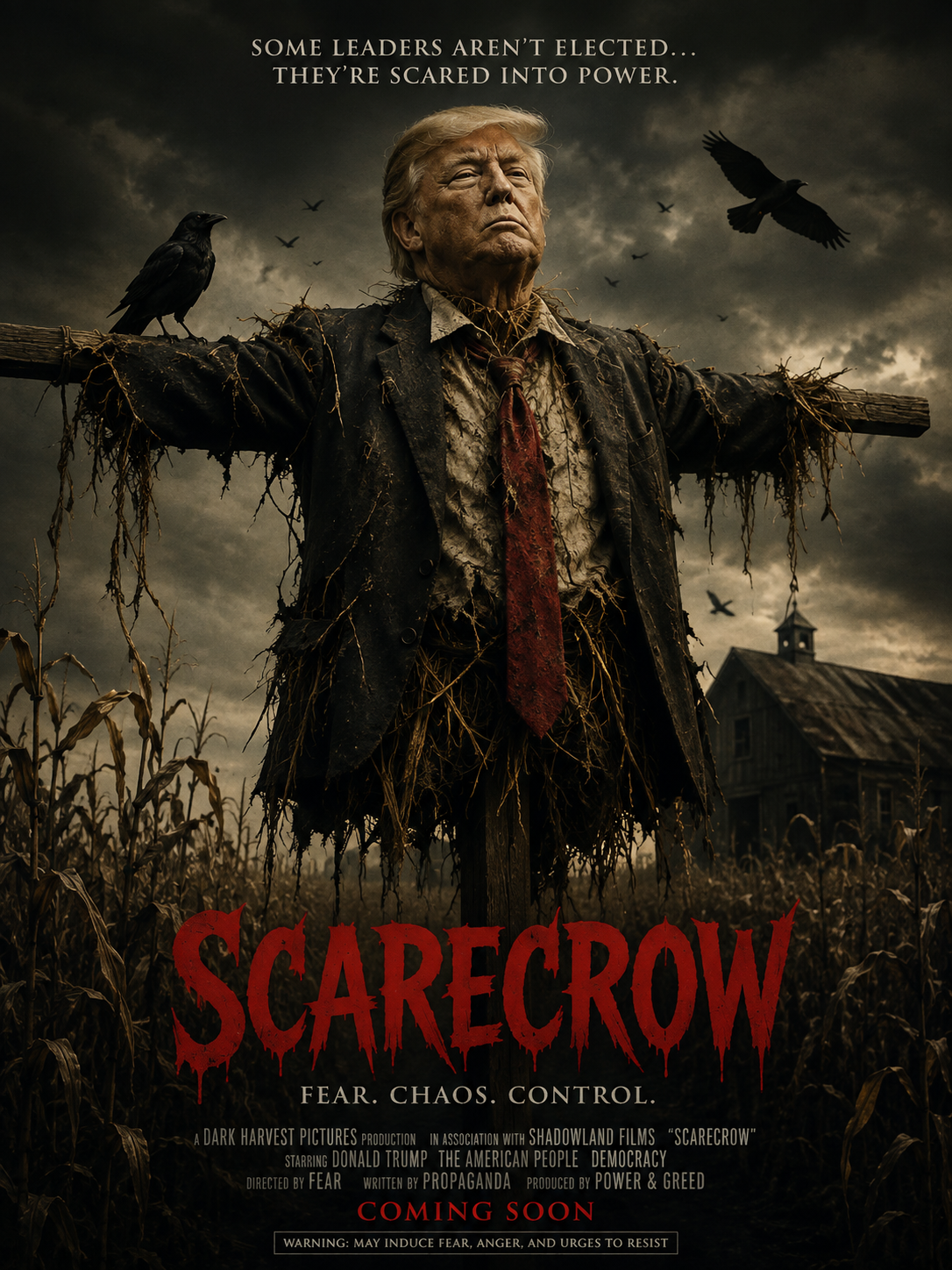
Satirical picture depicting Donald Trump as a scarecrow in a horror film poster
How Mark Carney and Christine Fréchette plan to manipulate you
We are currently acting out a very bad political play, worthy of a low-budget horror film, so blatant is the manipulation of the masses, and this play originated with the election of Justin Trudeau's Liberals in 2015. Whereas before this election, the Canada While the United States could boast of being one of the most prosperous countries in the world, its economy has since deteriorated significantly. As 2025 approaches, and after ten years in power, the Trudeau government is worn out and on the brink of collapse. Everyone predicts the Liberal Party's annihilation in the next general election. After months of stubbornly clinging to power, Justin Trudeau yields to pressure from his party, resigns, and prorogues Parliament until his successor as leader of the Liberal Party is elected.
But while the Liberal leadership campaign was in full swing, a glimmer of hope appeared for the Liberals: Donald Trump was elected President of the United States for a second term and launched a trade war with Canada by imposing tariffs on various Canadian products. Mark Carney, who, unlike Justin Trudeau, had a stellar resume, immediately seized the opportunity to present himself as the most qualified man to challenge Donald Trump. This was something that Liberal Party delegates, and then the Canadian electorate, eagerly embraced. After a spectacular turnaround, the party, which just a few months earlier had been destined to be wiped off the electoral map, managed to win a majority, falling just three seats short. It ultimately achieved this majority through dubious means, by persuading opposition MPs to switch sides.
I candidly admit that at the time, I seriously underestimated Mark Carney. I was undoubtedly not alone in that. I won't repeat that mistake. Mark Carney inherited a crisis when he entered the political arena. He quickly grasped that it represented a powerful political advantage and exploited it very skillfully, and continues to do so today. For that, I must, somewhat reluctantly, tip my hat to him. It was a masterstroke. But my admiration has its limits.
But it must also be admitted that Donald Trump provided the perfect scapegoat to divert public attention from the record of Liberal governance over the past 10 years and its consequences. Carney's task would have been extremely difficult had he had to defend that record. Nevertheless, even when Trump is gone, we will not be able to escape these consequences. Canada remains grappling with structural problems of productivity and anemic growth, a galloping affordability crisis, a housing crisis, and out-of-control immigration. These problems existed before Trump's election, and they will still be there after he's gone because, so far, Carney has shown no interest in doing anything to solve them despite his fine promises to "build a strong Canada." Now, let's hit the "fast forward" button.
A year and a half later…
While Mexico, which also had to contend with Donald Trump's antics, has managed to resolve most of its differences with the United States, Canada remains stuck. Just over a week ago, we seemed close to an agreement, but everything fell apart last Friday. Mark Carney broke off negotiations, alleging that the United States had added new demands that he deemed unacceptable. However, an interview with Jamieson Greer on the CBC And an article from the New York Times In particular, they debunk a large number of his arguments.
It's worth remembering that, despite its imperfections, the American offer wasn't as bad as Carney would have us believe. According to available information, it included, among other things:
- reduction of the American automobile tariff towards 15%;
- reduction of certain tariffs on steel and aluminum;
- more favorable treatment of certain products;
- cooperation in critical minerals;
- cooperation in aerospace;
- measures concerning forced labour;
- opening of broader North American economic negotiations.
It must be admitted that this was a substantial offer and could have improved the situation for Canadians if our government had been more conciliatory. It would have significantly reduced tensions regarding:
- the automobile;
- steel;
- aluminium;
- certain other products;
- access to the American market.
And Greer argues that Washington was offering Canada particularly favorable tariff terms compared to those offered to other trading partners. So why did Carney choose to resort to belligerent rhetoric and break off negotiations when he could have accepted an imperfect offer and improved the situation, perhaps continuing to negotiate the contentious points rather than imposing an even greater tariff burden on the Canadian economy? Were Canada's grievances sufficient to justify such a breakdown? Is Mr. Carney acting in the best interests of Canadians? I don't think so. So why?
What impeccable timing!
Coincidentally, three by-elections will be held on August 31st, including Chicoutimi– THE Fjord, a Quebec riding that the Liberals would very much like to wrest from the Conservatives. Not to mention that there's a general election in Quebec on October 5th, something Mark Carney is well aware of. So, we have:
August 22: Negotiations break down
↓
August 31: Three federal by-elections
↓
October 5: Quebec election
It's hard to imagine a better time to introduce the topic:
"We are defending Canada and protecting the French language against the Americans."
And as if by chance, one of the points of contention raised by Carney concerned the Frenchman's defense (which turned out to be a sham, let's not forget). I don't believe in coincidences, do you? The timing is too good.
So, did Carney deliberately sabotage the negotiations for purely electoral reasons? Difficult to prove, but certainly possible. Otherwise, how can we explain this radical break? While it's true that Donald Trump is unpredictable, Mexico still manages to negotiate with him, whereas Carney fails despite having promised, upon his election 18 months ago, to quickly reach an agreement. Not only has he failed to keep this promise, but this latest breakdown has exacerbated the situation. Therefore, the theory of a strategic conflict is gaining traction and becoming increasingly credible.
Christine Fréchette - Garden entrance…
Since we're talking about political theatre, we might as well go all the way.
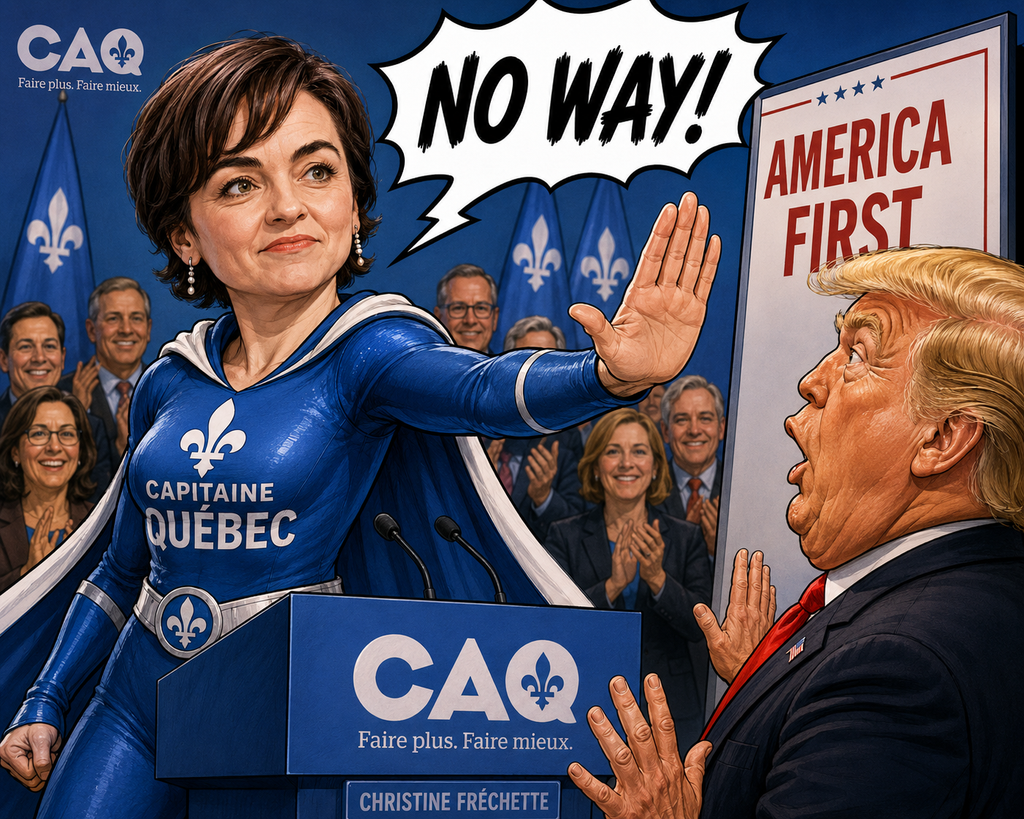
So, Christine Fréchette, just like Carney, inherited a party worn down by years in power and with such an abysmal record that she felt compelled to rebrand it as "Team Christine Fréchette" to make people forget it. When she was elected party leader, the party was also facing possible electoral annihilation. What a godsend, then, this failed negotiation that allowed her to don the fleur-de-lis mantle of Captain Quebec and present herself as the great defender of French culture against the big bad orange man. What an opportunity! And of course, just a few days after the negotiations failed, she did exactly that. When she called the election on August 27, she designated Donald Trump as her main opponent. In doing so, she hoped to pull a Mark Carney out of herself and repeat the same feat of resurrecting her moribund party. Isn't that wonderful? Are you going to fall for it? I hope not.
About the Author