What if Trump's tariffs were justified?
What the little-known story of fentanyl, organized crime, and China reveals about the origins of the trade war with the United States
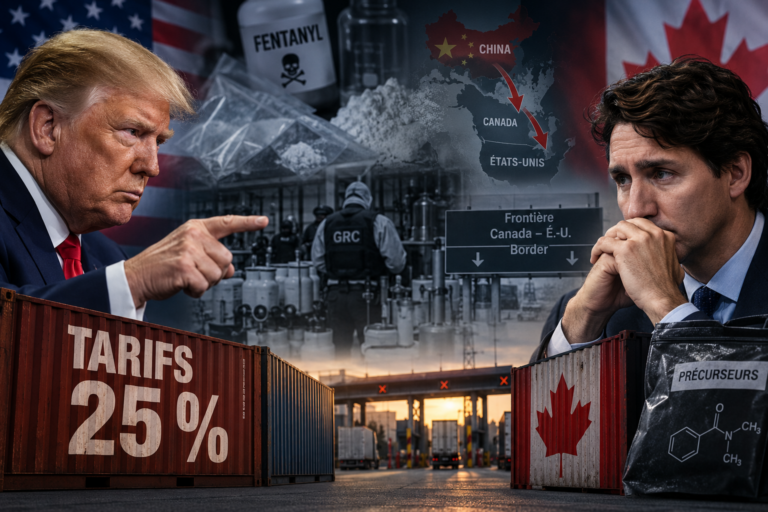
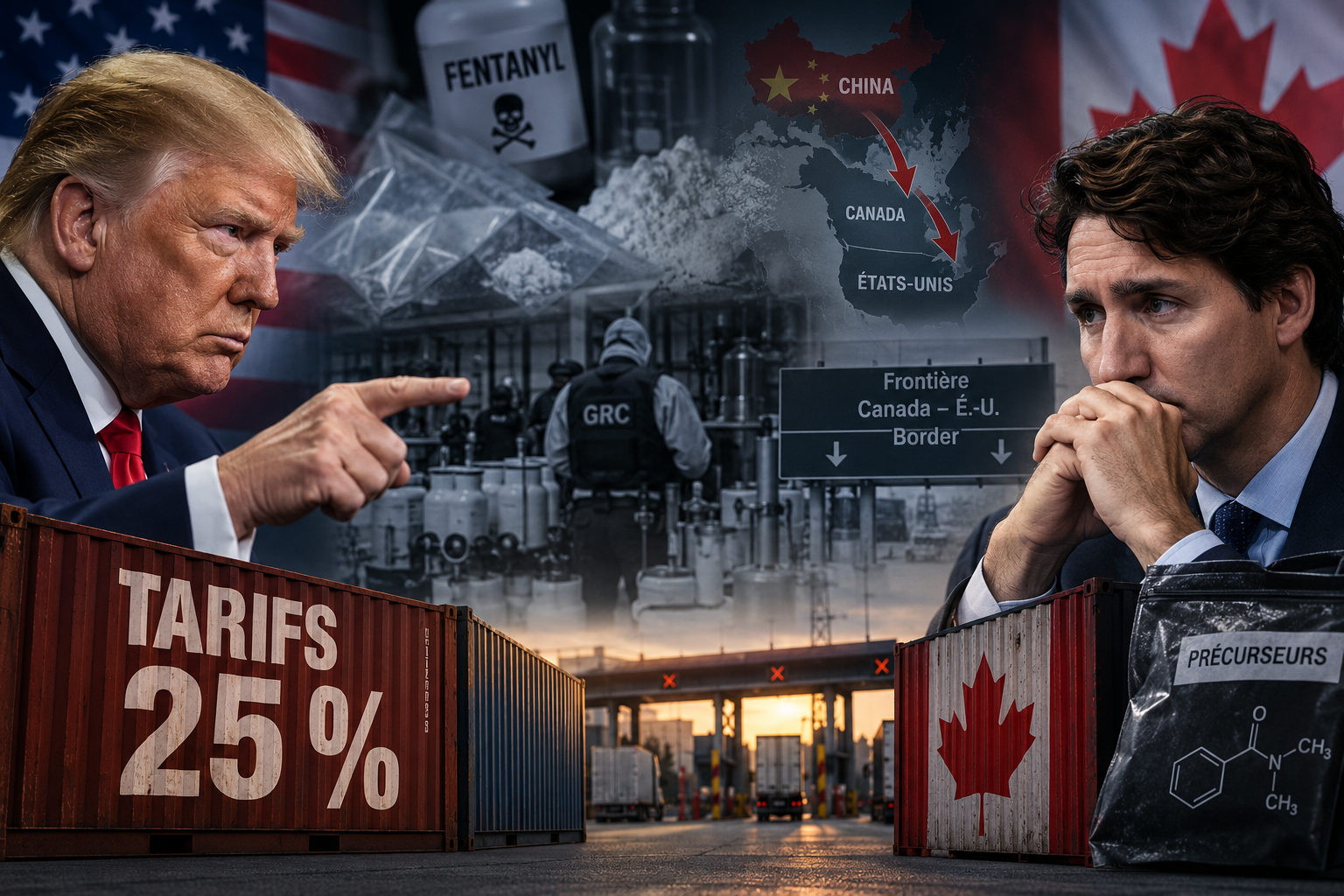
Lorsque Donald Trump a annoncé qu’il imposerait des tarifs de 25 % sur les produits canadiens si le Canada was not doing more to secure its border and combat fentanyl trafficking, our government's reaction was as swift as it was predictable.
The prices were unjustified.
Canada was being unfairly attacked.
And to prove it, Justin Trudeau and his government had an apparently irrefutable argument: less than 1% of the fentanyl seized at the American borders came from Canada.
The figure was indeed the one officially put forward by Ottawa, which claimed that "less than 1% of fentanyl and illegal crossings into the United States originate from Canada" while describing the American tariffs as unjustified.
Indeed, seen from that angle, the whole thing seemed quite ridiculous.
Why threaten your main trading partner with 25% tariffs for a problem representing a tiny fraction of the fentanyl entering the United States?
The explanation that quickly took hold in Canada was therefore quite simple: Donald Trump was looking for a pretext. The American bully had decided to attack his poor Canadian neighbor, and he had to be stood up to.
Elbows up!
But there's a small problem with this story.
It begins in 2025.
The real story begins almost ten years earlier.
A problem known since 2016
As early as 2016, the RCMP testified before the House of Commons Standing Committee on Health that, according to its investigations and criminal intelligence, China was the main source of fentanyl entering Canada.
British Columbia was the main distribution point at the time. Even more interestingly, the RCMP explained that fentanyl arriving in Canada was processed into a finished product in clandestine laboratories before being distributed across the country. and, to a lesser extent, in the United States.
The following year, the The Trudeau government officially recognized that criminal investigations and available intelligence identified China as the primary source of fentanyl and its analogues entering Canada.
Ottawa also confirmed that bilateral work was already underway with the U.S. DEA to determine how to better cooperate with China. Canada was also participating, along with the United States and Mexico, in the new North American Drug Policy Dialoguewhere the three countries discussed, among other things, chemical precursors and the trafficking of synthetic drugs.
In other words, when Donald Trump accuses Canada of having a fentanyl problem in 2025, he has not just discovered a phenomenon that no one had heard of.
Ottawa and Washington have been working on this problem since at least 2016.
Trump and Trudeau had already talked about it
In June 2019, Donald Trump was in his first term and Justin Trudeau was Prime Minister of Canada. The two men met in Washington and discussed, among other things, the opioid crisis. They agreed to strengthen cooperation between their two countries.
This discussion will lead, on January 31, 2020, to Canada-US Joint Opioid Action Plan, intended in particular to strengthen cooperation against the trafficking of fentanyl and other synthetic opioids as well as in law enforcement, border security and intelligence sharing.
Trump was therefore personally familiar with the matter. He had spoken directly with Trudeau about it, and their governments had created a mechanism specifically designed to address it.
Then Trump lost the 2020 election and left the White House.
The problem, however, persists.
Trump leaves, fentanyl remains
During the following four years, cooperation continued under Joe Biden. And China remained at the center of the problem.
In January 2025, FINTRAC will issue an operational alert based in particular on the analysis of some 5,000 reports of suspicious transactions received between 2020 and 2023. The organization explains that organized criminal groups import or divert from China and other Asian countries the chemical precursors and laboratory equipment necessary for the production of illegal synthetic opioids.
But Washington was already directly interested in certain activities taking place in Canada.
On October 3, 2023, the US Treasury Department sanctions vast Chinese network involved in the international production and distribution of precursors of fentanyl, methamphetamine and MDMA.
Among the companies targeted is Valerian Labs Inc. , located in Western Canada.
According to the U.S. Treasury, Valerian Labs was a major client of a company within the Chinese network. A related company, Valerian Labs Distribution Corp., had notably attempted to acquire 2,000 liters of chloroform, 800 liters of dichloromethane, and 200 kg of iodine—substances that can be used in the production of fentanyl, heroin, and methamphetamine.
We are still under Joe Biden's administration.
It therefore becomes quite difficult to argue that American concerns about the Canadian fentanyl supply chain were invented by Donald Trump to justify his trade war.
And then there's Falkland
On October 25, 2024, the RCMP conducts a series of coordinated operations and dismantles in Falkland, British Columbia, what it will describe as the largest and most sophisticated superlaboratory of its kind ever discovered in Canada.
The police seized 54 kilograms of fentanyl, 390 kilograms of methamphetamine, 35 kg of cocaine, 15 kg of MDMA as well as huge quantities of chemical precursors.
There GRC itself describes the operation and the superlaboratory as part of an investigation targeting an organized criminal group suspected of producing and distributing synthetic drugs in Canada and abroad.
Less than two weeks later, Donald Trump won the American presidential election.
Now imagine the situation from his point of view.
During his first term, his administration was already working with Canada on fentanyl. He had personally discussed it with Justin Trudeau. The two countries had created a joint plan.
He left Washington for four years and, when he returned, Asian precursors were still fueling North American production, transnational criminal networks were still active, and the RCMP had just discovered the most important super-laboratory of its kind in Canadian history.
To top it all off, who is still prime minister?
Justin Trudeau.
The two men are not exactly known for spending their holidays together.
This personal animosity obviously doesn't fully explain American policy. However, it does help explain why Trump might have been reluctant to give Trudeau the benefit of the doubt after years of discussions on the same issue.
The famous "less than 1%"
When Trump moves from threats to action, Ottawa officially responds that Less than 1% of fentanyl and illegal smuggling into the United States originates from Canada.and asserts that the country is being "unnecessarily and unfairly targeted". It's clearly stated in the Canadian government's press release of February 1, 2025..
The figure is correct.
And we must say it clearly: US seizures of fentanyl at the Canadian border were minuscule compared to those made at the Mexican border. Trump's own decree acknowledges this.
But was that really the entirety of the American accusation?
Not really.
THE executive order signed by Trump on February 1, 2025 accuses Canada of not devoting enough attention and resources to the problem and of not sufficiently coordinating its actions with American police forces.
He also mentions the growing presence of Mexican cartels operating, according to Washington, fentanyl and nitazene synthesis labs in Canada. He cites, in particular, Canadian domestic fentanyl production and its increasing integration into international distribution networks.
Even more revealing, Trump points out that despite a North American dialogue on illicit drugs dating back to 2016The problem has worsened.
Exactly the same year that the RCMP was already testifying before Parliament about the Chinese fentanyl supply chain.
The famous number therefore correctly answers a question:
What proportion of fentanyl seized at US borders originates directly from Canada?
Very few.
But Washington's grievance was much broader:
Why does Canada still have, after almost a decade of cooperation, a criminal infrastructure involving foreign precursors, clandestine laboratories, transnational criminal organizations, and money laundering?
And that's where the answer becomes much more uncomfortable.
What Ottawa said and what Ottawa knew
This is probably the most disturbing element of this whole story.
On December 3, 2024, even before Trump's inauguration, theThe Canada Border Services Agency itself described the current threat related to fentanyl. such as involving the smuggling of chemical precursors from China and the persistence of domestic production of fentanyl and other synthetic drugs.
The CBSA added something particularly interesting.
When China regulates a precursor chemical, chemists and exporters can quickly switch to another, unregulated chemical. According to the CBSA, these methodological changes likely resulted in a "A considerable underestimation of drug trafficking activities" during the first half of 2024.
Let's reread this calmly.
In December, the agency responsible for our border warned that seizure statistics may significantly underestimate the traffic.
A few weeks later, our government specifically put forward seizure statistics to demonstrate to Canadians that the problem raised by Washington is marginal.
Both statements could be true.
But let's just say that the choice of indicator was politically convenient.
At the same time, FINTRAC was painting a much broader picture: organized crime, precursors and equipment coming mainly from China and other Asian countries, production of synthetic drugs and money laundering. Its operational alert of January 2025 is particularly instructive..
So it wasn't simply Donald Trump's case.
This was a matter for the Canadian government's own security agencies.
This does not mean that Trudeau was lying when he quoted the figure of less than 1%. The figure was real.
But he was addressing the easiest part of the problem to downplay, while his own government agencies were describing a much more complex threat.
Was Washington frustrated with Canada?
This is where the work of investigative journalist Sam Cooper, author of Wilful Blindness.
Cooper has been investigating the links between money laundering, transnational organized crime, Chinese networks and drug trafficking in British Columbia for several years.
His claims, however, must be distinguished from the facts established so far by government documents.
During his testimony before the Standing Committee on Public Safety in October 2025Cooper asserted that delays in certain sensitive investigations had hampered cooperation between the RCMP and the DEA in major fentanyl and money laundering cases. He also stated that in 2017, an official from the U.S. State Department had personally alerted him to long-standing concerns about a deterioration in GRC-DEA cooperation.
Cooper attributes these difficulties in particular to the legal and operational obstacles encountered in complex investigations into transnational criminal networks. He also reported, based on American and Canadian sources, other cases where cooperation was allegedly insufficient.
These allegations should be treated with caution. We do not have access to the internal DEA-GRC communications necessary to fully verify them.
But they become particularly interesting when we reread Trump's decree.
He specifically criticizes Canada for not having devoted enough attention and resources to the problem and for not having sufficiently coordinated its actions with American law enforcement.
Therefore, the allegations reported by Cooper do not prove Trump's accusation.
But they provide a context that allows us to better understand where it might have come from.
Then Trump takes the bit between his teeth
Let's put ourselves in his shoes once again.
You discussed the problem with the same government during your first term.
You have created a joint plan.
You are leaving the White House for four years.
You come back and consider that the problem is still not solved.
You're dealing with the same Justin Trudeau with whom your relations were already terrible.
And there are at the very least serious allegations of American frustration regarding police cooperation.
What is the probability that Donald Trump would then propose the creation of a new committee tasked with studying the possibility of creating another committee?
We know the character well enough to guess the answer.
Trump possesses an instrument he is particularly fond of: access to the gigantic American market.
He is therefore threatening Canada with tariffs of 25%.
It's brutal.
Perhaps that's disproportionate.
But this is perfectly consistent with his way of negotiating: identifying a behavior he wants to change, threatening to impose a considerable economic cost and then offering to remove that cost in exchange for concessions.
And that is precisely what is happening.
And suddenly, Ottawa finds .3 billion
On December 17, 2024, following Trump's tariff threat the previous month, Ottawa announced a new .3 billion border plan.
New detection capabilities. New canine units. New imaging tools. New Canadian Drug Profiling Centre. New Chemical Precursor Risk Management Unit. Increased police resources and coordination.
Then Trump insists.
In February, Ottawa announced the appointment of a fentanyl tsar, the launch of a joint Canada-US strike force against organized crime, fentanyl and money laundering, as well as a new intelligence directive supported by 0 million in order to increase Canada's capacity to collect and share information on transnational organized crime. The government itself details these new measures here..
On February 20, Canada also registered seven transnational criminal organizations on the list of terrorist entities.
And Trump is temporarily suspending the application of his border-related tariffs while these commitments are implemented.
Which raises a rather obvious question:
If all these measures were useful in 2025, why weren't they taken before?
This does not prove that Canada was doing nothing before Trump came to power. Ottawa was already devoting considerable resources to the problem and had a long history of collaboration with Washington.
But this demonstrates at the very least that there was still significant room to strengthen this action.
Now imagine what Trump might conclude from this:
We've been talking about this problem for years. I threaten tariffs and suddenly Canada finds .3 billion, a fentanyl czar, new resources and increased cooperation.
In his mind, the conclusion is likely to be quite simple:
The pressure is working.
So, were the prices justified?
It all depends on what we mean by "justified".
From a purely economic perspective, tariffs remain a tax on imports. They increase costs for American businesses and consumers and disrupt deeply integrated supply chains.
One might also question whether threatening almost the entire Canadian economy with 25% tariffs constitutes a proportionate response to a security problem.
But let's consider the question from another angle.
Trump believed he was facing a problem that the United States had been discussing with Canada for almost a decade.
He himself had dealt with the matter with Trudeau during his first term.
When he returns to power, the problem still exists.
It has enormous economic leverage over Canada.
He uses it.
And Canada is taking action.
Trump's tariffs can therefore be considered a bad economic policy while recognizing that, as an instrument of diplomatic coercion, the threat of tariffs could be remarkably effective in forcing the Canadian government to do more on an issue that Washington had been raising for years.
That doesn't necessarily make Trump the good guy in the story.
But this also makes it much harder to portray Canada as the poor innocent victim of an American bully who invented a pretext to attack us.
A much less simple story
Trump was certainly pursuing other objectives. He had several trade grievances against Canada: supply management, softwood lumber, digital services tax, regulatory barriers, and the trade deficit.
Fentanyl could therefore be both a genuine security problem and a lever for obtaining further concessionsThe two are not mutually exclusive.
But one thing becomes difficult to maintain after examining the timeline:
The Canadian fentanyl problem was not invented by Donald Trump in 2025.
Our own government agencies had been documenting this for years.
Washington had been discussing this with Ottawa since 2016.
Trump had spoken about it personally with Trudeau during his first term.
The two countries had created a joint plan.
Nevertheless, the Chinese pioneers continued to enter Canada.
Domestic production continued.
Transnational criminal organizations continued their activities.
And just days before Trump's election, the RCMP had dismantled the largest super-laboratory of its kind in Canadian history.
The Trudeau government was absolutely right when it stated that less than 1% of the fentanyl seized at the U.S. border originated in Canada.
But that figure only told a small part of the story.
And perhaps that was precisely the part of the story Ottawa wanted Canadians to watch.
So, were Donald Trump's tariffs really unjustified?
Perhaps they were excessive. Perhaps they were economically counterproductive. Perhaps they also served protectionist objectives that had nothing to do with fentanyl.
But after almost ten years of warnings, cooperation, meetings, and action plans, and with the problem still persisting upon Trump's return to the White House, The answer is much less obvious than we were led to believe.
About the Author