Quebec elections 2026
As the October 5th general election approaches, Quebec's main political parties are ramping up their economic announcements and, as expected, each is promising to stimulate the economy and improve our productivityMaking life more affordable and restoring order to public finances. But behind these very similar objectives lie economic philosophies that are sometimes completely opposed.
The question that interests us here is therefore not which party makes the most beautiful promises, but rather which one proposes the measures most likely to produce the announced results.
To compare them, several factors must be taken into account: the likely effect of the measures on investment and productivity, their cost, their financing, their feasibility and, in the current context of trade disputes with the UNITED STATEStheir ability to make the Quebec economy less vulnerable to American tariffs.
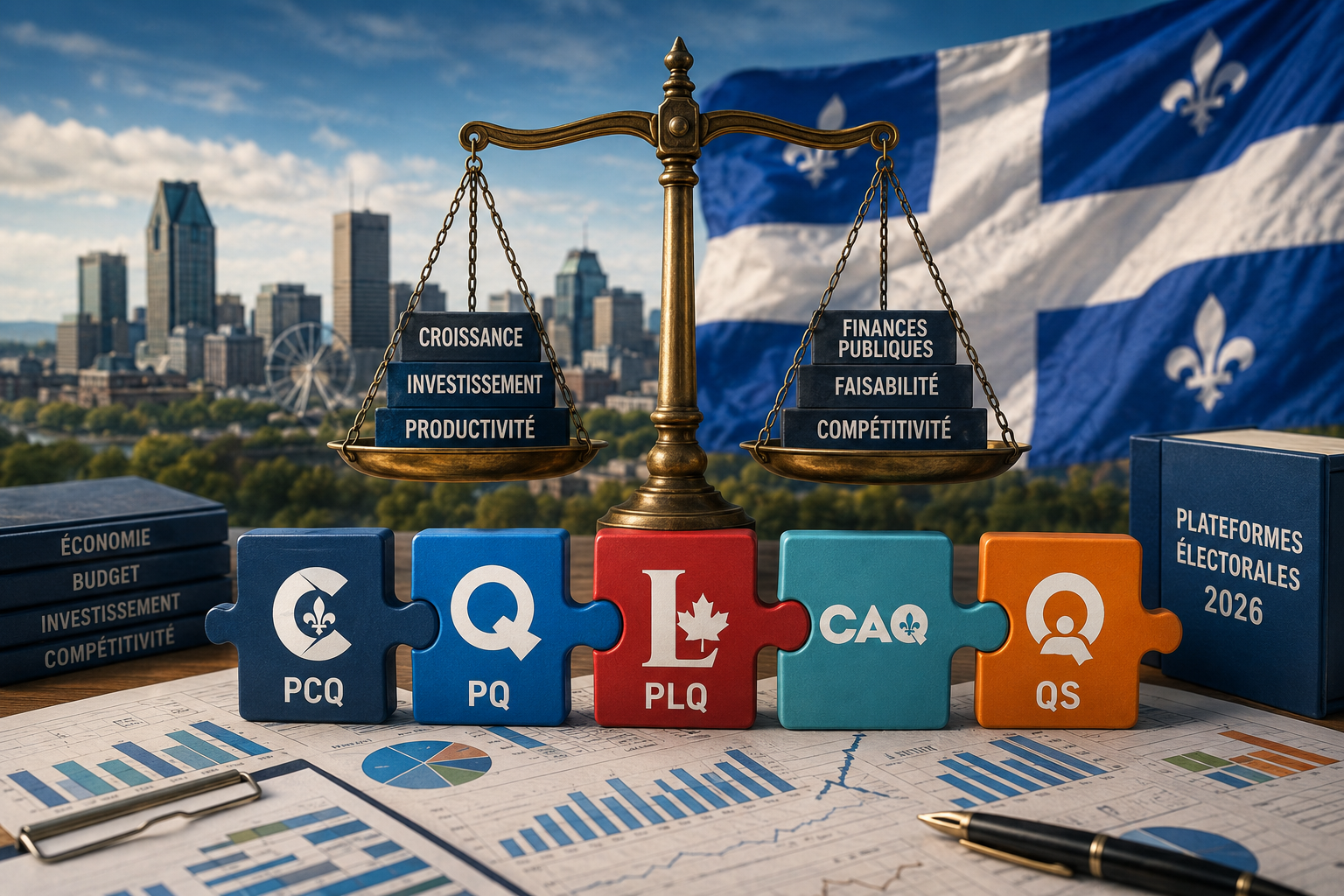
At this stage of the campaign, the Conservative Party of Quebec appears to have the most ambitious and coherent economic program, followed by the Parti Québécois and the Liberal Party. The CAQ offers greater fiscal certainty, but essentially proposes to continue the economic model it has been implementing for the past eight years. Québec solidaire, for its part, proposes a completely different approach, in which the government would play an even greater role in resource allocation.
| Party | Economic orientation | Main strength | Main weakness |
|---|---|---|---|
| PCQ | Reallocation towards the private sector | Productivity, taxation, investment | Risk of execution |
| PQ | Market with a strategic state | Good compromise between growth and discipline | Interventionism maintained |
| PLQ | Pro-business moderate | SMEs, trade, deregulation | Less profound reforms |
| CAQ | State as investor and strategist | Budget predictability | Continuity of a model with mixed results |
| QS | Intervention and redistribution | Public services | Private investment and financing |
Methodological note
This analysis is based on the proposals made public by the parties as of [date]. September 3, 2026We primarily assess their likely effects on productivity, investment and growth, their impact on public finances, their feasibility and their ability to improve Quebec's competitiveness in the face of the trade dispute with the United States.
The notes represent a comparative evaluation, and not a precise economic forecast. They may be revised as new proposals and more detailed financial frameworks are published.
The PCQ: to completely change the way Quebec intervenes in the economy
[View the Conservative Party of Quebec's electoral platform]
The PCQ's program is probably the one that proposes the most significant break with the current Quebec economic model.
Its philosophy is quite simple: rather than collecting a lot of taxes and then redistributing some of that money to companies chosen by the government, the PCQ proposes to significantly reduce government subsidies and spending in order to finance general tax cuts.
In other words, instead of the state choosing where capital should be invested, a larger part of that decision would be left to businesses, investors, and taxpayers.
The PCQ claims it can achieve approximately billion in savings over five years. Its proposals include a comprehensive review of programs, a reduction in the public service workforce primarily through attrition, a significant decrease in targeted subsidies and tax credits for businesses, and a modernization of the public administration.
These savings would be used in particular to increase the basic personal amount from ,952 to ,242 and to gradually reduce the general Quebec corporate tax rate from 11.5% to only 4.7%.
Such a significant reduction in corporate tax could have considerable effects on investment. The economic studies used by the PCQ generally find a strong correlation between corporate taxation, investment, employment, capital, and wages. The party estimates that its reform could increase the capital stock by 4% to 8%, create between 25,000 and 45,000 jobs, and increase GDP by 1.8% to 2.5% over five years.
Contrary to what one might initially think, these estimates do not appear particularly extravagant compared to the cited studies. In several cases, the PCQ even applies more conservative assumptions than a direct extrapolation from some studies would allow.
This obviously does not mean that these results are guaranteed.
Our review of the billion in savings reveals, in particular, that some may overlap with measures already planned by the current government. The treatment of the Economic Development Fund and Investissement Québec also requires further explanation, while some of the savings resulting from program revisions remain to be substantiated.
The same applies to the dynamic effects of the tax cuts. The PCQ estimates that the growth generated by its corporate tax reduction would recoup approximately 30 to 40% of the initial tax loss. This order of magnitude is economically plausible, but the party has not yet released sufficient details to demonstrate precisely how it arrives at this result.
The Conservative program is therefore far from risk-free. But contrary to some criticisms claiming that it relies primarily on imaginary savings and tax cuts that would miraculously finance themselves, our examination reveals instead an economically coherent plan with several reasonable assumptions, but whose execution remains highly ambitious.
The PQ: much more pro-market than one might think
[View the proposals and plans of the Parti Québécois]
The Quebec Party's economic program probably holds the biggest surprise.
The Parti Québécois also proposes reducing corporate taxes, decreasing certain forms of corporate aid, streamlining regulations, and gradually reducing government payroll costs. Specifically, it anticipates recurring savings of 2.5% on public sector pay over three years, amounting to approximately .6 billion annually in the long term.
The fundamental difference with the PCQ lies less in the diagnosis than in the role that the two parties want to leave to the State.
The PCQ largely seeks to replace government allocation of capital with private allocation. The PQ, on the other hand, believes that a government must retain the capacity to intervene in certain sectors deemed strategic.
It is therefore a more interventionist approach, but also less risky to implement.
The savings sought are more modest, the tax cuts less significant, and the transformation of the state less radical. The growth potential is probably lower than that of the PCQ, but so is the risk of missing budget targets.
The PQ therefore presents so far a rather interesting compromise between budgetary discipline, market economy and strategic intervention of the State.
The PLQ: improving the model rather than replacing it
[View the commitments of the Quebec Liberal Party]
The Liberal Party is also proposing several measures that are favorable to businesses.
The PLQ wants, in particular, to reduce taxes for SMEs, decrease red tape, impose a "two-for-one" rule on certain new administrative requirements, facilitate interprovincial trade and improve SMEs' access to public markets.
His approach is probably the most traditional of the three parties currently most favorable to private sector growth.
The PLQ is primarily seeking to improve the functioning of the existing system rather than to fundamentally change the way the state intervenes in the economy.
This has one obvious advantage: the risk of execution is lower.
But in a Quebec economy that has long suffered from a problem of productivity and private investment, one can wonder whether relatively modest adjustments will be sufficient.
The PLQ therefore proposes a reasonable and relatively prudent economic program, but one less likely to produce significant structural change.
The CAQ: the devil we know
[See the financial framework and commitments of Team Christine Fréchette]
The CAQ's main economic strength is paradoxically also its main weakness: after eight years in power, we already know roughly what it would do and, above all, we now have a long enough track record to judge its economic model on its results rather than its intentions.
We therefore don't need to imagine how the CAQ would govern the Quebec economy. Its model relies heavily on a strategic state that uses Investissement Québec, subsidies, tax credits, and industrial policies to direct a significant portion of investments.
The government also has the most detailed financial framework and still plans to return to a balanced budget. From a purely accounting perspective, this gives it a clear advantage over parties whose proposals still need to be integrated into a comprehensive financial framework.
But the question is whether continuing essentially the same strategy will solve the economic problems that this strategy has not solved so far.
The difficulties surrounding certain government investments, of which Northvolt has obviously become the most spectacular example, illustrate the fundamental problem with this model: when the government decides which companies and technologies deserve the available capital, it is the taxpayers who assume a significant part of the risk when its choices prove to be bad.
The CAQ therefore probably presents the program whose execution is the most predictable, but also the one that offers the least change among the four parties that rely mainly on private enterprise to create wealth.
Québec solidaire: more resources under state control
[View the Québec solidaire electoral platform]
Québec solidaire essentially proposes the opposite philosophy of the PCQ.
The party wants, in particular, to tax large fortunes more heavily, intervene more directly in the housing market, and use the additional revenue to finance more public services.
QS estimates that a tax on fortunes exceeding million could generate approximately billion annually.
This is probably one of the tax hypotheses that deserves the most caution of all those proposed so far.
Wealth is far more mobile than earned income. Affected taxpayers can change their tax residence, restructure ownership of certain assets, or alter their investment strategies. Some private assets are also difficult to value annually.
This does not mean that a wealth tax would generate no revenue. It simply means that collecting five billion dollars annually without applying a significant discount to account for behavioral effects would be risky.
The economic problem with QS's approach is more fundamental. In a province that is precisely seeking to increase private investment and its productivity, increasing capital taxation while simultaneously expanding the state's role in resource allocation risks producing the opposite effect.
And what about compared to American prices?
The trade dispute with the United States now adds an important dimension to this comparison.
Much of the political debate focuses on the need to diversify our exports in order to reduce our dependence on the American market. This is certainly desirable, but presenting diversification as an economic policy in itself is putting the cart before the horse.
A Quebec company will not start selling more in Europe or Asia simply because a minister participates in a trade mission.
It still needs to be able to compete with companies already present in these markets.
This is where the PCQ program probably gains an additional advantage.
His philosophy is very similar to that defended by Pierre Poilievre regarding American tariffs, as we examined in [Who was really the adult in the room?] Rather than primarily compensating affected businesses with subsidies, we should take advantage of the shock to reduce taxes and regulations, facilitate investment, and make the Canadian economy more competitive.
The PCQ essentially transposes this strategy to Quebec.
The logic is quite simple:
Less tax and regulation → more investment → more capital per worker → better productivity → more competitive businesses → easier access to new markets.
Diversification then becomes partly a consequence of competitiveness.
The Parti Québécois (PQ) and the Liberal Party of Quebec (PLQ), for their part, are proposing more explicit trade diversification strategies. They specifically want to further develop European, Canadian, and international markets. These policies can certainly be useful, particularly when they eliminate trade barriers or improve the infrastructure necessary for exports.
But they cannot replace competitiveness.
A trade agreement can open the door to a foreign market. It cannot force foreign consumers to buy a Quebec product that is too expensive to produce.
The CAQ is taking a more defensive approach by offering financing and support to businesses affected by tariffs. Such assistance may be justified temporarily when a viable business experiences a sudden external shock, but it risks becoming counterproductive if it simply serves to artificially prop up businesses that are no longer competitive.
QS also offers more direct aid and local purchasing policies. Again, these measures can temporarily cushion the blow, but they don't necessarily solve the structural problem.
The best long-term protection against Donald Trump is probably not another subsidy to offset every one of his decisions. It's an economy that is productive, competitive, and diversified enough that a decision made in Washington will hurt less.
And so far, it is probably the PCQ that offers the program most directly oriented towards this objective.
So, who has the best plan?
Based solely on the economic and budgetary criteria studied so far, our provisional ranking would be as follows:
1. PCQ — 8.4/10
2. PQ — 7.9/10
3. PLQ — 7.6/10
4. CAQ — 7.0/10
5. QS — 4.0/10
The PCQ came in first primarily because its platform directly addressed issues of productivity, investment, and competitiveness, while also proposing a significant reallocation of government resource allocation power to the private sector. Its strategy also gave it an advantage in the context of the trade dispute with the United States.
But this top spot comes with a significant caveat: it is also the program with the most ambitious implementation. The comprehensive financial framework will have to demonstrate that the announced savings materialize quickly enough to finance the tax cuts without permanently increasing the deficit.
The Parti Québécois (PQ) likely offers the best compromise between economic reform and prudence. The Liberal Party of Quebec (PLQ) presents a reasonable but less transformative approach. The Coalition Avenir Québec (CAQ) offers greater fiscal certainty, but essentially the continuation of an economic model whose results we can now judge based on eight years. Finally, Québec solidaire proposes a significant increase in the role of the state, which seems difficult to reconcile with the need to attract more private capital and improve productivity.
However, there remains one important reason not to declare the competition over.
The economy and public finances are only part of a government's job. Health, housing, cost of living, energy, education, and immigration can still significantly alter this assessment.
The PCQ therefore takes the lead after the first events.
It remains to be seen whether it is as convincing when we move beyond the Excel spreadsheet.
About the Author