
Who is the adult in the room?
The trade war with Trump reveals the strengths and weaknesses of Mark Carney and Pierre Poilievre
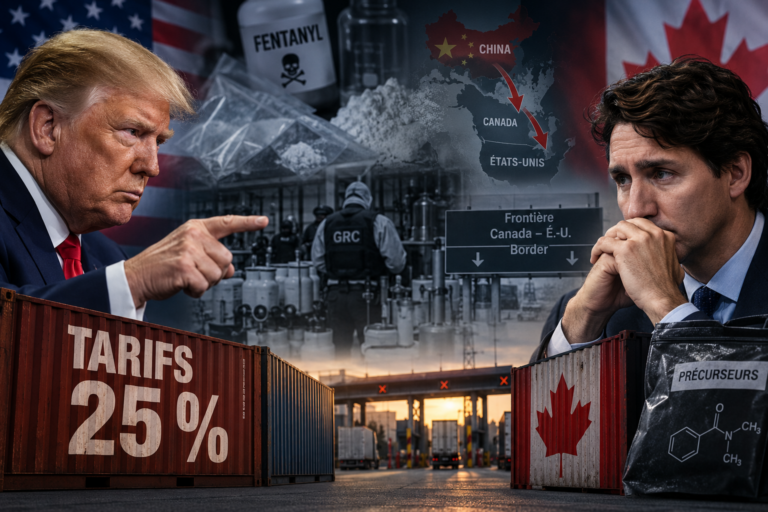
Pendant la campagne électorale fédérale de 2025, Mark Carney s’est essentiellement présenté comme « l’adulte dans la pièce ». Le message était assez simple. Donald Trump était imprévisible, agressif et menaçait le Canada of a trade war. Faced with this threat, someone serious, experienced, calm, and competent in economics was needed to defend the country. A former governor of the Bank of Canada and the Bank of England, Carney seemed to have exactly the résumé for the role.
Pierre Poilievre, for his part, had primarily made a name for himself as a critic of the carbon tax, deficits, bureaucracy, and the cost of living. In a campaign suddenly dominated by Donald Trump, this contrast seemed to work strongly in Carney's favor.
And politically, it worked.
But now that the dust has settled, one question deserves to be asked: Which of the two was actually behaving like the adult in the room?
Because being an adult isn't just about speaking calmly while someone else is shouting. It's mainly about correctly identifying the problem and making the decisions that will actually solve it.
And that's where things get interesting.
A problem that didn't start with Trump
To understand the situation, we must first get rid of a rather convenient idea: that Donald Trump is the cause of Canada's economic problems.
It is not.
Trump certainly created a new problem, and a serious one, but he arrived in a Canada that was already burdened with several economic problems.
For several years, GDP per capita growth had been anemic. Private investment was weak. Canadian productivity was increasingly lagging behind that of the United States. Housing had become unaffordable in several regions. Federal spending and debt had increased considerably, and a build-up of regulations, approval delays, and barriers to domestic trade was hindering investment.
In other words, the house already needed repairs before Trump started throwing rocks at the windows.
This is an important distinction because if the disease is misdiagnosed, there is a high chance that the wrong medication will be prescribed.
The arrival of American tariffs suddenly gave Canada a very visible external enemy. Politically, this was much more convenient than explaining why our standard of living had stagnated for years.
Now, Trump could be pointed at.
Then came Donald Trump
At the beginning of 2025, Trump launched his trade war against Canada. After some postponements and exemptions, several Canadian sectors found themselves hit by American tariffs, notably steel, aluminum and automobiles.
Canada retaliated with its own tariffs.
There's nothing particularly surprising about that. Even Pierre Poilievre was proposing retaliatory tariffs.
It's important to emphasize this.
The difference between Carney and Poilievre was therefore not that one wanted to fight Trump while the other wanted to bow down to him.
This caricature doesn't hold water.
Poilievre also proposed retaliatory tariffs, but wanted to use the revenue from them to reduce taxes for Canadian workers and businesses affected by the trade war. He simultaneously proposed reducing taxes on labour, investment, and energy, accelerating natural resource projects, and reducing trade barriers between provinces.
In other words:
Yes, let's fight back against Trump. But while we're at it, let's make our economy harder to hurt.
This is a distinction that deserves far more attention than it received during the campaign.
The Carney reflex
Mark Carney's philosophy was different.
Carney viewed the crisis triggered by Trump as a structural shift in the global economic order. Canada needed to become more resilient, diversify its markets, develop its infrastructure, protect strategic industries, and make greater use of the state to facilitate this transformation.
It must be acknowledged that he did more than just hand out checks.
His government adopted Bill C-5, the Canadian Economic Unity Act, which aims in particular to eliminate certain federal barriers to domestic trade and, through the Building Canada Act, to accelerate certain projects deemed to be of national interest.
Alright.
In fact, the idea of reducing regulatory delays is excellent.
But there's a problem.
Nearly a year after the adoption of Bill C-5, however, we must be wary of the large figures announced by Ottawa. The government is now talking about tens of billions of dollars in projects referred to the Office of Major Projects. However, Referring a project to the Bureau is not the same as approving it.. The government itself specifies this : a reference does not guarantee federal funding, regulatory approval, or even the listing of the project under the Building Canada Act.
In the spring of 2026, Ottawa announced 15 projects representing over 5 billion in investments referred to the Major Projects Office.
Impressive.
But how many of these projects were actually approved thanks to C-5?
None so far.
This is where the distinction between announcements and approvals must be made. In fact, more than a year after the adoption of Bill C-5, the government is still reviewing the registration of its first projects. As recently as August 28, 2026, Ottawa announced that two projects had moved forward to a new stage. registration possible, while specifying that no decision to register them had yet been made.
In other words, we created a new law to accelerate major projects, announced more than 5 billion in projects, and created a Major Projects Office to move them forward.
More than a year later, how many projects have actually received the fast track promised by C-5?
Zero.
This raises a much more fundamental question:
Why C-5?
Or rather:
Why C-5 rather than abolishing C-48 and thoroughly reforming or replacing the impact assessment regime inherited from C-69?
After all, if the problem is that our regulatory process is so cumbersome that it prevents the construction of projects essential to our economy, why create a new law allowing the government to select certain projects that will have the privilege of taking a faster route?
Why not repair the road?
The law stemming from Bill C-48, which imposes a moratorium on oil tankers off the north coast of British Columbia, is still in effect. The federal impact assessment regime established by Bill C-69, even though it has since been amended, is still in effect.
And now, C-5 essentially adds a door allowing the government to push certain projects through the system more quickly.
In other words, Ottawa seems to recognize that its own regulatory maze is problematic, but rather than demolishing the maze, it is handing out a few cards allowing some to find the exit.
That seems like a strange way to solve the problem.
And that raises another question:
Who decides which projects deserve this fast track?
The government.
So we come back once again to the philosophical difference between Carney and Poilievre.
The Carney approach is more about maintaining the regulatory framework, but giving the government the power to identify strategic projects and move them forward more quickly.
The Poilievre approach is more about reducing regulatory barriers so that economically viable projects can move forward without having to obtain special status from Ottawa.
The first approach can certainly move some major projects forward.
But the second one raises a much more fundamental question:
Why should an economically viable project require the special blessing of the federal government to be built within a reasonable timeframe?
But are we really at war?
However, there is another aspect of Carney's strategy that bothers me more: his rhetoric.
And she is sometimes downright warlike.
Carney asserted that Americans wanted "our land, our resources, our water, our country" and that Trump was trying to "break us" so he could own us. He also declared that our old relationship with the United States, based on ever-deepening economic integration, was over.
These are extremely powerful words.
Of course, all of this needs to be put into context. Trump has repeatedly provoked the 51st state, and his tariffs are unjustified and economically damaging. A Canadian prime minister must defend the country's sovereignty. No one is suggesting that Carney show up in Washington with a box of Timbits and politely ask Trump to be nicer.
But there is a difference between be firm And to be belligerent.
And Carney's rhetoric is sometimes so belligerent that you would almost think he is trying to destroy our relationship with our southern neighbor.
What exactly is its purpose?
The United States is not only our main trading partner. They are our neighbor, our military ally, and the country with which our economy is most deeply integrated.
According to Carney himself, 85% of trade between Canada and the United States remains tariff-freewhile more than 90% of exports from sectors such as automobiles, steel and aluminum are destined for the United States.
Think about it for a moment.
We are talking about a trade war in which 85% of our trade with the supposed enemy continues to cross the border without tariffs.
That does put things into perspective a bit.
This does not mean at all that the affected sectors are unimportant. According to the Bank of CanadaThe industries currently affected by sectoral tariffs represent approximately 1% of production and employment in Canada, but approximately 15% of our exportsSteel, lumber, aluminum, and automobiles suffered significant damage.
So there is a real problem.
But a real problem does not need to be transformed into a permanent patriotic war to be taken seriously.
Especially since there is something rather curious about the current situation.
On one hand, Carney tells us that the old relationship with the United States is over and that Canada must reduce its dependence on the Americans.
On the other hand, his own government boasts that Canada has the best agreement of all of the United States' major trading partners and that 85% of our trade remains tariff-free.
So which of these two realities should guide our policy?
Trump will come and go, the United States will remain.
This is probably where Carney's rhetoric becomes most counterproductive.
Donald Trump will not be president forever.
The United States, however, will always be there.
If your neighbor becomes temporarily unbearable, you can certainly stand up to them. You can put up a fence. You can even call a lawyer if the situation warrants it.
But if you start announcing to the whole neighborhood that your neighbor is now your mortal enemy and that your old relationship with him is over, don't be surprised if the next neighborhood barbecue becomes rather uncomfortable.
We share a border of nearly 9,000 kilometers with the United States. We have integrated supply chains, a common continental defense, and hundreds of billions of dollars in annual trade.
Geography will not change after Trump.
Why would we want to turn an argument with Donald Trump in an argument with the United States?
It would be perfectly reasonable to take advantage of the current crisis to diversify our trade and reduce our vulnerability. It is even desirable.
But Diversifying our markets and sabotaging our relationship with the United States are two completely different things.
The first one can be done without doing the second one.
That's probably even preferable.
The best defense against Trump is not Trump.
Imagine a company where 80% of sales depend on a single customer.
One morning, this customer became difficult. He demanded discounts, threatened to reduce his orders, and started buying elsewhere.
What should the owner do?
He can obviously negotiate with the client. He can even stand up to him.
But if his entire strategy consists of spending his days on the phone arguing with this client, perhaps he is missing something quite obvious.
Why does his company depend on him so much?
This is essentially the Canadian problem.
The United States is our neighbor and by far our main trading partner. This relationship is immensely beneficial for both countries.
But such a significant economic dependence inevitably becomes a vulnerability when an American president decides to use market access as a political lever.
So let's diversify.
But how do you actually diversify an economy?
It's not by giving a Canadian company a world map and telling them to go sell their products in Germany.
To sell elsewhere, you still need to be competitive.
Competitiveness comes before diversification
This is where Poilievre's approach becomes much more interesting.
If we reduce taxes on investment, accelerate project approvals, facilitate infrastructure construction, reduce trade barriers between provinces, and allow businesses to invest more in their productivity, what happens?
They are becoming more competitive.
And what usually happens to a more competitive company?
She finds new clients more easily.
Diversification then becomes a consequence of competitiveness, rather than an objective that the government is trying to artificially create.
Let's take our natural resources.
Canada has oil, natural gas, uranium, critical minerals, timber, aluminum and a host of other resources that the world wants to buy.
But if we do not have the pipelines, ports, railways, LNG facilities or reasonable regulatory timelines to operate and transport them, it matters very little whether we sign a hundred free trade agreements.
We can have a client in Japan.
But you still have to be able to deliver the goods.
That's why the debate about C-5 is so important.
The fundamental problem is not just finding a way to accelerate a few projects chosen by Ottawa.
It's about creating an environment in which All economically viable projects can receive a yes or no response within a reasonable timeframe..
The rates are a tax
There is also something a little strange about the enthusiasm with which some welcome retaliatory tariffs.
A tariff is not a fine that we are sending to Donald Trump.
It is a tax imposed on an imported product.
And who ultimately pays this tax?
The Canadian who buys the product.
Retaliatory tariffs can be temporarily justified to exert political pressure on Washington. In trade negotiations, one obviously needs leverage.
But a tariff remains an expensive tool.
That is why Poilievre's idea of using tariff revenues to reduce other taxes had a certain economic logic.
The position was therefore not:
"Let's not retaliate."
It was more like:
"Let's fight back, but let's try not to shoot ourselves in the other foot while Trump shoots us in the first."
It's not exactly the same thing.
The Carney paradox
And this is where the paradox arises.
Carney won the election largely because he appeared to be the candidate best equipped to handle an economic crisis caused by Trump.
But several of the solutions needed to make Canada less vulnerable to Trump bear a striking resemblance to the problems Poilievre was talking about even before Trump triggered the crisis.
Low productivity.
Low investment.
Taxation.
Regulation.
Difficulty in construction.
Difficulty in exploiting our resources.
Barriers to interprovincial trade.
Dependence on the United States.
Suddenly, these much less exciting topics become issues of economic sovereignty.
And Carney himself now recognizes that Canada needs to accelerate major projects, reduce internal barriers and develop the infrastructure to reach new markets.
Alright.
But again:
If these reforms are now essential to protect us from Trump, why weren't they essential before Trump?
Carney was, however, right about one important thing
It would be far too easy to conclude that Poilievre was right about everything and Carney wrong about everything.
That's not the case.
Trump has indeed changed the rules of the game.
Even a perfectly competitive Canadian economy would have been affected by a sudden increase in U.S. tariffs. Some sectors are so integrated into the U.S. market that rapid diversification is virtually impossible.
According to the Bank of CanadaThe industries currently affected by sectoral tariffs represent approximately 1% of production and employment in Canada, but approximately 15% of our exports.
In such a situation, temporary assistance may be justified.
There is a huge difference between artificially keeping an uncompetitive business afloat for twenty years with taxpayers' money and temporarily helping a viable industry hit by an external political shock.
Carney is also right when he says that Canada needs to develop new markets and new infrastructure.
Where I remain more skeptical is when this adaptation becomes a pretext for a new industrial policy where Ottawa decides which sectors to protect, which companies to support, and where to direct capital.
Our governments have rarely demonstrated that they possess a supernatural talent for choosing winners.
However, they possess a remarkable talent for continuing to subsidize losers.
So who was the adult in the room?
It all depends on what we mean by adult.
If being an adult means possessing impressive experience, mastering financial markets, and projecting an image of technocratic competence, then Mark Carney is certainly a better fit for the role.
He is not the incompetent person that some of his detractors would like to portray him as.
Some of his reforms are even going in the right direction.
But if being an adult means looking beyond the immediate crisis and asking why our economy was vulnerable to this crisis in the first place, the advantage leans more towards Poilievre.
And if being an adult means knowing the difference between to firmly defend its interests And needlessly turning a temporary dispute into a permanent break with one's neighborCarney's rhetoric becomes much more difficult to defend.
Trump is a variable that we do not control.
He might set a price tomorrow and remove it the day after. He might change his mind after a phone call, a negotiation, or because he got out of bed on the wrong side.
But we control many things.
We control our taxes.
We control our regulations.
We control the approval times for our projects.
We control our interprovincial trade barriers.
We control our ability to build pipelines, ports, mines, housing, and factories.
We control the conditions under which our entrepreneurs invest.
And the more productive, competitive, and globally capable our economy is, the less power any American president will have to harm us.
But there is one last thing we should control:
our own rhetoric.
Trump will win.
The United States will remain.
Our goal should therefore not be to win a war against our neighbor, but to settle this dispute while building an economy strong enough that the next American trade threat will frighten us much less.
After all, maybe that's what being the adult in the room is all about.
About the Author