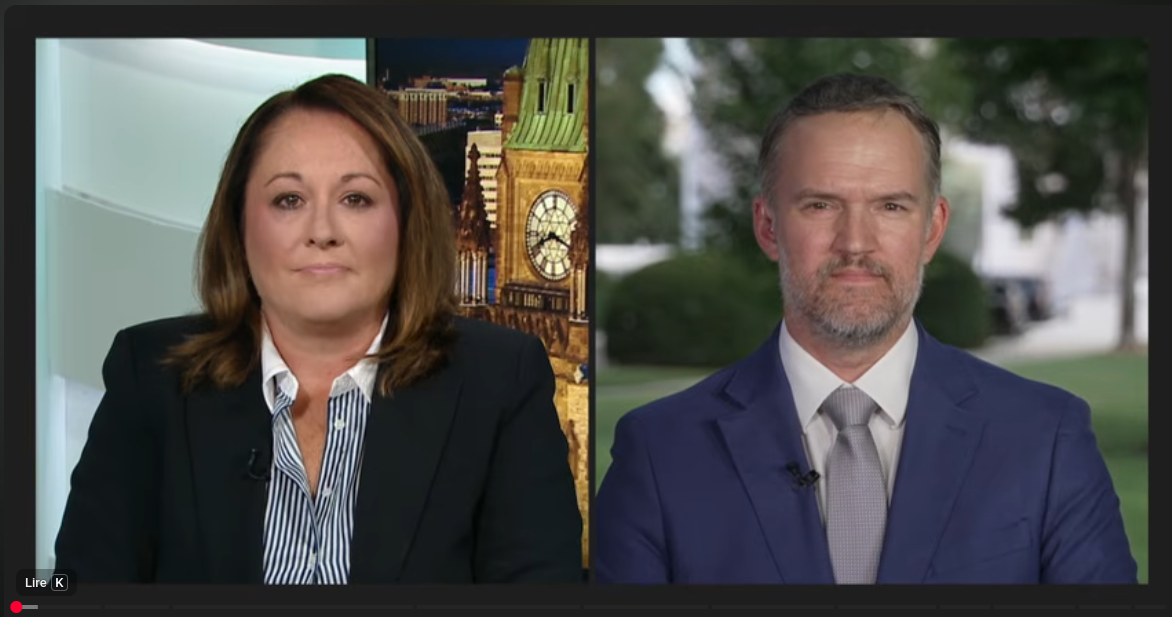
interview ofJamieson Greer by Rosemary Barton on the CBC
Video from the Canadian Broadcasting Corporation
In an interview with Rosemary Barton on the CBC network on August 26, 2026, U.S. Trade Representative Jamieson Greer completely disputes Prime Minister Mark Carney's account of the reasons for the failure of recent negotiations.
The Carney government essentially asserts that the United States introduced new last-minute requirements, particularly concerning:
- the automotive industry;
- French culture and language;
- the regulation of digital media;
- Canadian sovereignty;
- Canada's trade relations with other countries.
Mr. Greer categorically rejects this version of events. His argument is that The Americans did not suddenly change the rules of the game.According to him, the discussions had progressed based on principles already discussed, and Canada ultimately decided to leave the table. According to Greer, Washington believes the problem was not a new American demand, but that Canada was asking for too much in exchange for access to the American market.
1. The question of the automobile
This minor dispute doesn't work in Greer's favor, as the United States maintains that it made no changes to the agreement. The framework reportedly reduced tariffs on Canadian automobiles from 25% to 15%. However, a question has arisen concerning medium and heavy vehicles.
Canada wanted the tariff relief to also cover this category, including trucks such as the Ford F-350, F-450 and F-550 products or intended to be produced in Ontario.
Sources close to the negotiations indicate that Canada requested this extension in the final stages, and that the Americans considered this as a new Canadian request.
But Carney claims that Washington himself modified the scope of the agreement on vehiclesand that the exclusion of heavy trucks represented a significant change from the framework discussed.
The Canadian automotive industry confirms that the issue of medium and heavy vehicles was among the last sticking points.
It therefore appears that both parties have modified or clarified their positions in the last few hours.
2. The question of Canadian sovereignty
Mr. Carney accused the United States of wanting to impose a veto right on Canada's right to conclude trade agreements with a third country (in this specific case, China), and there is indeed a relevant clause in the USMCA, namely clause 32.10.
What exactly does the article say? 32.10
The article focuses on free trade agreements concluded with a "non-market country" (non-market country). The CUSMA defines the latter as a country that one of the parties considers to be a non-market economy for the purposes of its trade laws and with which neither party has already concluded a FTA.
The mechanism is quite precise:
- Three months before negotiations even beganThe country must inform the other two parties of its intention to negotiate a free trade agreement with a non-trading country.
- Upon request, he must provide information on the objectives of the negotiations.
- No later than 30 days before signingHe must give the other two parties the opportunity to examine the full text of the agreement.
- And most importantly, if the country ultimately signs this FTA, the other two parties can terminate the CUSMA with six months' notice and replace it with a bilateral agreement between them.
So, at first glance, the United States would technically be within its rights to terminate the USMCA/CUSMA with Canada if Canada signs a free trade agreement with a country like China, for example. This would simply prevent Canada from becoming a gateway for Chinese products to enter the United States while circumventing the usual tariffs imposed on China. But in the interview, Greer reveals something interesting.
Fortress North America
In the interview, Greer explains how, for the past year and a half, the Canadian delegation has been proposing a North American fortress which would be, roughly speaking:
a more integrated North American market, with a coordinated trade policy towards the rest of the world.
This would imply that Canada and the United States would need to coordinate their trade policies more closely with third countries. This reveals a certain contradiction.
If Ottawa wants some sort of "Fortress North America"It becomes difficult to simultaneously argue that each country should be able to freely conclude totally independent trade agreements with the rest of the world.
If Canada now wants to complain about an infringement on its sovereignty, one is entitled to ask "Do they really want more substantial integration or not?" It was their idea after all!
Mark Carney looks particularly bad in this one.
3. The question of French culture and language
Carney stated that Washington had raised questions regarding, among other things:
- cultural subsidies;
- French-language content;
- the discoverability of French content on digital platforms;
- certain language requirements;
- bilingual labelling.
Ottawa presented these demands as an unacceptable intrusion into Canadian cultural policies.
Greer, however, makes an important distinction.
On the "discoverability" of French contentHe acknowledges that the issue had been brought to the attention of the White House, but he indicates that it was not not necessarily a condition that would cause the entire agreement to fail.
This is an important distinction.
"The United States has raised the issue." does not mean "The United States demanded that Canada abandon its cultural policy."
And today we have a particularly interesting confirmation.
THE August 27Dominic LeBlanc stated that Washington had now confirmed that Canadian policies aimed at promoting the French language and culture would not be subject to future US trade measures.
It turns out, then, that the Americans never intended to abolish protections for the French language. Ms. Fréchette can therefore calm down. Washington did indeed have a trade objection to certain Canadian measures promoting French, but it was never a deal breaker.
The best deal
According to Greer, the United States had offered Canada “the best deal available to any country on the planet”.
It's hard to say if that's true. According to available informationShe understood:
- reduction of the American automobile tariff towards 15%;
- reduction of certain tariffs on steel and aluminum;
- more favorable treatment of certain products;
- cooperation in critical minerals;
- cooperation in aerospace;
- measures concerning forced labour;
- opening of broader North American economic negotiations.
It was, after all, a respectable offer which, even if imperfect, would have greatly improved Canada-US trade relations. So why such a visceral reaction from Mark Carney and why the belligerent rhetoric?
I will attempt to answer this question in my next article.
About the Author